
Tour review · TOUR REVIEWS
Private Transfer: Naples to Sorrento with Pompeii Guided Tour
Pompeii without the stress of trains and lines. This private Naples to Sorrento transfer pairs an official guided walk through Pompeii with door-to-door service, so you can see a lot without juggling buses. I especially like the flexible pickup in Naples and the fact that Pompeii is guided with skip-the-line entry, not just self-guided wandering. The main trade-off is time, it is a fast, high-impact route, so you will not get a slow, full-day explore of every street and museum room.
The itinerary moves you through the headline ruins in a half-day window, starting with a focused 2-hour walk in the Archaeological Park and then short targeted stops around the Forum area, baths, a famous brothel, a grand house, and the big public buildings. You end in Sorrento with a drop-off at your chosen address, which is a big quality-of-life win when your day is already packed.
Pompeii in One Half-Day, Naples to Sorrento Door-to-Door
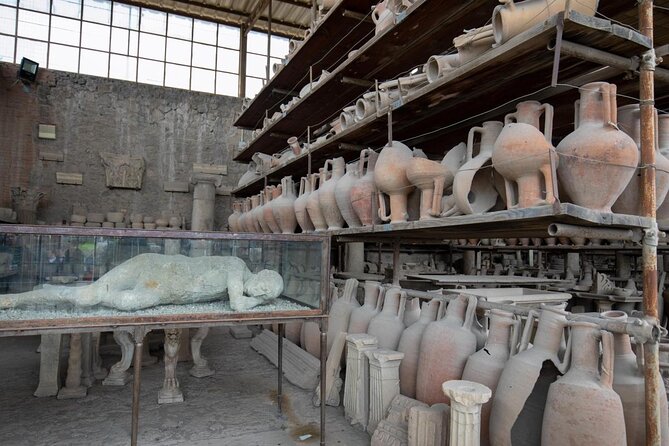
If your plan is to base yourself in Sorrento (smart move for Amalfi Coast access), this is one of the cleanest ways to tack Pompeii onto the beginning or end of your trip. You start in Naples, get set up with an air-conditioned car and a professional driver, then step into Pompeii with an official local guide.
What makes it practical is the balance: you get real guiding for the heart of the site, but the schedule still leaves enough room to continue to Sorrento. And because the pickup and drop-off are included, you are not stuck solving the logistics puzzle while trying to enjoy the scenery.
Quick hits that matter
- Pickup works with your actual schedule, from hotel to airport, port, or train station in Naples.
- Official guide plus skip-the-line entry keeps Pompeii moving instead of waiting.
- Targeted stops cover the Forum, main street, baths, Lupanar, Casa del Fauno, theater, and basilica.
- Air-conditioned private transport with luggage space helps on warmer days.
- Door-to-door drop-off in Sorrento saves you time and hassle at the end of the day.
You can also read our reviews of more guided tours in Naples


How the Timing Really Feels in 4 to 5 Hours
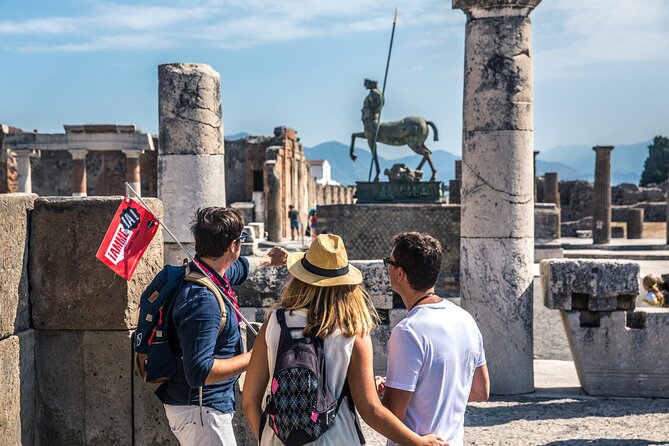
This is a 4 to 5 hour experience from Naples to Pompeii and then onward to Sorrento. That sounds short because it is short, but it works because Pompeii is not just one attraction. It is a whole city, so any plan that tries to do everything turns into a blur.
Here is what you can expect in a realistic way:
- You get picked up in Naples, then head to the Archaeological Park.
- You do a 2-hour guided walking tour inside Pompeii.
- After that, the route becomes a series of quick, curated stops, mostly around the Forum area and other standout ruins.
- Then you are transferred onward and dropped in Sorrento at your chosen location.
The reason this setup works is that you get both context and direction. The 2-hour guide time helps you understand what you are looking at. The shorter stops then let you see more of the “greatest hits” without spending hours in each pocket of the site.
A key consideration: it is not a slow museum visit
If you want to sit and read every sign, compare every mosaic, and treat Pompeii like a multi-day project, this may feel too brisk. It is designed for people who want a strong overview and memorable highlights in limited time.
Naples Pickup and the Ride You Want on a Hot Day
The transfer starts with pickup from wherever makes sense in Naples: your hotel, airport, port, or train station. Your driver meets you holding a board with the lead passenger’s name, which is a small detail but makes a difference when you are trying to gather bags and keep the day on track.
A few practical perks are built in:
- Air-conditioned vehicle to make the ride tolerable, especially in summer.
- Luggage space so you are not playing bag Tetris between shoulders and knees.
- Private transportation, meaning your group stays together and you are not waiting on strangers.
The luggage allowance is clearly stated: you can bring 1 medium or big size suitcase per passenger seat plus 1 small item like a camera bag or laptop bag. Since vehicle capacity can vary, the safest move is to double-check with the operator if you are traveling with more or larger luggage than that.
Pompeii With an Official Guide (Skip the Line, No Guessing)
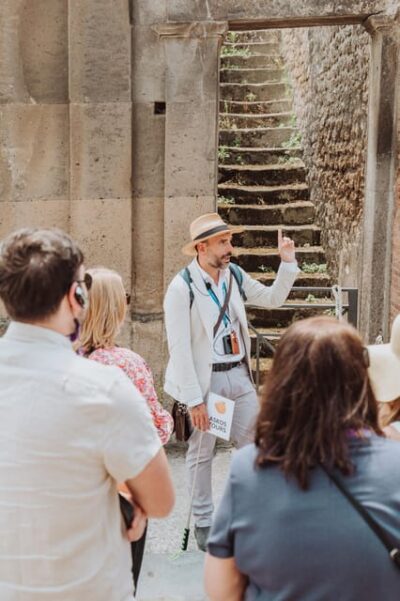
The biggest quality leap here is the combination of official local guide and skip-the-line entry. Pompeii can be confusing at first glance because it is a maze of streets and building outlines. A guide helps you make sense of the layout and the purpose of spaces, so the ruins feel less like random stones and more like a lived-in city.
You can also read our reviews of more private tours in Naples






The 2-hour walking tour inside the Archaeological Park
The schedule starts at the Archaeological Park of Pompeii for about 2 hours with an official guide. This section is where you get the essential story: after the eruption of Mount Vesuvius in 79 AD, the city was buried under volcanic material and preserved. That is the core reason Pompeii still feels so direct. You are not looking at a rebuilt theme park. You are looking at a city that was covered and held in time.
Your guide also helps with the next-layer value: understanding daily life and civic design. Pompeii was not laid out for tourists. The city plan reflects Roman public life, commerce, worship, and social routine, and you will see that theme repeat as the tour continues.
What the skip-the-line entry changes for you
Skipping the line matters because Pompeii has a lot of high-volume visiting. Even a short delay can steal focus when you are standing under the sun deciding whether to press on or rethink your pace. With skip-the-line entry, you start seeing ruins sooner, and the rest of the route stays smoother.
Forum Stops: Jupiter, Justice, Markets, and the Main Street
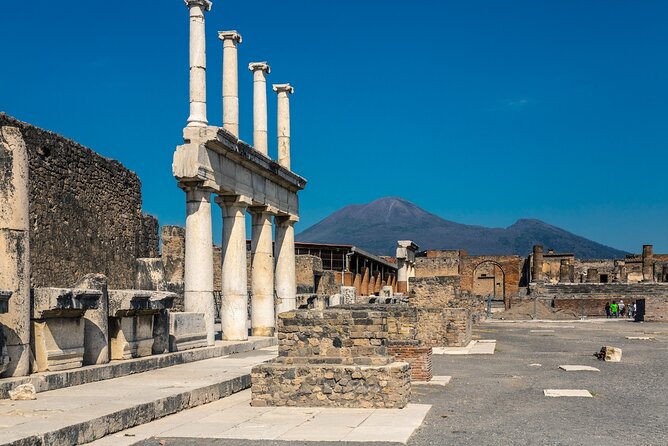
After the guided walk, you move into a set of shorter stops where each location is a recognizable piece of the Forum and its surrounding life.
Foro de Pompeya: the city’s daily core
The Forum is described as the core of daily life, tied to civic administration, justice, business management, trade activities such as markets, and places of citizen worship. In practice, this is where Pompeii stops feeling like a collection of buildings and starts feeling like a functioning community.
If you only have a short time, the Forum is the right place to focus. You get the biggest civic signals in one concentrated area.
Tempio di Giove Capitolino: Jupiter dominates the north side
The Temple of Jupiter sits on the north side of the Forum, with Mount Vesuvius rising behind it in scenic contrast. When the colony was founded around 80 BC, the temple was renovated into a Capitolium style setting, linked to the three cult statues of Jupiter, Juno, and Minerva.
This stop is especially worth your attention if you like the Roman angle. Pompeii is not just about tragedy and ruin. It is also about how Romans expressed authority through architecture.
Macellum: an open market with civic and even religious undertones
Next is the Macellum, Pompeii’s market complex. It is described as a tuff quadriporticus with a hall for worship in an elevated position on the eastern side. The design points to a real pattern: commerce and ritual were not separate worlds.
If you are trying to picture daily routines, the Macellum helps. Markets were where people returned again and again, not just a tourist stop.
Via dell’Abbondanza: Pompeii’s main street
Then you head to Via dell’Abbondanza, the ancient main street, a decumanus maximus running east-west between the Forum and Porta Sarno. This was a corridor packed with shops, workshops, cafes, snack bars, and restaurants.
Even in the ruined state, this is one of those stops where you can almost hear the noise again. It is also a good place for photos because it gives you a sense of scale and street geometry.
Trade-off in these quick stops
Each of these places gets about 10 minutes. That is enough to see the main structure and understand what it was for, but it is not enough to go in every direction with total freedom. Treat these moments as orientation and highlight viewing, not as deep study.
Baths and Social Life: Stabian Baths and the Lupanar

Pompeii stands out because it includes not only grand buildings but also the intimate spaces of everyday life. This tour hits two of the best examples.
Stabian Baths (Terme Stabiane): routine, temperature, and design
The Stabian Baths date to shortly after the colony of veterans by General Silla in 80 BC. The tour notes separate women’s and men’s quarters with separate entrances.
What makes this stop interesting is the layout of bathing temperatures:
- apodyterium (dressing room)
- tepidarium for medium temperature
- frigidarium for cold baths
- calidarium for hot baths
There is also a historical reminder: like many Pompeian structures, the baths were damaged during the earthquake of 62 AD. In other words, you are seeing a site that was already stressed before Vesuvius sealed it.
Lupanar: Pompeii’s famous official brothel
The Lupanar is a narrow, two-story stone building with built-in masonry beds in small rooms. It is famous for its preserved erotic frescoes above the doors, which likely worked like a visual menu. You can also spot graffiti left by visitors, giving a raw glimpse into social life and language.
This stop is not for everyone, but it is important for balance. Pompeii tells multiple stories, from politics to labor to leisure, and the Lupanar makes the point that ancient urban life included spaces we do not always like to talk about.
Casa del Fauno and Theater Time: Luxury and Performance
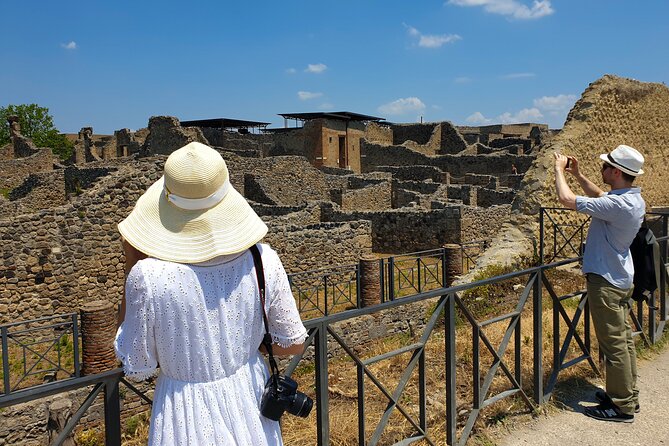
Two of the most memorable stops in Pompeii are the ones that show different sides of status and public life.
Casa del Fauno: aristocratic wealth in stone
The Casa del Fauno is one of Pompeii’s largest and most impressive private residences, built during the 2nd century BC. It is described as a luxurious aristocratic house and noted for being among the most impressive examples of the Roman republic style.
This is the kind of place where, even with limited minutes, you can feel the difference between civic spaces and private power. If you like mosaics, art, and architecture meant to signal wealth, this stop is a must-see even when time is tight.
Teatro Grande: a Roman stage built into the landscape
The Large Theater (Teatro Grande) takes advantage of the slope of a hill. It was built in Roman times with a majesty auditorium divided into five sectors. The stage hosted tragedies of Greco-Roman traditions.
The practical value of this stop is that it ties Pompeii to broader Roman culture. You are not only seeing local life. You are seeing the civic entertainment system.
Basilica: Business and Justice in 1,500 Square Meters
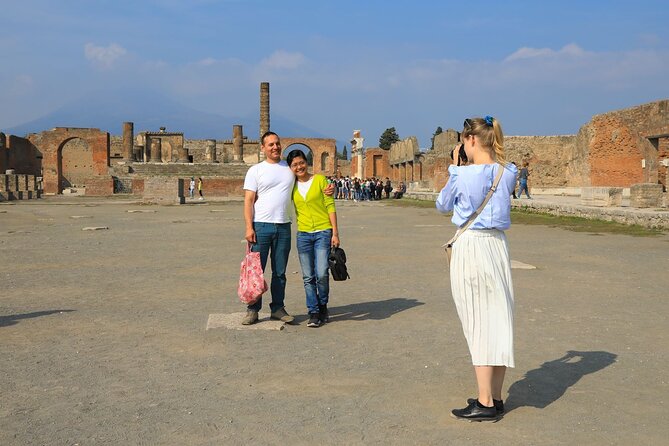
The Basilica is described as Pompeii’s most sumptuous Forum building, with about 1,500 square meters of space. It was used for business and administration of justice.
This is a great final “big picture” stop because it reminds you that the Forum area was designed to run society: trade, decisions, and public transactions all under one roof and one civic zone.
If you are feeling tired by this point, that is normal. Pompeii does wear you out, but the Basilica helps you wrap the day with a sense of order.
Language, Tickets, and What You Actually Need to Know
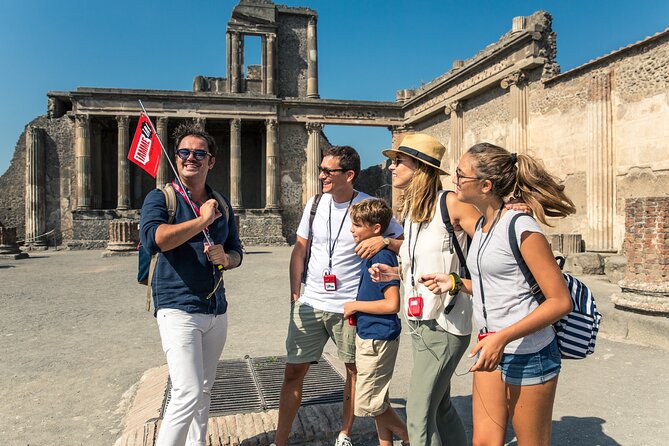
You can choose English for the Pompeii guided portion, and the driver will speak English or Italian. The tour in Pompeii operates in the selected language, so you are not stuck listening to something you cannot follow.
Admission ticket fees are included for the Pompeii tour and all listed stops. That matters because it removes a common stress point: adding up tickets and trying to confirm what is included versus what is an extra.
You also get a mobile ticket, which tends to make entry faster when it is working smoothly.
Price and Value: Is $492.76 Worth It?
At $492.76 per person, this is not a budget day. It is priced like a true private arrangement: Naples pickup, air-conditioned private transport, an official guide, skip-the-line entry, and door-to-door drop-off in Sorrento, plus admission included for Pompeii stops.
Here is how I think about value:
- If you tried to piece this together yourself, you would likely spend time coordinating the drive or trains and add costs for guided access and ticketing.
- The skip-the-line and guided focus reduce wasted time, which is part of what you are paying for.
- Door-to-door service is a real advantage when you want Sorrento logistics to be easy rather than stressful.
This tour tends to be strongest value for small groups who hate waiting, want comfort on the ride, and have limited days in the area.
What to Pack, Wear, and Plan for a Fast Pompeii Day
This itinerary is outdoors and walking-heavy, even if each stop is short. I suggest you plan like it is summer, because Pompeii often feels like it.
At minimum:
- wear comfortable shoes
- use sunscreen
- consider a hat or sunglasses
- bring water, since lunch and beverages are not included
Also remember the pacing: you will move through several locations in a short window. If you want to read every plaque, this may feel overwhelming, so prioritize what matters most to you, like Forum buildings, mosaics, or the theater.
Who This Tour Suits Best
I would book this if:
- you want Pompeii but your total time is limited
- you are based in Sorrento and want a clean start or finish to your trip
- you value official guidance more than wandering independently
- you want private door-to-door transport instead of public transit juggling
I would think twice if:
- you want a slow, thorough Pompeii exploration at your own pace
- you dislike quick stopovers and prefer long time in fewer areas
- you are traveling with someone who cannot handle heat and walking even for short segments
Should You Book This Tour or Go Your Own Way?
If you want Pompeii as a highlight without spending your day on logistics, I think this is a smart booking. The official guide and skip-the-line access do the heavy lifting, and the door-to-door transfer to Sorrento protects your time.
If you already plan to spend most of the day in Pompeii and want deeper freedom, you might prefer a longer, self-paced visit with a separate guide. But for a half-day plan from Naples to Sorrento, this is one of the more straightforward ways to see the core ruins, understand what you are looking at, and still end the day where you are staying.
FAQ
How long is the Naples to Sorrento transfer with Pompeii?
It runs about 4 to 5 hours.
Is pickup included in Naples?
Yes. Pickup is offered from the hotel, airport, train station, or port in Naples.
Do I get a guided visit inside Pompeii?
Yes. You join a walking tour at the Archaeological Park of Pompeii with an official local guide for about 2 hours.
Are Pompeii admission tickets included?
Yes. Admission ticket fees are included for the Archaeological Park portion and for the listed stops.
Is lunch included?
No. Lunch and beverages are not included.
Where will I be dropped off in Sorrento?
You will be dropped off directly at your accommodation in Sorrento, at the location you provide at booking.
What language options are available?
The tour in Pompeii runs in the selected language. The driver will speak English or Italian.
What luggage can I bring?
You can bring 1 medium or big size suitcase per passenger seat plus 1 small item. You should contact the supplier to confirm vehicle capacity.
Can I cancel for a full refund?
Yes, you can cancel up to 24 hours in advance for a full refund.
What should I wear for Pompeii?
Wear comfortable shoes and consider sunscreen, since it can get very hot in summer.
More Guided Tours in Naples



More Tours in Naples





More Tour Reviews in Naples

Not for you? Here's more nearby things to do in Naples we have reviewed










Tour Reviews, compared.
 ★ 4.8Pompeii: Entry Ticket and Guided Tour with an ArchaeologistFrom $3519,459 reviews
 ★ 4.2Pompeii: Entry Ticket with Optional Audio GuideFrom $2612,360 reviews
 ★ 4.8Pompeii: Small Group Tour with an ArchaeologistFrom $4012,264 reviews
 ★ 4.3Pompeii Ruins & Mount Vesuvius Day TourFrom $12011,459 reviews
 ★ 4.6Sorrento, Positano and Amalfi Full-Day TourFrom $10710,988 reviews
 ★ 5.0Sorrento, Positano & Amalfi Coast – Small Group TourFrom $768,643 reviews
 ★ 4.6Catacombs of San Gennaro Entry Ticket & Guided TourFrom $157,941 reviews
★ 5.0Pompeii Small Group Tour with an ArchaeologistFrom $356,593 reviews
★ 4.6Catacombs of San Gennaro Entry Ticket & Guided TourFrom $157,941 reviews
★ 5.0Pompeii Small Group Tour with an ArchaeologistFrom $356,593 reviews
Browse the lists this tour appears in