

Tour review · TOUR REVIEWS
Naples City Walking Tour Exploring Naples with a Native Guide
Naples feels like a living museum when you walk it with a local guide. This 2.5-hour city-center stroll packs major sights into an easy, story-led route, from the Royal Palace to the Spaccanapoli maze.
Two things I really like here are the tight focus on top landmarks and the way the route connects Naples’ layers, Greek city roots to Bourbon power. The second big plus is the small group feel, max 10 people, so you can ask real questions and get answers that fit what you are curious about.
One possible drawback to consider: you will cover a fair amount of ground on crowded streets, so plan for heat and hustle. Also, the meeting point can be a little confusing at first, so give yourself a few extra minutes to locate the guide.
Key highlights you should care about

- A native-led route through Naples’ historic center with stop-by-stop storytelling
- Royal Palace, San Carlo, Castel Nuovo, and St Chiara all in one walk
- Spaccanapoli on foot, so you actually feel the city grid from inside
- Small group size (max 10) for calmer pace and easier questions
- Two finish options, Piazza del Gesu or Piazza Carita, to help you plan the rest of your day
- Teatro di San Carlo stop with a strong Naples culture payoff
Start at Piazza Plebiscito, Then Go Right to the Power Centers

Most first-time Naples visitors start in the scenic postcards. This tour starts smarter. You begin in Piazza Plebiscito, the kind of open square where you can immediately sense how important this city has been for rulers, ceremonies, and public life.
From there, the walking route pushes you toward Naples’ big “who mattered when” sites. The first stretch is about authority and culture, not just pretty buildings. That sets the tone for the rest of the walk, because later you are going to read the city’s past into smaller churches, cloisters, and street corners.
You can also read our reviews of more walking tours in Naples



Palazzo Reale and Bourbon Naples in a Nutshell
A key early stop is the Royal Palace (Palazzo Reale), one of the Bourbon kings’ residences. Even if you do not go inside, you learn how palaces sit at the center of politics and identity. Naples was never just a port city. It was a capital with taste and power.
This is also where a guide earns their keep. A good local will explain why this palace belongs in the same story as opera, fortresses, and the historic center streets you will see later. You start to understand that Naples is not random. It is layered, and each layer leaves architectural fingerprints.
Practical note: this is a fast-moving stop, around a few minutes, so keep your eyes up and your questions short. Save the longer questions for the parts where the guide can slow down.
Teatro di San Carlo, Europe’s Old Opera House, Up Close
Next comes the Teatro di San Carlo, described as the oldest opera house in Europe. Standing near it, you get that very Naples feeling: culture that is serious, but not stuffy. Opera here is not a hobby. It is part of the city’s identity.
You get the chance to connect the theater to the broader Bourbon story. When you hear how this city treated performance and public spectacle as something to fund and protect, the buildings start making sense as living institutions, not just monuments.
If you love theater, you’ll probably want to return later for a performance. If you do not, the stop still works, because it gives you a cultural anchor for everything else you see.
Galleria Umberto I, Castel Nuovo, and the City’s “Main Stage” Feel
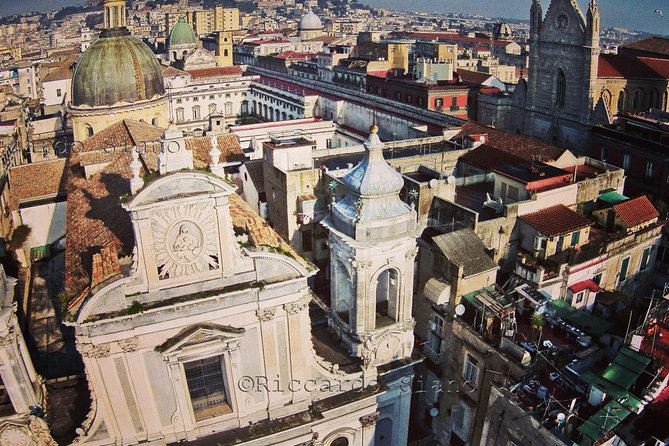
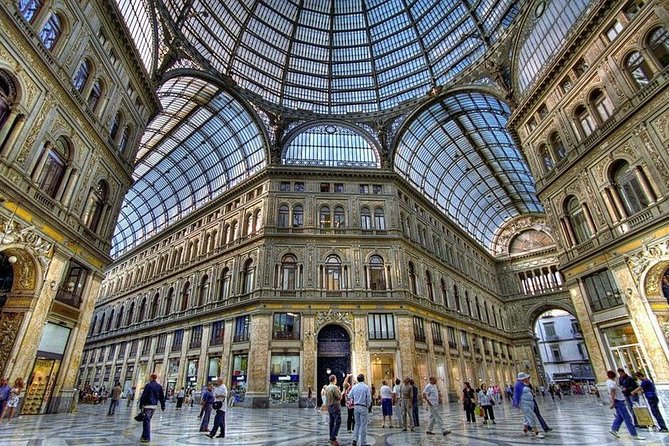
From the big cultural anchor, the walk moves toward the impressive Galleria Umberto I, a large 19th-century shopping gallery. The value of this stop is not buying anything. It is learning how Naples built elegant public spaces that felt like social centers, even in everyday life.
Then you head toward Castel Nuovo (Maschio Angioino) in Piazza Municipio. This is one of Naples’ most significant landmarks, and the guide focuses on what you can see from the outside. That is the right approach for a walking tour: you get the snapshot, then you can decide whether to go deeper later.
Why Castel Nuovo matters for your day: it is the visual reminder that Naples has always been a crossroads of defense and trade. When you later walk through neighborhoods that feel medieval and tightly packed, the fortress logic helps it all connect.
The Historic Center Walk: Cloisters, Churches, and Architectural Clues
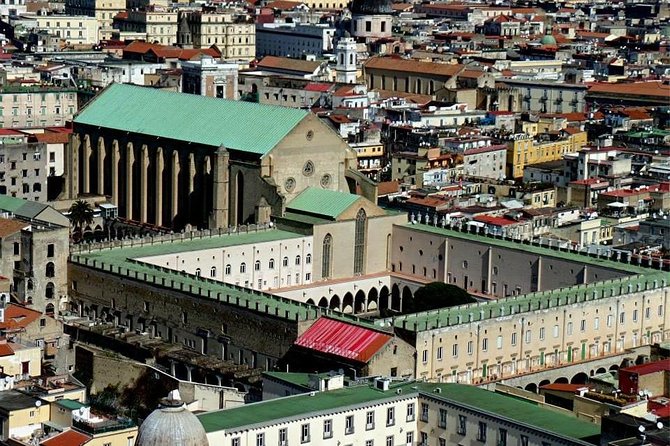
After the “big name” stops, the tour shifts into old Naples mode. You stroll past churches, monuments, and palaces in the historic center, with your guide pointing out stories behind the architecture. This is where you start spotting patterns on your own.
The tour is not trying to make you memorize dates. It tries to teach you how to read the city. For example, why a square is shaped the way it is, how religious buildings reflect wealth and devotion, and how the city’s movements show up in the street layout.
If you are the type who usually skips church interiors, do not. Even when you are mostly outside, a guide can explain what to notice so the buildings feel less random.
You can also read our reviews of more guided tours in Naples




Complesso Monumentale di Santa Chiara: A Stop That Changes How You See Naples
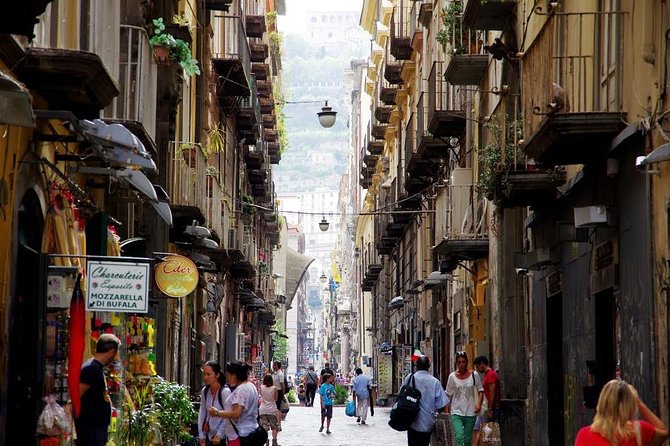
One standout stop is the Complesso Monumentale di Santa Chiara. You spend time near the complex, which is famous for its cloisters and monastery spaces. This is not just a pretty break. It is a mental reset.
Cloisters are quieter by design, and they put you in the right headspace to understand why religious sites in Naples are not isolated. They connect to community life, art, and the rhythms of the city.
If it is a hot day, this area can feel like relief. Not because it is magically cool, but because it breaks up the walking with a calmer architecture experience.
Via Napoli and San Francesco da Paola: Religion as a City Narrative
The walk also includes Via Napoli, plus a stop at the Basilica Reale Pontificia San Francesco da Paola. These stops matter because they give you different ways Naples expresses faith, from street-level context to grand religious architecture.
Via Napoli acts like a spine through the historic center. When your guide talks about why the street matters, you start to see it as part of the city’s original logic, not just a route you happen to pass.
San Francesco da Paola gives you a more monumental counterpoint. You are moving from medieval-feeling spaces to buildings that show later styles and continued devotion. That contrast is part of the point of doing a walking tour now, rather than later.
Piazza del Gesu Nuovo and the Church-Square Connection

Another key stop is Piazza del Gesu Nuovo, where you see the Church of Jesus and the Monastery of St Chiara. Even on a short stop, it is a powerful pairing because it shows how squares function in Naples.
Squares are where people pause, meet, and gather. In a city known for strong street life, these public spaces make the architecture feel social. The guide’s job here is to connect your visual impressions with what those sites meant for community life.
One more tip: this is the kind of place where a quick photo is easy, but a thoughtful look takes longer. You may want to linger after the tour ends too.
Spaccanapoli, the Greco-Roman Street You Can Actually Walk
If you only remember one street name from the day, make it Spaccanapoli. This is where the tour really becomes “Naples, in motion.” It cuts straight through the historic center and is one of the three east-west streets from the original Greco-Roman city of Neapolis.
That fact changes your perspective. You are not just walking through a pretty old neighborhood. You are walking along a line that has held the city’s structure for centuries.
Spaccanapoli also helps you understand Naples’ pace. The street is full of everyday activity, and the guide uses that energy to explain how neighborhoods evolved. You will likely feel the city more than you see it here, which is exactly what you want on a first visit.
A practical note: this section is crowded. Keep your pace smooth, stay close to the guide, and be ready for shoulder-to-shoulder moments.
Finishing at Piazza del Gesu or Piazza Carita
Tours end in one of two places, either Piazza del Gesu or Piazza Carita. This flexibility is useful for planning. If you like to explore in a loose loop, finishing near a major square is perfect because it is easier to branch out into smaller streets afterward.
The best way to use this ending: decide on your next move before you get to the final square. You will be more relaxed if you already know whether you want museums, food, or just more wandering.
What the Best Guides Seem to Do (And Why You Will Feel It)
The strongest feedback shows up again and again: guides who are fun, energetic, and organized. Names that come up in the guide lineup include Anna, Maria, Vincent, Francesca, Elizabeth, Sonia, Patrizia, and Maria Paola.
What you should take from that for your own trip is not just personality. It is how the tour is paced. People describe guides who keep things on schedule without rushing and who answer questions in a natural way. That is the difference between “see these buildings” and “understand why the city looks like this.”
Also, the meeting point issue comes up in at least one account, where help came quickly after a participant could not locate the guide. So if you arrive and feel a little lost, do not panic. Make contact and give it a minute.
Price and Value: Is $106.42 Worth It?
At $106.42 per person for about 2 hours 30 minutes, this is not the cheapest way to see Naples. But it is also not trying to be. You are paying for a professional local guide, a tight route, and multiple major landmarks in a single go.
Here is how I think about value for a tour like this:
- You save time by hitting the “big anchors” first, rather than playing catch-up on your own.
- You learn what to notice, which makes your later self-guided wandering more rewarding.
- The group size limit of 10 travelers matters. You get a more personal flow, so the tour does not feel like a loud conveyor belt.
If you enjoy history but do not want to turn your day into a classroom, this kind of guided walk is a strong trade. You get context, then you keep exploring on your own with better instincts.
Timing, Weather, and Getting Through Crowds Comfortably
This experience requires good weather. If it is not cooperating, you can be offered a different date or a refund, which is reassuring if you are planning flights around Naples.
When the weather is good, your main challenge becomes physical. You should wear comfortable shoes. The tour moves through busy areas and includes multiple stops that take only a few minutes each, so you are constantly transitioning between walking and looking.
Also, you can choose a morning or afternoon tour. My practical advice: pick the time that matches your energy. Morning often feels easier for stepping into the historic center before the heaviest crowds. Afternoon can work well if you want a relaxed start and are okay with the heat.
Who This Tour Suits Best
This tour is a great fit if you:
- want a first-day introduction to Naples without feeling overwhelmed
- like architecture, city planning, and the “why” behind famous sights
- want a guide who can answer questions and keep the pace moving
It may feel less ideal if you want long museum-style stops or a slow, deep dive into interiors. The schedule is designed for efficient coverage. You will get snapshots that help you decide what to see more of later.
Should You Book This Naples City Walking Tour?
Yes, I think you should book it, especially if it is your first time in Naples. The route covers the kind of landmarks that usually take multiple days to arrange independently, and the guide element is the real engine of the experience.
Book it if you want to:
- learn the city’s layout and stories fast
- walk Spaccanapoli with context instead of just passing by it
- get a clear sense of where you want to return on your own
Skip or switch plans if you already know Naples well and prefer more time in fewer places. This is an efficient orientation walk, not a marathon of one neighborhood.
FAQ
How long is the Naples City Walking Tour?
It runs about 2 hours 30 minutes (approximately).
Where does the tour start?
The meeting point is Gran Caffè Gambrinus, Via Chiaia, 1, 80132 Napoli NA, Italy.
Where does the tour end?
The activity ends in a different location, either at Piazza del Gesu or Piazza Carita.
Is the tour offered in English?
Yes, it is offered in English. It may also be operated by a multi-lingual guide.
How many people are in the group?
There is a maximum of 10 travelers per tour, and a minimum of 2 people per booking is required.
How much does it cost?
The price is $106.42 per person.
What should I wear or bring?
Wear comfortable shoes, since it is a walking tour.
Can I cancel and get a full refund?
Yes. You can cancel up to 24 hours in advance for a full refund. If you cancel less than 24 hours before the start time, the amount paid is not refunded.
More Walking Tours in Naples



More Tours in Naples




More Tour Reviews in Naples

Not for you? Here's more nearby things to do in Naples we have reviewed










Tour Reviews, compared.
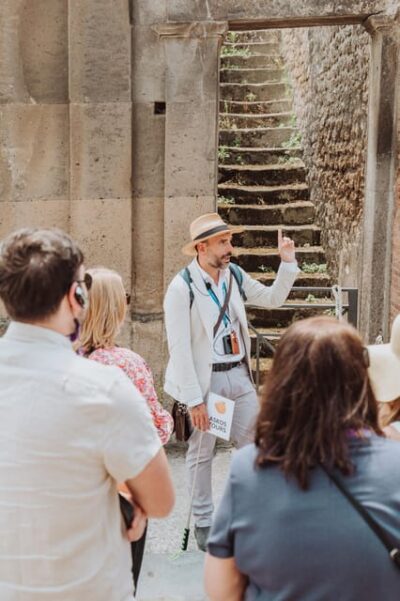 ★ 4.8Pompeii: Entry Ticket and Guided Tour with an ArchaeologistFrom $3519,459 reviews
 ★ 4.2Pompeii: Entry Ticket with Optional Audio GuideFrom $2612,360 reviews
 ★ 4.8Pompeii: Small Group Tour with an ArchaeologistFrom $4012,264 reviews
 ★ 4.3Pompeii Ruins & Mount Vesuvius Day TourFrom $12011,459 reviews
 ★ 4.6Sorrento, Positano and Amalfi Full-Day TourFrom $10710,988 reviews
 ★ 5.0Sorrento, Positano & Amalfi Coast – Small Group TourFrom $768,643 reviews
 ★ 4.6Catacombs of San Gennaro Entry Ticket & Guided TourFrom $157,941 reviews
★ 5.0Pompeii Small Group Tour with an ArchaeologistFrom $356,593 reviews
★ 4.6Catacombs of San Gennaro Entry Ticket & Guided TourFrom $157,941 reviews
★ 5.0Pompeii Small Group Tour with an ArchaeologistFrom $356,593 reviews
Browse the lists this tour appears in