
Tour review · TOUR REVIEWS
Pompeii and Herculaneum Private Walking Tour with an Archaeologist
Two ancient cities, one volcanic day.
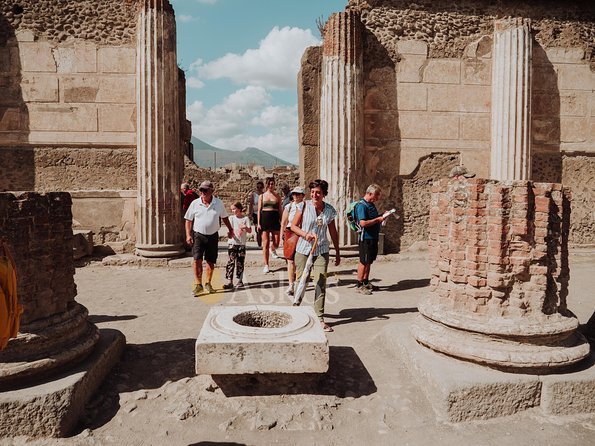
This private, half-day style tour is built around an archaeologist guide and a private pacing that keeps the questions coming. I love how the guide ties the site details to daily Roman life, and how you get to see both towns without feeling rushed through the highlights. One thing to plan for: entry tickets are not included, so you should budget extra on top of the tour price, especially for Pompeii and Herculaneum.
You start at Herculaneum, where the ash did something rare and very helpful for us, it preserved spaces in a way that makes the buildings feel almost touchable. After a short transfer by train, you finish inside Pompeii, working from set pieces like the forum and baths to big-ticket homes and the theaters. It’s about 5 hours 30 minutes overall, with a quick lunch break if you need it.
In recent bookings, the guides mentioned by name include Mena, Vincenzo, Ivan, Sylvia, Raffaele Romano, Paola, Giancarlo, Giovanni, and Alessandra. Even if your guide is different, the common thread is clear: the people leading this tour tend to stay focused on archaeology, not just storytelling.
Key reasons this tour works so well
- Archaeologist-led, not just a guide with slides, so you can ask how and why things were built
- Two sites in one day, arranged so Herculaneum comes first and Pompeii ends inside the park
- A house-by-house and bath-by-bath route, with real explanations for what you’re looking at
- Private group format up to 15, which makes the pace feel less like a conveyor belt
- Carbonized and wood details in Herculaneum, like door remains and a famous wooden partition
- Pompeii highlights beyond the postcard stops, including the Lupanar and both major theaters
Herculaneum first: why this ash-preserved town feels different
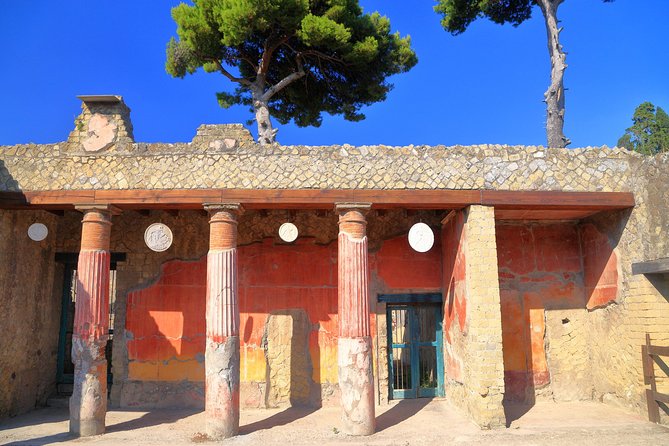
Herculaneum hits you fast because it shows Roman life in a tight, lived-in way. The volcanic ash from Mount Vesuvius didn’t just bury the city, it sealed many spaces with unusual detail. That’s why your walk here can feel more personal than a lot of ancient ruins.
I like the way the tour starts with the Archaeological Park of Herculaneum, because it sets the stage for everything you’ll see later in Pompeii. You get the rhythm of the town, the layout of domus and baths, and the way public life blended with private home space. Then Pompeii feels like the bigger, busier sibling.
If you’re the type who likes to connect objects to behavior, you’ll get a lot here. A marble deer statue in a garden is more than decor, it can signal taste and status. A preserved doorway edge can turn into a mini lesson about materials and disaster.
You can also read our reviews of more walking tours in Naples



Getting to the meeting points without wasting time
Logistics matter on a day like this. You’re moving between two major sites, and the best experience depends on you arriving ready.
For Herculaneum, the meeting point is the Ticket Office of the Herculaneum ruins. You can reach it by:
- car in via Pignalver, where parking is nearby and described as not guarded
- train to Corso Resina 1 (Circumvesuviana station), about a 10-minute walk
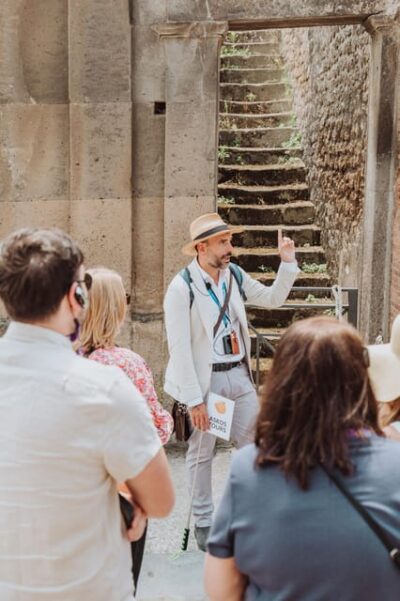
For Pompeii, you meet the guide at the main entrance called Porta Marina Superiore, and the guide holds a sign with Askos Tours on it. This is one place where arriving a little early helps. Even a small delay can cut into your time inside the park.
Also note the tour ends inside Pompeii ruins, so plan your departure time with that in mind. You’ll be walking and you’ll want comfortable energy left for the final stops.
Herculaneum houses and sacred corners you will remember
The Herculaneum portion is packed with variety. You’ll bounce between homes, civic spaces, and baths, usually spending around 10 minutes per stop.
House of the Deer, the vibe check for a rich domus
One of the first stops is the House of the Deer, named for marble statues of stags or deer found in the peristyle. This is a good place to slow down for a moment and look at how the courtyard layout channels movement and light. You’re not just seeing a room, you’re seeing how the home choreographed daily life.
La Terrazza di M. Nonio Balbo, status written in stone
Next up is La Terrazza di M. Nonio Balbo. M. Nonius Balbus was a major benefactor who restored and built public buildings. When he died, he became the patron of the city, with honors described in a long inscription on his funeral altar. This stop is a reminder that Roman “architecture” is also political.
If you like epigraphy and public messaging, you’ll enjoy how the inscription is used as a teaching tool for who mattered and why.
You can also read our reviews of more private tours in Naples






College of the Augustales, religion and power in one building
The College of the Augustales is thought to relate to the cult of Emperor Augustus and the local collegium Augustalium, with a possibility of connecting to the local curia. In plain terms, you’re looking at a building tied to institutions, not only to private living.
This stop helps you connect the dots between what you see in houses and what funded the city.
Casa del Rilievo di Telefo, artwork with a private perk
Casa del Rilievo di Telefo is linked to leading benefactors such as Marcus Nonius Balbus. It’s unusual because it has its own private access to the adjoining Suburban Thermae to the south. That detail matters. It turns the thermals from a generic “bath stop” into a personal convenience that signals wealth.
Partem Domus lignea, the wooden partition you can’t ignore
Then comes a standout: Partem Domus lignea – Casa del Tramezzo di Legno. This is important because it preserves an elegant wooden partition. Herculaneum is famous for the way organic materials survive here, and this is exactly the type of thing your archaeologist guide can turn into an explanation of daily routines and room functions.
House of the Skeleton, a grim but human reminder
House of the Skeleton takes its name from human remains found in a second-floor room in 1831. It’s heavy subject matter, but it’s also where the site turns from “architecture” into “people.” You’ll see how archaeologists interpret remains and how discoveries change what we think we know.
Central Thermae, men and women separated
The Central Thermae are built around the beginning of the 1st century AD, and they were divided into men’s and women’s baths, each with separate entrances. You’ll see why the Roman bath wasn’t just hygiene. It was social order, schedule, and space planning.
House of the Black Salon, preserved door carbon and luxury
The House of the Black Salon is one of Herculaneum’s more luxurious mansions. It has a monumental entrance retaining carbonised remains of the doorposts and lintel. That detail is striking because it’s not just a wall, it’s the charred evidence of a threshold people walked through.
If your guide points it out clearly, this stop becomes a “wait, this is real” moment.
Casa Sannitica and Casa del Bel Cortile, two distinct home styles
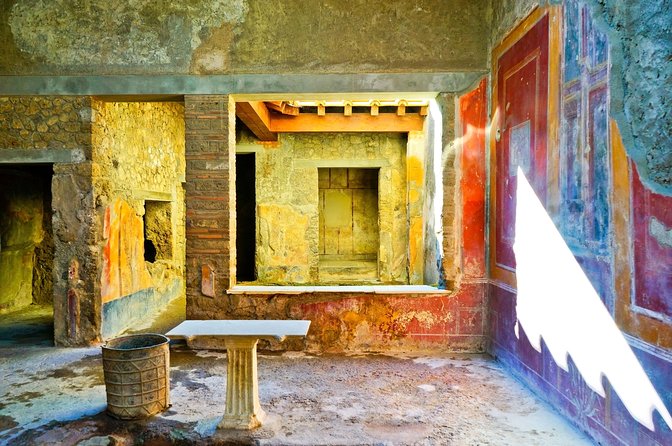
Casa Sannitica features a typical Samnite arrangement, with a splendid atrium and a gallery with Ionic columns, plus rooms decorated with frescoes. Then Casa del Bel Cortile shows another original layout, with a courtyard, a stairway, and a stone balcony instead of an atrium.
These two stops are a great pairing because you can compare architectural choices and talk about taste and regional influences.
House of the Grand Portal, the “inside life” view
Finally in Herculaneum, you’ll see the House of the Grand Portal, with environments including collonnati and frescoed spaces. It also includes charred remains of wooden parts, which ties back to why Herculaneum reads as more preserved than many other volcanic sites.
You’ll walk away with the sense that you didn’t only see highlights. You saw how a whole neighborhood operated.
Pompeii after Herculaneum: from street life to the forum
Once you reach Pompeii, the pace keeps the day moving. The stops are still short, but the mix shifts from Herculaneum’s preserved domestic feel to Pompeii’s public landmarks.
Lupanar, the brothel everyone remembers
The Lupanar is the most famous brothel in Pompeii. It’s a controversial subject, but it’s also useful because it shows how entertainment, commerce, and sexuality were part of city life. Your archaeologist guide can help you focus on the physical layout and the context rather than turning it into a sideshow.
Main street walk, how the city moved
A walk along the main street of Pompeii is more than a transition. It’s where you can visualize daily foot traffic: shops, movement, and the way people navigated between big public spaces.
Foro de Pompeya, Pompeii’s main square
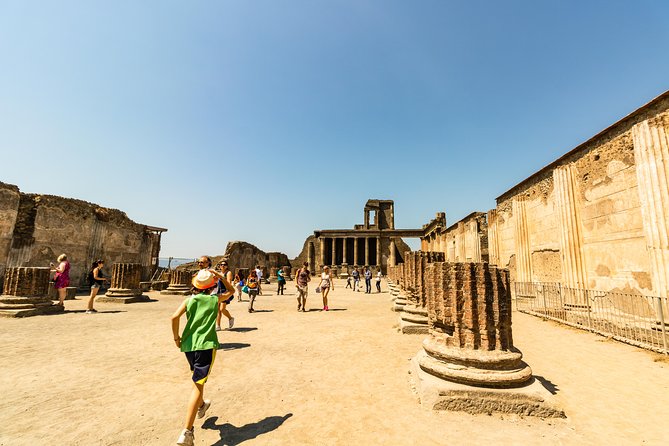
Next is the Foro de Pompeya, the ancient main square. Expect to connect it to earlier civic themes you learned at Herculaneum. This is where the city’s public face shows itself.
Granaries of the Forum, plus casts of victims
The Granaries of the Forum include marble tables and baths for fountains near house entrances. You’ll also see casts of victims of the eruption, plus casts of a dog and a tree. This stop can feel emotionally intense, but it’s also one of the most historically important areas for understanding what survived, what was found, and how restoration efforts preserve evidence.
Basilica and Stabian Baths, work and leisure zones
The Basilica was an open portico that sheltered merchants and other activities. Then you move into the Stabian Baths (Terme Stabiane), which occupy a vast area and are described as the oldest thermal complex in the city.
Put together, these two stops help you see Pompeii as a working city. People weren’t only living and praying. They were transacting, negotiating, and relaxing on a daily schedule.
Houses of Faun and Menander, the “wow” layer
Two big residential stops follow:
- House of the Faun, one of the largest and most impressive private residences
- House of Menander, known for richness in architecture, decoration, and contents
These are where you get to measure wealth through details. If you’re the kind of person who enjoys comparing home design, this part delivers. Your guide’s interpretation can also help you understand what decorative style and layout were trying to communicate.
Teatro Grande, Pompeii’s big theater energy
Finally, you’ll visit the Teatro Grande, Pompeii’s most important theater. Then you get a look at the Teatro Piccolo.
Even if you’re not a theater nerd, these stops help you understand community life. Theater spaces were where stories, politics, and spectacle overlapped.
Private guide value: how archaeologist Q and A changes the day
A private walking tour only works when it gives you time to ask real questions. That’s the main reason people rate tours like this so highly.
In particular, the guide format here tends to reward curiosity. The archaeologists mentioned by name in past bookings include Mena, Vincenzo, Ivan, Sylvia, and Giancarlo, and the consistent theme is patient, thorough answers. When you ask how a mosaic relates to social status, or why a bath has separate entrances, you get a clear explanation that makes the structures easier to remember later.
There’s also a practical benefit: crowd stress drops when you can hold the pace steady. If you’re with a small group, you’re less likely to get shoved into someone else’s photo moment, and the guide can slow down at the details that matter to you.
One drawback to consider: delivery may feel more structured than free-form for some people. If you need constant explanations while walking between stops, you might want to ask your guide to pause more often, especially in the gaps.
Price and what to budget beyond the tour cost
The price is $597.36 per group, for a private tour up to 15 people, lasting about 5 hours 30 minutes. That can sound steep until you divide it by how many people are sharing it.
Here’s how I think about value:
- If you’re traveling as a small family, the cost per person will be higher, but you still gain time, fewer hassles, and an archaeologist instead of a general commentary.
- If you have a group of friends or a larger family unit, this becomes more reasonable because the private guide cost spreads out.
Then factor in what’s not included. Admission tickets are not part of the tour price. Herculaneum entry is listed at 16 euros for adults and 2 euros for EU citizens ages 18 to 25. Pompeii tickets are also not included, and the tour mentions Pompei express entry tickets as not included too.
Also, transportation is listed as not included in general. At the same time, the itinerary includes a train transfer to Herculaneum (about 30 minutes by train plus about 10 minutes walking). So you’re responsible for getting to the meeting points, then the day’s route uses local transit steps as part of the plan.
What to pack for Pompeii and Herculaneum walking
Comfort here is not optional. You’ll be on uneven ground, moving between houses and public areas, and spending enough time outdoors that weather matters.
Bring:
- Comfortable shoes (no flip flops)
- Sunglasses and sunscreen
- A water plan for the day, since food and drinks are not included
Also, think about pacing. The itinerary is made of short segments, but the total walking adds up. If you have moderate physical fitness, you should be fine, but I would still build in breaks when your guide offers them, especially around the quick lunch stop if you need one.
Who should book this tour, and who might prefer something else
This tour is a strong match if you want:
- an archaeologist-led experience at both sites
- a private format that supports questions
- a blend of domestic life, public spaces, and the big Pompeii landmarks
It may be less ideal if you are shopping for the cheapest way to see ruins. The entry tickets are extra, and the private guide pricing only becomes very efficient when you have multiple people sharing the group cost.
If you’re traveling with kids, this can work well too, as at least one family group highlighted how patient the guide was with questions. Just remember the day is still long and walking-heavy.
If you prefer lots of free time to wander on your own, this structured route might feel “tight.” The stops are short, so you’ll be seeing a lot, not roaming for hours.
Should you book this Pompeii and Herculaneum private archaeologist tour?
I would book it if you care about understanding what you’re looking at, and you want the day shaped around a person who can explain it in real time. The biggest payoff is the combination of two sites, a private pace, and the kinds of details you only get when someone can tie material clues to ancient life.
Skip it or look for another option if your priority is low cost, or if you dislike structured stop-and-go tours. Also budget for tickets, because that’s the one recurring add-on you cannot ignore.
If you want a Pompeii day that feels organized, educational, and human, this is a very solid choice.
FAQ
How long is the Pompeii and Herculaneum private walking tour?
It runs about 5 hours 30 minutes.
Is this tour private or shared with other groups?
It is private, and only your group will participate.
What group size is allowed?
The price is per group for up to 15 people.
Are admission tickets included in the tour price?
No. Herculaneum entry tickets and Pompeii entry tickets are not included.
What are the Herculaneum ticket prices?
The tour info lists Herculaneum entry tickets at 16 euros for adults, and 2 euros for EU citizens ages 18 to 25.
Where do you meet for the Herculaneum portion?
You meet at the Ticket Office of the Herculaneum ruins.
Where do you meet for the Pompeii portion?
You meet the guide at the main entrance called Porta Marina Superiore, where the guide holds a sign for Askos Tours.
Does the tour include transportation to the sites?
Transportation to the sites is listed as not included, but the Herculaneum part includes a transfer by train (about 30 minutes) plus a short walk.
What should I wear and bring for the walking?
You should wear comfortable shoes with no flip flops, and bring sunglasses and sunscreen.
Can I cancel for a full refund?
Yes, you can cancel up to 24 hours in advance for a full refund.
More Walking Tours in Naples



More Tours in Naples




More Tour Reviews in Naples

Not for you? Here's more nearby things to do in Naples we have reviewed









Tour Reviews, compared.
 ★ 4.8Pompeii: Entry Ticket and Guided Tour with an ArchaeologistFrom $3519,459 reviews
 ★ 4.2Pompeii: Entry Ticket with Optional Audio GuideFrom $2612,360 reviews
 ★ 4.8Pompeii: Small Group Tour with an ArchaeologistFrom $4012,264 reviews
 ★ 4.3Pompeii Ruins & Mount Vesuvius Day TourFrom $12011,459 reviews
 ★ 4.6Sorrento, Positano and Amalfi Full-Day TourFrom $10710,988 reviews
 ★ 5.0Sorrento, Positano & Amalfi Coast – Small Group TourFrom $768,643 reviews
 ★ 4.6Catacombs of San Gennaro Entry Ticket & Guided TourFrom $157,941 reviews
★ 5.0Pompeii Small Group Tour with an ArchaeologistFrom $356,593 reviews
Browse the lists this tour appears in