

Tour review · TOUR REVIEWS
Pompeii & Herculaneum Guided Tour – High Speed Train from Rome
Two Roman cities, one tightly run day. I like how this tour pairs a high-speed train with an archaeologist-led route, so you lose hours to logistics instead of to lines. You also get skip-the-line style entry and headsets, which matters once you are inside big, loud ruins.
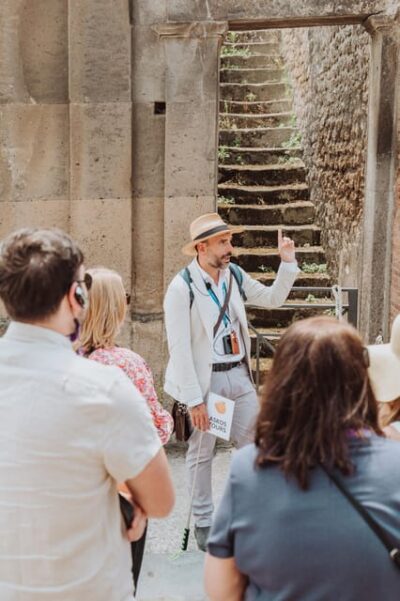
I really like the small group setup, capped at 20 people, and the fact that your Pompeii guide is an actual licensed archaeologist (I have seen names like Michele and Alfredo pop up). The day is long, though, and Pompeii is very much an on-foot experience with limited shade, so if you hate walking or need lots of breaks, plan carefully.
Key things that make this tour worth your time
- High-speed roundtrip from Roma Termini with train tickets sent one day before departure
- Meet-up in Naples by Piazza Giuseppe Garibaldi with Askos Tours staff and a driver handling the transfers
- Archaeologist guidance at both sites in English, plus headsets for clearer explanations
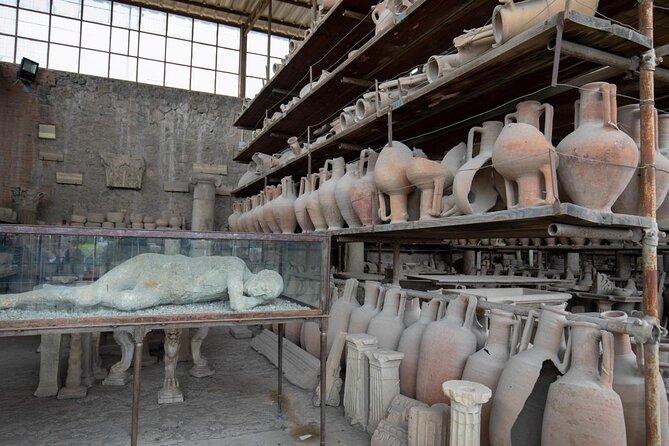
- A Pompeii route packed with the most readable highlights, from Porta Marina to the theaters and the Lupanar
- Herculaneum’s 2-hour park visit, where mosaics and frescos can still be seen
- MaxiMall Pompeii stop for a welcome kit and discount card, plus a practical break from walking
Fast Train From Rome Termini, then Naples Takes Over
This is the kind of day trip that only works because the transportation is handled for you. You start from Roma Termini on your own, using high-speed train tickets that are sent to you one day before the tour. The guide does not meet you at Rome Termini, so you need to get yourself onto the correct train and then join the group in Naples after you arrive.
When you land in Naples, your first transfer is short and easy. You head to Starhotels Terminus in Piazza Giuseppe Garibaldi, right across from Naples Central Station. That is where you meet your local guide and the Askos Tours driver, and from there the day becomes a well-timed bus-and-walk operation.
The “value” here is not just speed. It is also time math. If you tried to plan the train, the drivers, and the timed entry for two sites yourself, you would spend your day micromanaging. On this tour, the schedule is the product, and you feel it in how smoothly you move from Rome to Naples to the ruins.
You can also read our reviews of more guided tours in Naples

Porta Marina Into Pompeii: A City Tour, not Just Random Ruins
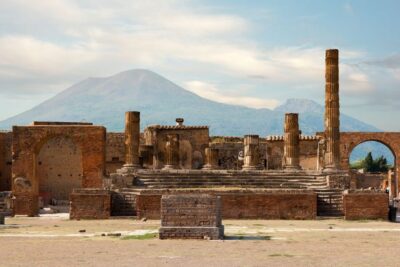
Pompeii is huge, and it can feel like a scavenger hunt if you go without a plan. Here, you enter through Porta Marina, one of the main gateways into the ancient city, and your guided portion starts immediately. Your archaeologist guide sets the stage by walking you through Pompeii’s history, its city layout, and what everyday life looked like before the eruption of 79 AD.
What I like about starting with the bigger picture is that it makes the individual stops make sense. After the first introduction, you are not just looking at walls and doorways. You are seeing a designed city with movement, neighborhoods, and daily routines. Pompeii is famous for the disaster, but a good guide helps you keep noticing the normal stuff that came before.
Pompeii also has practical challenges. The surface is uneven in places, and there is limited shade. Even when the tour is paced to keep you moving, you should still treat this as a serious walking day. Comfortable shoes matter more than you think.
Pompeii on Foot: Via dell’Abbondanza to the House of Menander
Once you are inside, the tour becomes a sequence of recognizable “sets” that archaeologists love because they show how Romans lived. You stroll down Via dell’Abbondanza, a main street that is great for understanding how the city’s streets functioned. Even a short walk here helps you orient your brain, especially if it is your first time in Pompeii.
Then you visit key home and public-space examples, including the House of Menander. From a touring standpoint, houses are a cheat code. You get windows into status, daily habits, and how rooms connected, so you start building a mental map of what you are seeing.
Next up are the Granaries of the Forum, the bread-and-bargain portion of the Pompeii story. You are not just sightseeing a pretty courtyard. You are learning how food moved, where storage sat, and how the public center supported city life.
This is also where your guide’s delivery matters. Some guides make you feel like you are standing in a neighborhood. Others rush through facts. The good news is that this tour uses archaeologists, and names like Paolo, Michele, Raphael, and Alfredo have shown up in the guide line-up, which points to a consistently high level of explanation.
Stabian Baths and the Lupanar: Daily Life Gets Specific
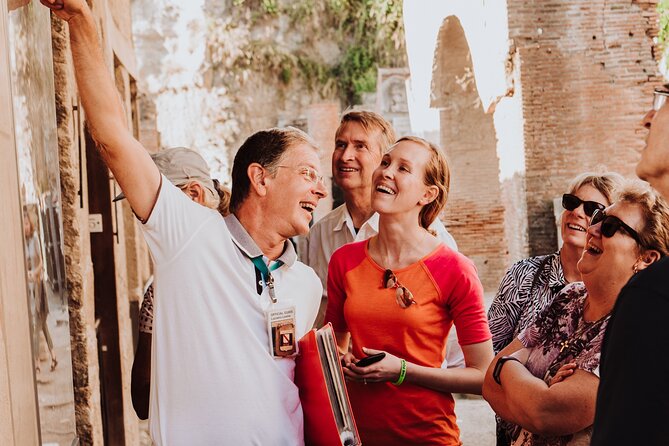
Two of the most memorable stops on the Pompeii side are the Stabian Baths (Terme Stabiane) and the Lupanar, Pompeii’s brothel, also known as the Lupanar. The baths show you how hygiene and social life intertwined in a Roman city. Even if you know Rome had public baths in general, seeing one at Pompeii makes it concrete.
Then the tour gets real about how society worked day to day. The Lupanar can be uncomfortable for some people, but that is also the point. Pompeii preserves details that make history less abstract. You see that ancient cities were not sanitized museums. They held work, pleasure, rules, and human behavior, all in the same streets.
If you want a tour that sticks only to the safe, pretty highlights, this might not be your pick. But if you want the full picture of how Pompeii operated, these stops deliver.
Pompeii’s Forum Edge and Theaters: Odeon to Teatro Grande
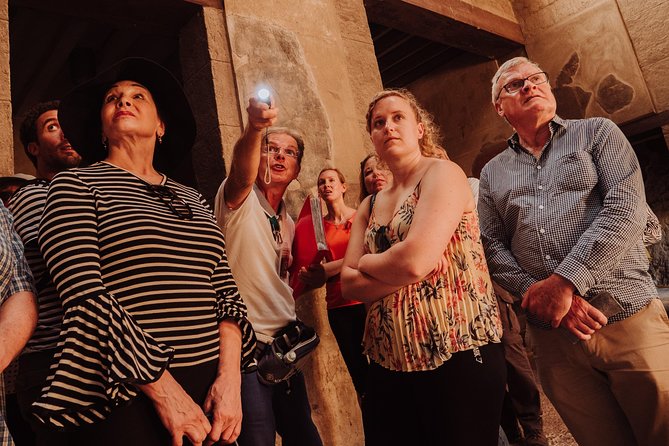
After the home and street rhythm, the tour turns to public spaces where Romans gathered. You spend time around the Odeon (Teatro Piccolo) and then head to Teatro Grande, Pompeii’s main large theater. These theaters are not just about entertainment. They tell you about crowd energy, politics, and the cultural calendar.
The timing here is important. You are seeing large-scale places that help you understand the city’s social structure, and your guide is likely connecting what you see to how people used these spaces. That is why theater stops can feel more rewarding with a guide than a solo visit. You leave with a story, not just photos.
Then you get a mid-tour break at MaxiMall Pompeii. It is a shopping center stop, but you also receive an exclusive welcome kit and a discount card tied to the mall. It sounds like a minor perk, yet it is genuinely useful. This is a rare chunk of time where you can step away from the sun, find restrooms, and reset your energy.
Some people also use this stop for quick food, because meals are not included in the tour price. So having a built-in break can make the rest of the day more manageable.




More Pompeii Houses: The Faun, Deer, and a Balcony View
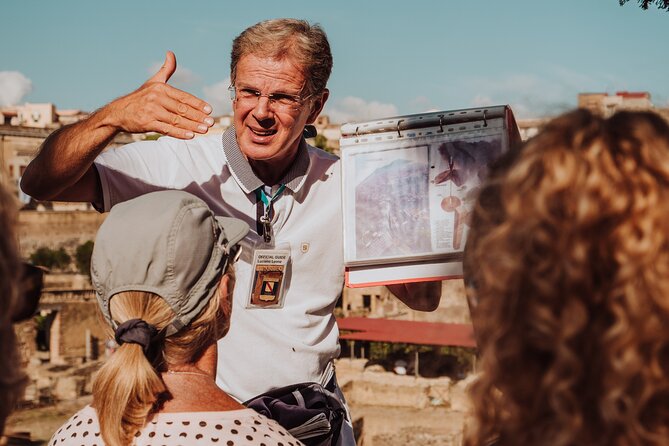
Pompeii’s best moments for many visitors are the houses, because each one is a different window into life. The tour includes the House of the Faun, a major site that helps you understand Roman domestic architecture and status. You also see the House of the Deer, plus shorter stops at places like the Terrace of M. Nonio Balbo.
The terrace stop is the kind of thing that sounds small until you are there. A higher view can change how you understand the city’s layout, especially when you have already been walking for hours. It is like giving your eyes a different job.
There is also time around the College of the Augustales, which helps connect private space and public cult life. Again, you are building context, not only chasing landmarks.
If you are hoping to linger and explore every nook, this is not that kind of itinerary. It is designed to show a lot, quickly, without turning Pompeii into a blur. That trade-off works best for travelers who want highlights with expert interpretation rather than hours of unstructured wandering.
Herculaneum After Pompeii: Smaller Ruins, Better-Preserved Details
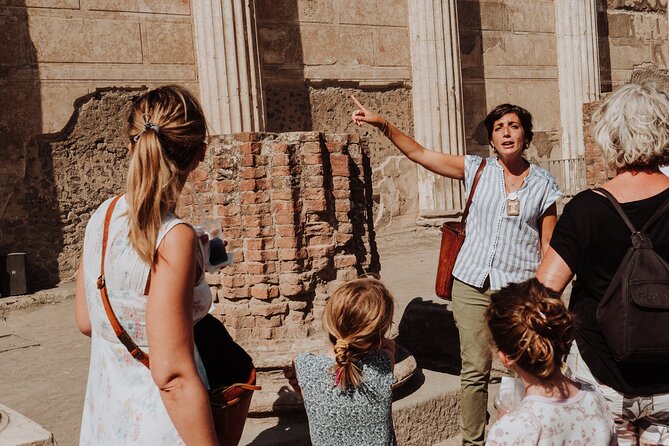
Then comes the pivot. Herculaneum is smaller than Pompeii, and that difference is a gift. You visit the Archaeological Park of Herculaneum for about 2 hours, with entry included. With less sprawling ground to cover, you get a better chance to focus on how the place felt and what survives.
A big reason this stop hits is preservation. One theme from past visitor experiences is that Herculaneum can show mosaics and frescos still existing, which feels like stepping into a lived-in space rather than a destroyed one. If Pompeii is about scale and streets, Herculaneum is often about texture and detail.
The tour then moves through a series of house and building examples, including Partem Domus lignea (Casa del Tramezzo di Legno), where wooden partitions are part of what makes the structure stand out. You also visit the House of the Skeleton, the Central Thermae, and the Casa del Rilievo di Telefo.
From a “what will I remember?” point of view, these house stops are great because they are named for specific features. Even if you cannot memorize every fact, you can remember the impression: this is a careful, human-scale place.
Additional stops include Casa Sannitica, Casa del Bel Cortile, House of the Grand Portal, and House of the Black Salon. Each one gives you another angle on daily life, building design, and how rooms were arranged.
Pacing, Comfort, and the Realities of Walking in the Sun
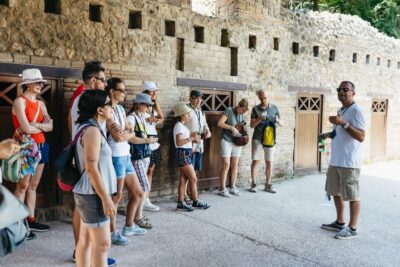
This tour caps at a maximum of 20 travelers, and that smaller size matters. You are not stuck in a giant herd, and the headsets are included to help you hear your archaeologist guide clearly during the Pompeii portion.
Still, this is not a sit-down day. You are walking through ancient streets, crossing uneven ground, and spending long blocks outdoors. More than one guide style gets described as fast-moving but organized, so you should assume you will keep up a steady pace.
Two practical tips come from the experiences people highlighted. First, bring water and plan for sun exposure, because Pompeii has limited shade. Second, if you have leg or knee issues, think twice about doing both sites in one day. The schedule is built to fit the trains, and that means fewer slow rests than you might want.
The upside is that you do get a built-in break at MaxiMall Pompeii, and the day is driven by transfers that keep you on track for the return train.
Price and Value: What You Pay For, and What You Skip
At about $204.38 per person, you are paying for more than just entry tickets. The tour includes roundtrip high-speed train tickets between Roma Termini and Naples Central, a minibus transfer from and back to Naples Central Station, and guided visits by an archaeologist at both ruins. You also get headsets, plus entry tickets for the sites, described as Pompeii Express entry tickets and Herculaneum entry tickets.
Meals and drinks are not included, so you should budget for lunch or snacks during your free time. The good news is that the itinerary includes a natural pause at MaxiMall, which makes meal planning easier than if you had no built-in break.
If you compare the cost to the time you gain, the deal becomes clearer. A day trip like this lives or dies on logistics. Here, you trade your own planning effort for a managed schedule that works.
Who This Tour Fits Best (and Who Might Prefer Something Else)
This is a strong match if you want guided Pompeii plus guided Herculaneum in one day without getting lost in transit details. It is also a great option for first-timers who want the highlights and context, not just ruins without explanation. Reviews and guide styles that mention pacing and clear answers suggest this works especially well when you want your questions answered.
It also has family appeal in practice, because one visitor account described the day as well organized and not overly taxing for little kids, even though you are still walking. If you travel with kids, still pack snacks, plan for restrooms, and treat shoes as non-negotiable.
On the other hand, if your idea of Pompeii is slow, long, and full of detours, you might feel the time in each place is too short. Pompeii is vast, and this itinerary is intentionally selective. Also, if you are visually impaired, the tour is noted as not recommended unless you have a dedicated personal assistant.
Should You Book This Pompeii and Herculaneum Day Trip?
Book this tour if you want a smart, time-efficient day that strings together the best parts of Pompeii and Herculaneum with an archaeologist guide, included tickets, and headsets, plus a return plan that gets you back to Rome without stress.
Hold off if you want to spend many extra hours wandering Pompeii at your own rhythm, because the tour is designed to fit both sites and the train schedule. Also be realistic about walking in the sun.
FAQ
FAQ
How long is the Pompeii and Herculaneum tour from Rome?
The full experience runs about 11 hours 30 minutes.
Does the price include entry tickets for Pompeii and Herculaneum?
Yes. Entrance fees are included, with Pompeii Express entry tickets and Herculaneum ruins entry tickets included.
What is the meeting point in Naples?
You meet at Starhotels Terminus in Piazza Giuseppe Garibaldi, just across the street from Naples Central Station.
Do I need to join the group at Rome Termini?
No. You start independently from Rome Termini Station. The guide does not meet you there, and you join the group after arrival in Naples.
How do the sites get included in the day once we reach Naples?
After you meet your local guide and driver near Naples Central Station, you travel by minibus to the archaeological sites, and you return to Naples Central Station after the visit.
Are headsets included?
Yes. Headsets are included.
Are meals included?
No. Meals and drinks are not included.
What happens during the MaxiMall Pompeii stop?
You take a short break and receive an exclusive welcome kit plus a discount card with special deals at the mall.
Is the tour suitable for visitors with limited mobility or vision?
The tour is not recommended for visually impaired guests unless accompanied by a dedicated personal assistant. For mobility, you should expect significant walking, and it may be strenuous on the feet.
What about luggage and cancellation?
If you have suitcases, you are advised to use a luggage deposit, since the minibus may not have a luggage compartment. Cancellation is free up to 24 hours in advance for a full refund.
More Guided Tours in Naples


More Tours in Naples

More Tour Reviews in Naples
Not for you? Here's more nearby things to do in Naples we have reviewed









Tour Reviews, compared.
 ★ 4.8Pompeii: Entry Ticket and Guided Tour with an ArchaeologistFrom $3519,459 reviews
 ★ 4.2Pompeii: Entry Ticket with Optional Audio GuideFrom $2612,360 reviews
 ★ 4.8Pompeii: Small Group Tour with an ArchaeologistFrom $4012,264 reviews
 ★ 4.3Pompeii Ruins & Mount Vesuvius Day TourFrom $12011,459 reviews
 ★ 4.6Sorrento, Positano and Amalfi Full-Day TourFrom $10710,988 reviews
 ★ 5.0Sorrento, Positano & Amalfi Coast – Small Group TourFrom $768,643 reviews
 ★ 4.6Catacombs of San Gennaro Entry Ticket & Guided TourFrom $157,941 reviews
★ 5.0Pompeii Small Group Tour with an ArchaeologistFrom $356,593 reviews
★ 4.6Catacombs of San Gennaro Entry Ticket & Guided TourFrom $157,941 reviews
★ 5.0Pompeii Small Group Tour with an ArchaeologistFrom $356,593 reviews
Browse the lists this tour appears in