
Tour review · TOUR REVIEWS
Pompeii and Herculaneum led by an Archaeologist with private transport
Herculaneum and Pompeii together is a smart one-day plan. What makes this tour stand out is the private A/C Mercedes ride plus a real archaeologist guide who helps you spot the details that usually get missed. My only caution: it is a long walking day, so you will want solid shoes and the stamina for lots of short stops.
You also get real convenience built in, with pickup and drop-off covering Naples, Salerno, Sorrento, and the Amalfi Coast. It runs about 7 hours, and it is paced around the major sites without wasting time. If you’re hoping for hours and hours in one single monument, this is more of a highlights-and-understanding day than a slow museum crawl.
Key things I like about this Pompeii plus Herculaneum tour
- Private transport in air-conditioned Mercedes between the two ruins, so the day stays comfortable
- Archaeologist-led walk at Herculaneum, then Pompeii, with short focused stops so you see more
- Herculaneum and Pompeii highlights in one circuit, including places like the Lupanar and the Teatro Grande
- Built-in lunch window (free time to eat on your own), with flexibility if you want to move fast
- Small-group feel since it is a private tour, meaning your guide can adjust pacing for your needs
Pompeii and Herculaneum in One Day: Why This Order Works
Doing Pompeii and Herculaneum in a single day sounds ambitious, but the flow makes sense. You start at Herculaneum, which is smaller and easier to manage first, and then you shift to Pompeii for the big set pieces like the Forum and theater area.
This order also helps with how ruins feel. Herculaneum gives you the close-up, personal side of daily Roman life, especially inside houses and bath complexes. Pompeii then hits you with the more public rhythm, main streets, and the dramatic scale of the city.
The main drawback is that both parks involve walking, even when the stops are short. You’ll be on your feet for most of the day, so plan for an active, not relaxed, outing.
You can also read our reviews of more private tours in Naples


Getting There Comfortably in a Private A/C Mercedes
One of the biggest quality-of-life upgrades here is transport. You get pickup from your accommodation area, then travel between sites in a private Mercedes with a professional driver, in an air-conditioned vehicle.
That matters because the bottleneck is not just the ruins, it’s the drive time, plus the stress of managing your own logistics. With a driver handling the route and timing, you spend more of your energy on the archaeology instead of figuring out buses, schedules, or where the shuttle drops you.
The reviews also underline that the handoff between driver and guide is smooth. People mention drivers like Giovanni and Luigi as friendly, professional, and good at practical recommendations for lunch. If your ship or train runs late, this setup is the kind that can actually absorb schedule changes without turning your day into a scramble.
Herculaneum Archaeological Park: Houses, Baths, and the Human Details
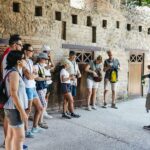
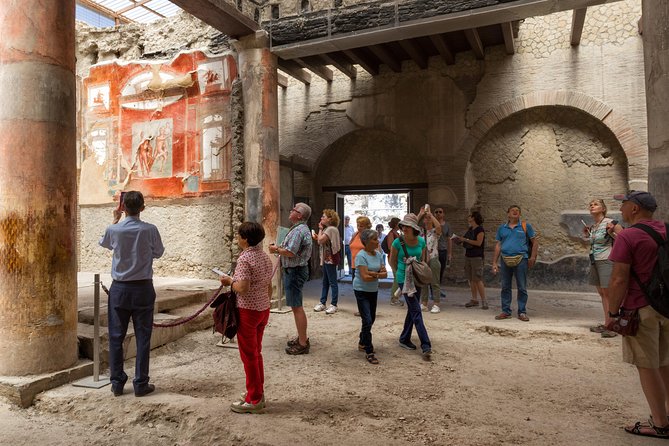
Herculaneum is where this day earns its “serious archaeology” vibe. You meet at the Herculaneum ruins ticket office and then your archaeologist guide takes you through a sequence of highlights, usually in quick blocks that still add up to a full picture.
House of the Deer and the city’s elite interiors
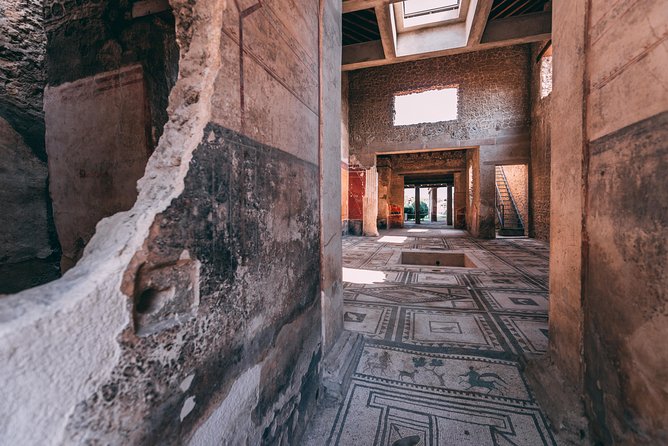
A strong early stop is the House of the Deer, named for marble statues of stags and deer found in the peristyle. Even if you only get a short look, this is the kind of detail that makes Herculaneum feel intimate. You’re not just seeing walls, you’re seeing what was displayed and valued in someone’s home.
Next you move through stops like La Terrazza di M. Nonio Balbo, tied to the city’s major benefactor and the funeral altar inscription. That inscription detail is a reminder that Roman elites still used public monuments to manage reputation, even in death.
Augustus-era religion and the social engine of baths
The College of the Augustales is one of those stops that makes you think about power and religion. It is associated with the cult of Emperor Augustus and the headquarters of the collegium augustalium, or possibly the local curia. In other words, it was not just a building, it was part of how the city organized civic life.
Then you get to the Central Thermae, built around the early 1st century AD. The key practical point here is that it was divided into men’s and women’s baths with separate entrances, reflecting real daily routines, not one-size-fits-all bathing.




Suburban Thermae and the House of Telefo
The Casa del Rilievo di Telefo is interesting for how it connects to other structures. The house is linked with its own private access to the adjoining Suburban Thermae. That physical connection helps you understand Roman architecture as a system, where leisure spaces and elite homes could overlap.
House of the Skeleton and why the names matter
The House of the Skeleton gets its name from human remains discovered in a second-floor room in 1831. It’s one of those labels that feels heavy, but it also keeps the story grounded in people, not just objects.
The tour also includes the House of the Black Salon, known for a luxurious interior and a monumental entrance. You can still see carbonised remains of doorposts and lintel, a stark visual reminder of what happened at the moment of destruction.
Wooden partitions, Samnite-style planning, and original courtyards
Herculaneum is also unusually good for the small design choices. At Partem Domus lignea, you’ll see an important wooden partition that survived in carbonised form. This kind of surviving material is rare in archaeology and it’s why Herculaneum feels different from Pompeii.
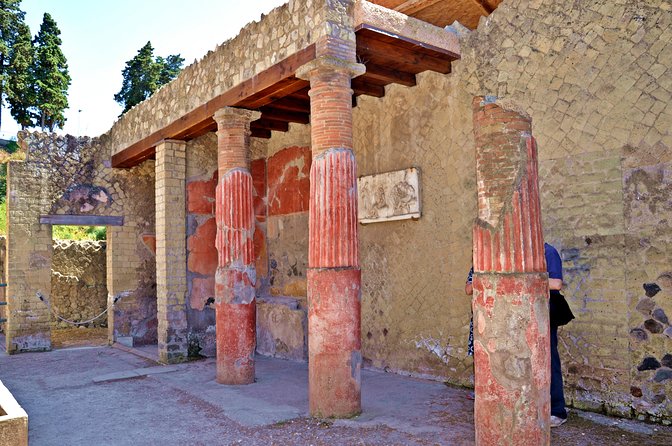
You also visit Casa Sannitica, with an atrium and a gallery supported by Ionic columns, plus fresco decoration. The layout is described as typical of the Samnites, which helps you picture how regional traditions influenced city design.
Another standout is Casa del Bel Cortile, known for a courtyard with a stairway and a stone balcony instead of a traditional atrium. Then comes the House of the Grand Portal, in the center of the archaeological area, with charred remains of wooden parts and frescoes throughout.
How long you’ll spend in Herculaneum
You are not wandering for hours with no structure. The stop pattern is built around short visits, roughly 10 to 15 minutes each for many highlights, plus the time needed to enter and orient. This keeps the day manageable and prevents that common problem where you get “ruined out” before you hit the best moments.
Lunch Reset Between Ruins, Then Back to Pompeii’s Main Stage
Once you finish Herculaneum, you get a pause built in. There is free time to have lunch on your own, then you continue into Pompeii.
The lunch window is not a formal sit-down meal included in the price. It is there so you can choose what works for your day, and it also gives you a chance to cool down and reset.
A practical tip from the guide style and pacing: if you want more time in Herculaneum before the biggest crowds build, eating faster or skipping lunch can help you keep your momentum. Some people choose to skip the stop, trading comfort for extra time on the ground.
During the Pompeii transfer, you’ll still be in the driver’s hands, so you can treat the break as breathing room rather than a logistical gap.
Pompeii Highlights: From the Lupanar to Teatro Grande
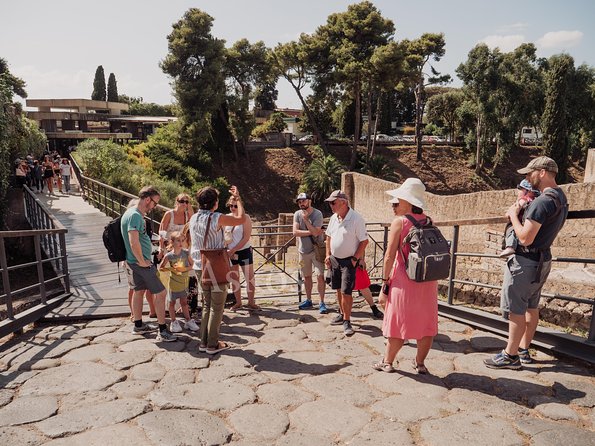
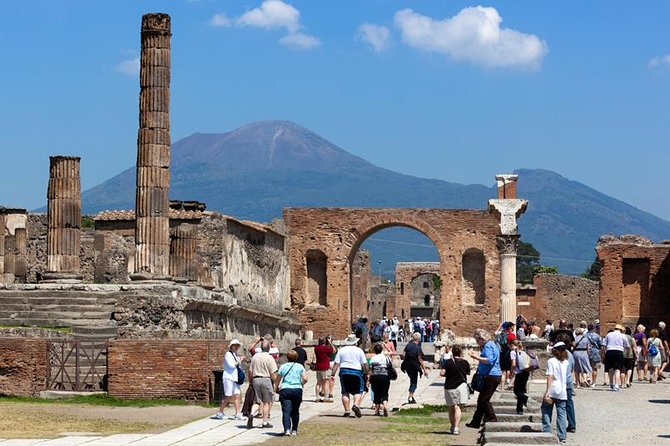
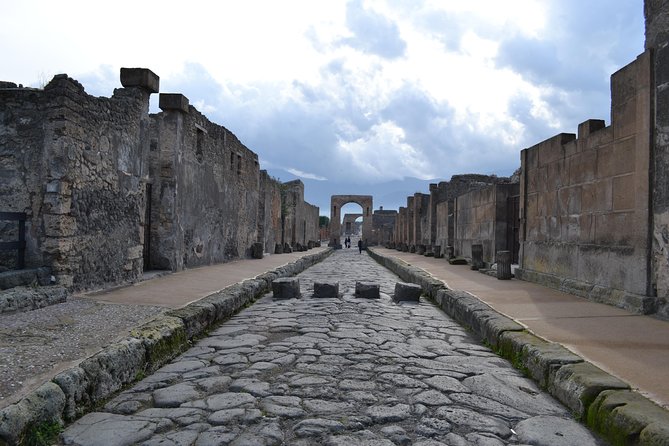
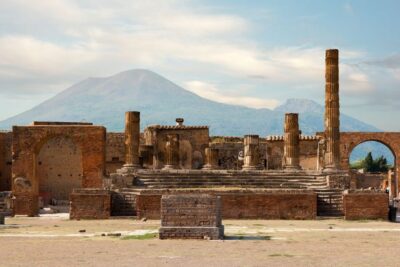
Pompeii is the big stage, and this itinerary targets the most recognizable, story-rich zones without forcing you into long detours. After you enter Pompeii, you get time to connect the city’s layout by moving through key areas.
Lupanar and the city’s darker side
You start with the Lupanar, Pompeii’s most famous brothel. It is not just shock value. The point is how Roman urban planning included commercial and social functions right alongside everyday life.
Forum, main street, and civic life
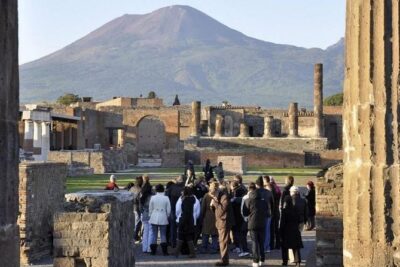
Then you move to the Foro de Pompeya, Pompeii’s main square, followed by time walking through the main street. This helps you understand how public and private life intersected through the city’s street grid.
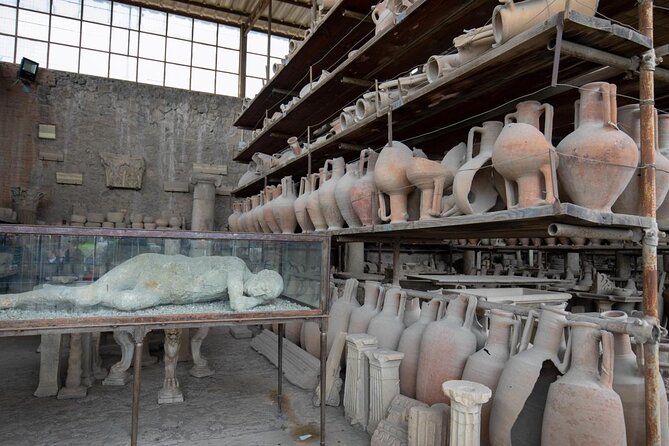
The tour also includes the Granaries of the Forum, where you can see marble tables and baths for fountains adorning entrances of houses. You’ll also see casts related to the eruption victims, plus casts of a dog and a tree. That blend of art, architecture, and aftermath is exactly why Pompeii hits so hard.
Basilica and Stabian Baths
Next is the Basilica, an open portico that sheltered merchants and other activities. Even in ruins, you can still sense how commerce moved through covered public spaces.
Then you visit the Stabian Baths (Terme Stabiane), described as the oldest thermal complex in the city. Bath buildings were about more than cleanliness, they were also about social contact and routine.
Menander, Faun, and the homes that explain status
A major part of the Pompeii section is domestic luxury. At the House of Menander, you see one of the richest and most magnificent homes in terms of architecture, decoration, and contents. The point is that these houses were built to display taste and power.
Then you move to the House of the Faun, one of the largest and most impressive private residences in Pompeii. It helps you see scale, and it reinforces a recurring theme across both parks: people lived in ways that were deeply physical, with daily routines tied to spaces we can still map.
Theaters: Teatro Grande and Teatro Piccolo
Finally, you reach the Teatro Grande, the most important theater in Pompeii, plus a look at the Teatro Piccolo. Theaters anchor the idea of public entertainment as a civic heartbeat, not an afterthought.
What the Archaeologist Guide Adds (and Why Short Stops Still Feel Worth It)
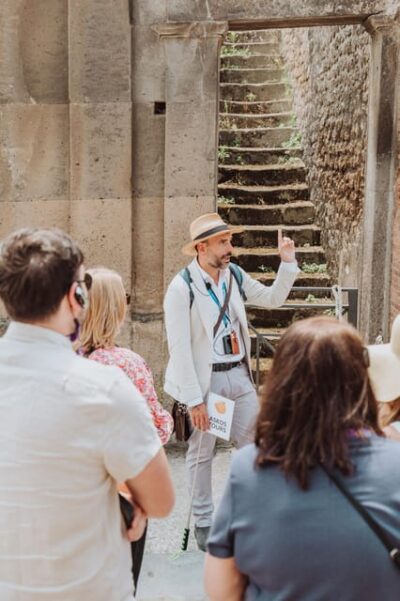
The magic here is not just that you have a guide. It’s that the guide is an archaeologist, and that changes how you interpret what you see.
In the reviews, guides such as Lucio, Alfredo, Daniela, Mena, Ivan, Benedetto, and John Carlos are praised for staying entertaining while staying grounded in real explanation. You should expect the guide to point out what matters in the architecture and to connect features to daily life.
One theme that shows up again and again is context around the eruption’s different effects. Pompeii and Herculaneum were destroyed differently, and a good archaeologist will help you connect those differences to what each site looks like today. That kind of cause-and-effect understanding is what turns a list of ruins into a story you can follow.
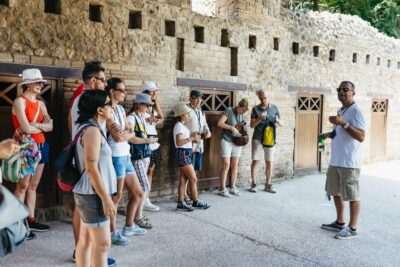
You’ll also get help adjusting pacing if your group has mobility limitations. Reviews specifically mention patience and helpfulness in those situations, which is a real quality marker for a private tour where the guide can adjust on the fly.
Tickets, Timing, and What to Bring for a 7-Hour Ruins Day
This is structured for about 7 hours total. You’re also starting earlier than many independent travelers, which helps with smoother entry and a steadier day.
Admission coverage is mostly handled for you. The package includes entry tickets for both parks through the Pompeii Express arrangement, and it specifically notes entry tickets for Herculaneum. Still, the stop notes mention that entry tickets may be separate at the start of Herculaneum, so I’d treat this as a “confirm in your booking details” situation rather than assuming every ticket detail is identical across vendors.
If you want the numbers for planning, Herculaneum entry is listed as 16 euros for adults and 2 euros for EU citizens aged 18 to 25. Even if your tour covers it, it’s useful context in case you need anything on your specific ticket type.
What to bring:
- Comfortable shoes with real grip
- Sunglasses, sunscreen, and water
- In summer, skip flip-flops, the tour suggests no flip-flops during hot months
Value for the Price of $666.75 Per Person
At $666.75 per person, this is not a budget excursion. The value comes from what you get for that cost, and it adds up fast.
You’re paying for a private setup: pickup and drop-off, plus a private A/C Mercedes ride. You also get an archaeologist guide, not just a driver with a playlist and a map. Then there are the key site entries, handled through the included ticket structure.
A big reason I see this as good value for the right traveler is that it reduces friction. In Pompeii and Herculaneum, friction is what burns your time and drains your experience. When someone else handles timing and transitions, your day is less about logistics and more about learning and actually seeing.
Also, the reviews are unusually consistent about the guide quality. When people describe the day as worth every penny and mention their archaeologist’s depth, it signals that you’re not just buying transportation.
Who This Private Tour Fits Best
This is a great fit if you want a guided day that still feels efficient. You’ll like it if you:
- Want to cover both parks without splitting your day into separate tours
- Prefer short, guided stops over wandering alone for hours
- Appreciate architecture and how Romans organized space, from houses to bath complexes to civic buildings
- Travel as a couple or small group and want a private vehicle and pacing
If you want a slow, museum-style day with lots of unstructured time, you might find the pace tight. But if you’re aiming for the “see it all and understand it” goal, this setup is exactly built for that.
Should You Book This Pompeii and Herculaneum Day Trip?
I’d book it if you want the most effective use of a single day in the Naples area. The combination of private, A/C transport plus an archaeologist-led circuit through major highlights is the kind of pairing that turns two intimidating ruins into a coherent experience.
I would hesitate only if you have very limited walking tolerance or you need long, unscheduled time in one specific area. Otherwise, this is one of the more practical ways to hit both sites while keeping your day organized.
FAQ
How long is the Pompeii and Herculaneum tour?
The tour is about 7 hours (approximately).
Where can pickup and drop-off happen?
Pickup and drop-off are offered in the Campania region, including Naples, Salerno, Sorrento, and the Amalfi Coast, as well as at the cruise port, train station, or airport. Drop-off returns you to your accommodation in those areas.
Are entrance tickets included?
The tour includes admission ticket entry through Pompeii Express, including Herculaneum entry tickets and Pompeii Express entry tickets. The stop notes also reference entry tickets, so it’s smart to confirm what is included in your booking.
Is lunch included?
No. You get free time for lunch on your own between Herculaneum and Pompeii.
What should I wear or bring?
Wear comfortable shoes. In summer, the tour advises against flip-flops. Bring sunglasses, sunscreen, and water.
Can I get a full refund if I cancel?
Yes. You can cancel for a full refund if you cancel up to 24 hours in advance of the experience start time.
More Private Tours in Naples



More Tour Reviews in Naples
Not for you? Here's more nearby things to do in Naples we have reviewed










Tour Reviews, compared.
 ★ 4.8Pompeii: Entry Ticket and Guided Tour with an ArchaeologistFrom $3519,459 reviews
 ★ 4.2Pompeii: Entry Ticket with Optional Audio GuideFrom $2612,360 reviews
 ★ 4.8Pompeii: Small Group Tour with an ArchaeologistFrom $4012,264 reviews
 ★ 4.3Pompeii Ruins & Mount Vesuvius Day TourFrom $12011,459 reviews
 ★ 4.6Sorrento, Positano and Amalfi Full-Day TourFrom $10710,988 reviews
 ★ 5.0Sorrento, Positano & Amalfi Coast – Small Group TourFrom $768,643 reviews
 ★ 4.6Catacombs of San Gennaro Entry Ticket & Guided TourFrom $157,941 reviews
★ 5.0Pompeii Small Group Tour with an ArchaeologistFrom $356,593 reviews
Browse the lists this tour appears in