
Tour review · TOUR REVIEWS
Herculaneum Private Tour with an Archaeologist
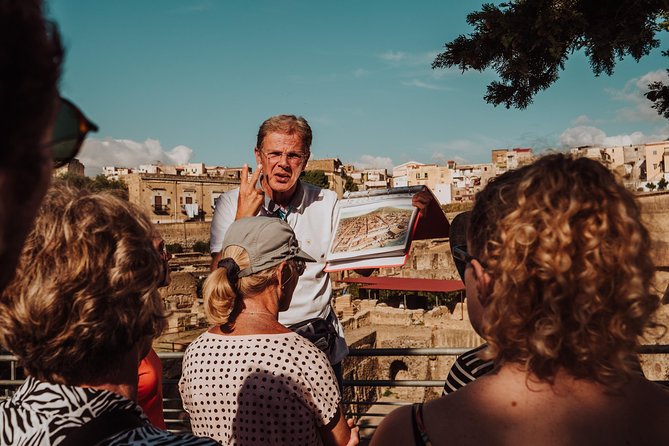
Herculaneum hits harder than you expect. In about two hours, you get a guided walkthrough of Ercolano’s buried streets and houses, where everyday Roman life and the eruption of Vesuvius are impossible to separate, especially with a private archaeologist explaining what you are looking at.
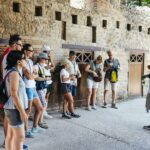
What I like most is the way the tour turns ruins into stories (not just stone shapes), and the laser focus on the moments you’d miss on your own. You also get a small group setup, with an English-speaking specialist who can pace the walk and answer questions as you go.
One drawback to keep in mind: the entrance and local private-tour fees are not included, so the total cost can climb once you add tickets.
Key things to notice before you go
- Meet at the Parco Acheologico di Ercolano ticket office and look for the sign for your guide (for example, Eliana Sandretti).
- You’ll see skeletons tied to the eruption, including the terrace viewpoint at M. Nonio Balbo.
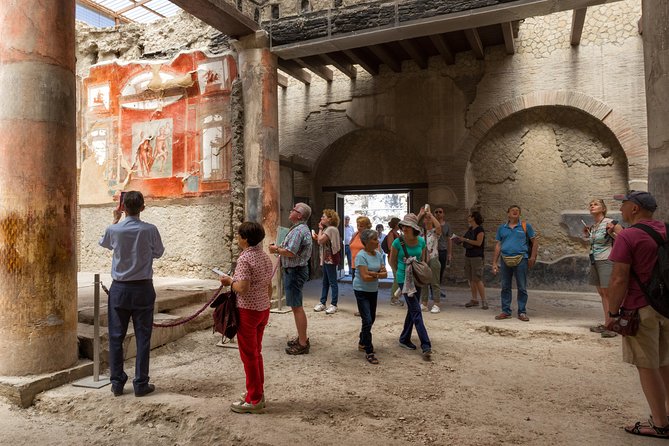
- Carbonized and preserved details matter here, like a charred wooden partition and a black-painted salon.
- The tour is short but structured, with about 10 to 15 minutes at most stops.
- It’s built for explanation, since several house names are tied to specific artwork or artifacts.
- Bring the right expectations about walking and heat, since you move through multiple rooms and terraces.
Private archaeologist in Ercolano, not just a checklist
This is the kind of Herculaneum tour where you benefit from real on-site interpretation. A private archaeologist can point out why a door location matters, what a ceiling decoration suggests, and how a “simple” room name connects to a specific preserved feature. Instead of you guessing, you get context as you stand where the evidence is.
The best part is that the pace feels designed for understanding, not racing. You cover major domus and key spaces in roughly two hours, with guided time at each stop. Guides you might be paired with include Eliana Sandretti, plus other archaeologist guides who have led groups before such as Amedeo, Roberto, Pina, Maria, Francesco, Mattia, and Pia, so you’re likely to get the benefit of strong expertise and careful English explanations.
If you are traveling with a group and want everyone to “get it,” this format is practical. Everyone hears the same story, and you can ask follow-ups rather than competing with a big crowd.
You can also read our reviews of more private tours in Naples

Price and what you get when you pay for privacy
The price is $349.98 per group, up to 10 people, for about 2 hours. Since it’s per group, value depends on how full you keep it. If you fill all 10 spots, you’re effectively spreading the cost to about $35 per person. If you travel as fewer people, it still can be a good deal if you really want a specialist guiding the exact houses and rooms.
You also aren’t paying only for “someone holding a flag.” What you are buying is time from an archaeologist who can explain the preserved evidence, especially the unusual items Herculaneum is famous for. Pompeii often grabs attention for scale, but Herculaneum often wins for intimacy, because the town is smaller and so much of the daily-life detail is concentrated.
Tickets: what’s included, what’s not
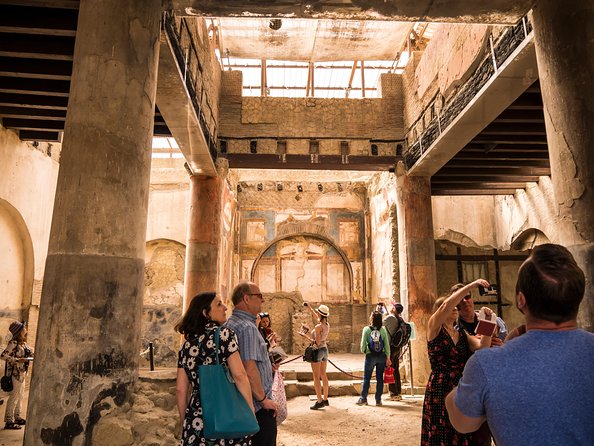
The tour includes the archaeologist guide, assistance during the tour, taxes, and access to see the main attractions as part of the experience.
What is not included:
- Admission fee for the private tour of Herculaneum: €15 per person
- Entrance tickets to Herculaneum: €15 for adults, free for under 18
- Food and drinks
That means you should budget for tickets on top of the group price. If you already bought online, you can walk in with less stress. If not, the meeting point includes time to buy entrance tickets at the site ticket office.
Tip: plan your arrival time so you are not rushing. Starting smoothly helps the guide give you a better first orientation, especially since this tour moves through multiple rooms and terraces.
Stop 1 at Parco Acheologico di Ercolano: the site intro that saves you later
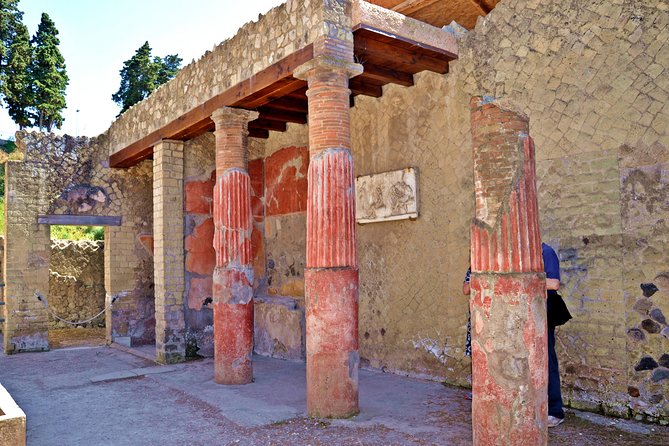
Your tour starts at Corso Resina, 187, 80056 Ercolano NA, at the Archaeological Park of Herculaneum ticket office. The guide will be waiting with a sign so you can spot them quickly. If you have entrance tickets already, you can focus on meeting and starting the walk.
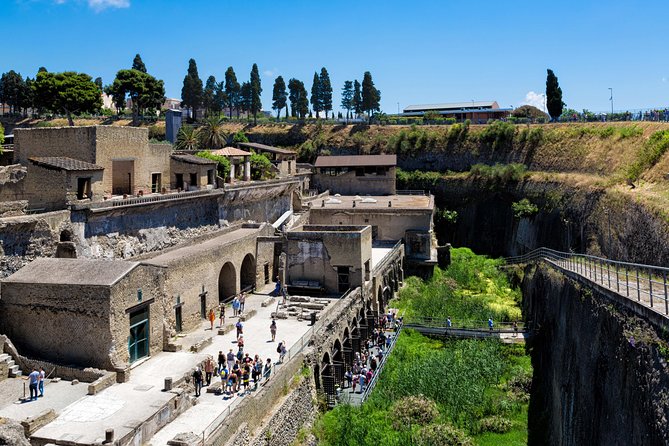
Why this first stop matters: Herculaneum can feel confusing at first, because you are looking at a town that got buried and then excavated in sections over time. A good guide frames what you’re seeing so later stops make sense. You’ll also get reassurance about what parts are safe to focus on, and how the eruption changed what survived.
If you buy tickets on-site, you might have slightly less time for photos early on. But it is worth it if it prevents a last-minute scramble.
Stop 2: La Terrazza di M. Nonio Balbo and the skeletons
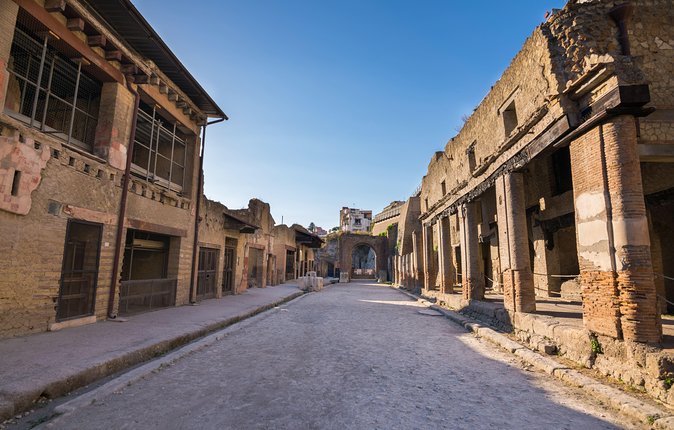
Next you head to La Terrazza di M. Nonio Balbo, a stop that turns the eruption into a human moment. You’ll spend around 5 minutes here and see skeletons of people who died during the eruption.
Then comes the clever part. The tour uses the terrace viewpoint to help you imagine the panorama before the explosive phase of Vesuvius. Standing there, you get a sense for how people once saw the coast and the broader setting, which makes the tragedy feel less like a distant disaster and more like a sudden interruption to daily life.
Practical note: this is a fast stop, so keep your questions ready. If you want deeper context about how the evidence was found or how the event unfolded, ask early.


Stop 3: Casa dei Cervi and the Telephus relief
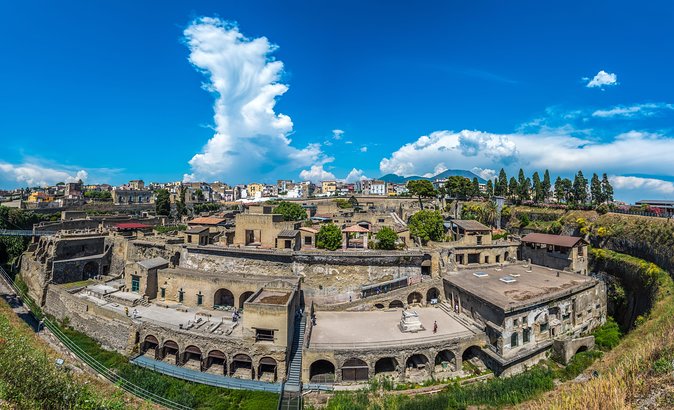
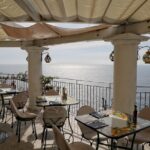
After the terrace, you visit Casa dei Cervi, a luxurious house with a terrace overlooking the sea, with about 15 minutes allotted. This is where Herculaneum starts to feel like a complete world, not just a disaster site.
The house name comes from a high relief that shows the myth of Telephus. That detail is the kind of thing you would likely miss if you were moving through rooms quickly. With a guide, it becomes obvious how art and storytelling were woven into domestic space.
Why I like this stop: it gives your brain a break from the heavier eruption evidence without skipping the seriousness. You get Roman creativity and status signaling at home, then you move back toward the eruption-related discoveries.
Stop 4: Partem Domus lignea and the charred wooden partition
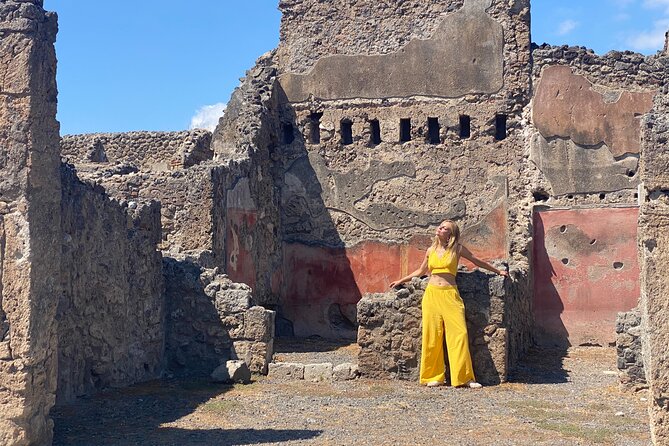
You’ll then head to Partem Domus lignea, also known as the Casa del Tramezzo di Legno. This stop focuses on a discovery of a wooden partition that was charred due to the eruption.
Around 15 minutes here is the sweet spot. The key is that Herculaneum is famous for the survival of organic materials in places where you would normally expect everything to rot away. A guide can point out what the wooden structure suggests about how spaces functioned, what people could see or pass through, and how the interior layout likely worked before the catastrophe.
If you love architecture and material details, this is a strong “how did they build this?” stop. If you just want the emotional story, it still works, because it shows the eruption’s impact in a very specific way: a burned divider that was part of everyday movement through the house.
Stop 5: Casa del Salone Nero, the black-painted salon
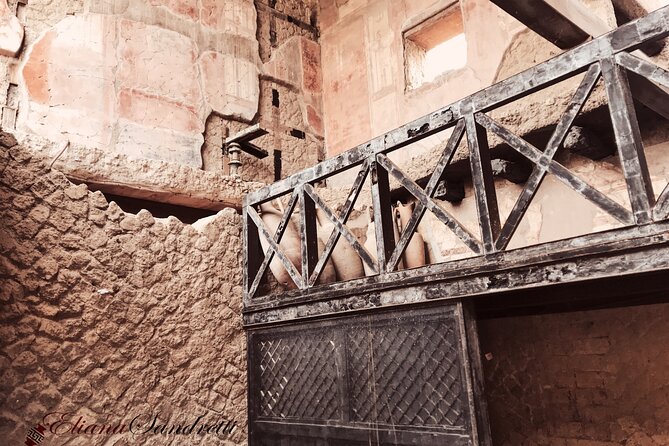
Next is Casa del Salone Nero, the house of the Black Room, named for its salon painted in black. You get about 15 minutes here, and it’s another high-value stop for art lovers.
Even without specialized art training, black interior spaces can feel striking. The guide helps you connect the look to Roman taste and status. In a place where much of the evidence survived in unusual form, this kind of color survives your imagination long after the tour ends.
Small drawback to be aware of: this stop can feel more “visual” than “dramatic.” If you are expecting another skeleton-based moment, you might want to keep asking questions until you find the angle that clicks for you, such as symbolism, room function, or why the painting was done this way.
Stop 6: Salone della Barca di Ercolano and a recently discovered boat
Then you visit the Salone della Barca di Ercolano, where you’ll see a boat charred by the eruption, with note that it’s been recently discovered.
This stop is one of those moments where Herculaneum’s character becomes unique. A boat in a room gives you instant clues about what people valued. It can hint at trade connections, coastal identity, or simply the sort of decoration someone chose to show guests.
You’ll have around 15 minutes. Use that time to ask how this evidence was interpreted and why it earned attention beyond the obvious visual. A good guide will connect decoration to the bigger daily life story.
Stop 7: College of the Augustales, Hercules entering Olympus, and a skeleton keeper
Next comes the College of the Augustales. This stop includes frescoes showing Hercules entering Olympus. You also get about 15 minutes, plus a reminder that this site holds human loss in multiple forms.
In this room, you can see a skeleton of the keeper who died during the eruption. The combination works well: art and death in the same space forces you to understand the scale of what happened to a community, not just to individual households.
If you like mythology, you’ll probably enjoy this stop. If you don’t, the guide can still connect the Hercules imagery to social and religious identity, so you don’t feel stuck in an “art history lecture.”
Stop 8: House of the Skeleton and the weight of one discovery
The House of the Skeleton is short on time, about 10 minutes, but it lands. The name comes from discovery of a skeleton of an inhabitant who was unable to save himself.
This is one of those stops where the guide’s pacing matters. You don’t need long paragraphs of explanation to feel the gravity. Instead, you benefit from a careful walkthrough of what the evidence represents and what it does not. A good archaeologist keeps it factual while letting the human reality stay in focus.
If you want something uplifting, this might be emotionally intense. If you want a sober, honest understanding of 79 AD, it is exactly the kind of stop that makes Herculaneum feel different from many other Roman sites.
Stop 9: Casa Sannitica, one of the oldest houses
You’ll then see Casa Sannitica, a Samnite House that is described as one of the oldest houses in Herculaneum, with about 15 minutes here.
This is valuable because it adds time depth. Instead of only looking at the final moments before the eruption, you start to sense that the town had layers, evolving ownership, and changing styles before it was buried.
It can also be a useful contrast stop. After houses with specific named decorations or discoveries, an older house gives you perspective on how varied the domestic experience was across the town.
Stop 10: Casa di Nettuno e Anfitrite and its scenographic compositions
The final house stop is Casa di Nettuno e Anfitrite, with around 15 minutes. The name refers to Neptune and Amphitrite, and the guide will show you an environment described as leaving people speechless thanks to rich scenographic compositions.
This is a strong way to end because it feels like a “full stop” for imagination. Even when you’ve had a sobering experience, the final contrast helps you walk away remembering what people built, decorated, and believed in. It turns the tour from disaster-focused into life-focused, without erasing the disaster.
Photo note: depending on light and room access, some compositions may be easier to photograph than others. Since you have only around 15 minutes, prioritize the key scenes the guide points out first.
How to get the most out of the 2 hours
This tour is compact by design. You have limited time at each stop, so your strategy should be simple:
- Bring your questions, even if you only remember one or two when you arrive.
- Ask the guide to connect what you see to the eruption story, not just what the artifact is.
- If you care about art, ask about the frescoes and painted rooms. If you care about construction, ask about wooden and architectural evidence.
- Wear shoes that handle uneven ground. Some stops involve terraces and rooms, and it adds up quickly.
Guides in the past have also shown flexibility with pace when someone in the group needed help with stairs or used a mobility scooter. If you have any mobility needs, it helps to mention them early so your guide can plan a smoother flow.
Who should book this private Herculaneum archaeologist tour
Book this if:
- You want context, not just visuals. The site is easier to appreciate with an archaeologist guiding the meaning of each stop.
- You are short on time and want a concentrated route across major houses and key eruption-related spaces.
- Your group likes a mix of art, architecture, and human story.
You might look at other options if:
- You prefer a very long free-roam visit with no stops and no timed sections.
- You want a lighter tone throughout. Several stops focus directly on deaths connected to 79 AD.
Should you book it?
I think this is a smart choice if you care about understanding Herculaneum and not just collecting photos. The value comes from the specialist explanations tied directly to the most memorable preserved evidence, including charred wood, painted interiors like the black salon, named myth references like Telephus, and the terrace viewpoint where skeletons connect the landscape to the eruption. The tour also stays tight, around two hours, so you can fit it into a Naples or Ercolano day without burning half your vacation.
If you can afford the group price and you can line up your tickets in advance to avoid delays, this private archaeologist tour is one of the best ways to get a real sense of how this town looked and felt when it was still alive.
FAQ
How long is the Herculaneum private tour with an archaeologist?
It lasts about 2 hours.
What is the price, and is it per person?
The price is $349.98 per group for up to 10 people.
Is the tour offered in English?
Yes, it is offered in English.
Is the entrance ticket included?
No. The admission fee and entrance tickets are not included. The tour lists €15 for adults and free tickets for under 18, plus a €15 private tour admission fee per person.
Where do we meet for the tour?
You meet at the Archaeological Park of Herculaneum ticket office, at Corso Resina, 187, 80056 Ercolano NA, Italy. The tour ends back at the meeting point.
Is this tour private?
Yes. It is private, meaning only your group participates.
Are mobile tickets used?
Yes. The tour includes a mobile ticket.
Is there free cancellation?
Yes. Free cancellation is available, and you can cancel up to 24 hours in advance for a full refund.
More Private Tours in Naples


More Tours in Naples

More Tour Reviews in Naples
Not for you? Here's more nearby things to do in Naples we have reviewed



Tour Reviews, compared.
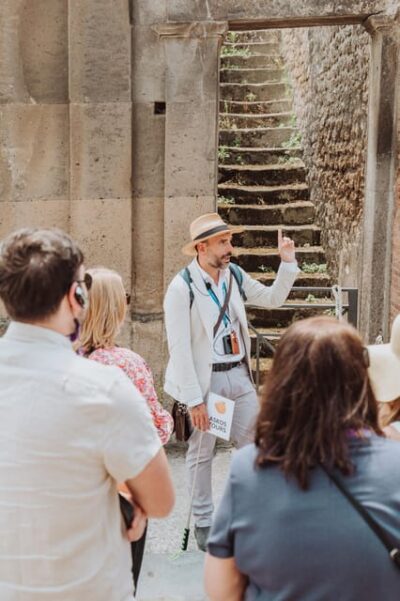 ★ 4.8Pompeii: Entry Ticket and Guided Tour with an ArchaeologistFrom $3519,459 reviews
 ★ 4.2Pompeii: Entry Ticket with Optional Audio GuideFrom $2612,360 reviews
 ★ 4.8Pompeii: Small Group Tour with an ArchaeologistFrom $4012,264 reviews
 ★ 4.3Pompeii Ruins & Mount Vesuvius Day TourFrom $12011,459 reviews
 ★ 4.6Sorrento, Positano and Amalfi Full-Day TourFrom $10710,988 reviews
 ★ 5.0Sorrento, Positano & Amalfi Coast – Small Group TourFrom $768,643 reviews
 ★ 4.6Catacombs of San Gennaro Entry Ticket & Guided TourFrom $157,941 reviews
★ 5.0Pompeii Small Group Tour with an ArchaeologistFrom $356,593 reviews
★ 4.6Catacombs of San Gennaro Entry Ticket & Guided TourFrom $157,941 reviews
★ 5.0Pompeii Small Group Tour with an ArchaeologistFrom $356,593 reviews
Browse the lists this tour appears in