
Tour review · TOUR REVIEWS
Pompeii the Ancient City (Tour+Transfer)
Pompeii is big, but this tour keeps it manageable. I like how the round-trip shuttle handles the hardest logistics, and how you get an accompanied visit through key ruins with a licensed guide. It is also a smart pick if you want the main sights without spending your whole day in the sun.
My favorite part is the tight itinerary that moves through the Forum area, big-house luxury, and the main street that ties everything together. You will get several stops that are free to view once you have your Pompeii entry ticket, so you can focus on seeing, not paying again and again. The main drawback to plan for is that Pompeii entry is not included in the tour price, and the listed language option is English and Italian, so if you need French you should check ahead.
Key highlights at a glance
- Guided route through the Forum, Macellum, and major landmarks in a timed half-day flow
- Vintage classic van transfers in sharing mode, with pickup windows that can run a bit
- Pompeii entry ticket sold separately (budget an extra €22 per person)
- A strong sampling of daily life and elite culture, from markets to private mansions
- At most 25 people, which tends to make it easier to hear the guide and ask questions
Why this 4-hour Pompeii plan works when time is tight

Pompeii can swallow a whole day, even if you are not a history nerd. The value of this tour is that it uses your time like a map, not like a suggestion. You are visiting a high concentration of the best-known ruins in about 4 hours, starting at 9:00 am, with short stops that keep you moving and seeing.
This format is great if you are on a schedule, such as a hotel stay that needs dinner plans, or if you want a first look before you go deeper on your own later. It is also a practical match for the area around Naples, because it includes transportation from a wide set of towns in the pickup zone. In other words, you are not spending your vacation time figuring out how to get to the park.
There’s also a “small-group” feel here. The tour caps at 25 travelers, so you are not disappearing into a sea of hats. That matters at Pompeii, where you want to hear what you are looking at, and you want to keep your bearings.
You can also read our reviews of more city tours in Naples



Price and logistics: shuttle convenience, plus one extra cost you must budget
Let’s talk money honestly. The price is $70.89 per person, and what that really buys you is the transportation and the guided structure. The tour includes a ride on a vintage classic van and private transportation as part of the transfer plan.
What is not included is the Pompeii entrance ticket (€22 per person). That is the one line item you should mentally add before you book. Lunch is also not included, so if you are doing the tour and then eating on your own afterward, plan for that cost and timing.
Here is the practical takeaway: you are paying for convenience plus a guided route. If you already love planning and want to roam at your own pace, you might do fine with self-guided entry. But if you want your Pompeii day to feel organized, the transfer and guided highlights make the math easier.
Pickup in the Pompeii area, not Naples proper
This is where the tour becomes either effortless or tricky, depending on where you sleep. The tour clearly does not pick up from Naples. Instead, pickup is offered from many nearby towns, including Castellammare di Stabia, Torre Annunziata, Pompei, Scafati, Sant’Antonio Abate, Angri, S. Maria la Carità, Gragnano, Letter e, Pimonte, Agerola, Vico Equense, Seiano, and Meta.
Pickup happens at accommodations in those zones, and the shuttle is free as part of the experience. But it is a sharing shuttle, not a private taxi. That means you get a pickup window: the pickup time starts at the indicated time and can run for the next 30 minutes. The good part is that this is normal for shared transport. The drawback is that you should build in patience, and not schedule a hard meeting right after.
If you are staying outside the pickup zone, the plan is to use the Circumvesuviana train to Castellammare di Stabia station and then reach their office. The tour data also notes that you can check coverage for Sorrento area pickup points like Meta, Piano, Sant’Agnello, and Sorrento with the meeting point on Statale Sorrentina 145.
First steps inside Pompeii Archaeological Park
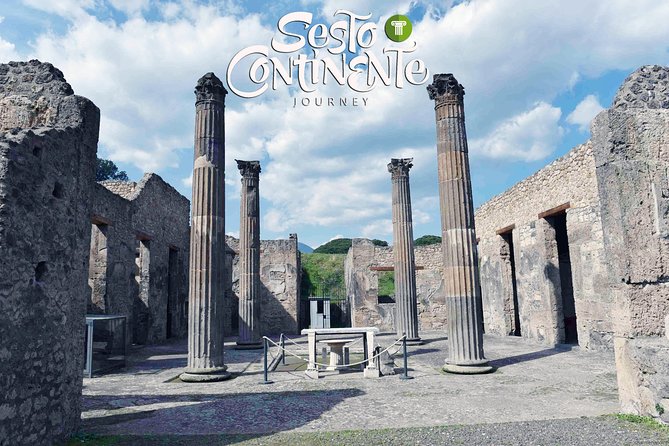
Once you arrive at the Pompeii Archaeological Park, you enter with the licensed multilingual guide. The time you spend right at the park entrance is brief, around 5 minutes, with your focus shifting quickly from logistics to landmarks.
One thing to plan for: Pompeii entry is not included, so you need to have the ticket sorted. The tour also notes a mobile ticket, which can make your arrival smoother once you have your documentation ready. If you are the type who hates standing in lines, this setup helps, because your visit starts with a guided push to key areas.
Also, with a half-day structure, pace matters. Each major stop is around 15 minutes. That is long enough to understand what you are seeing if you listen closely, but it is not long enough to do a slow walk and read every sign line-by-line. Think “smart highlights” rather than “every stone, every detail.”
The Forum of Pompeii: the city’s big crossroads
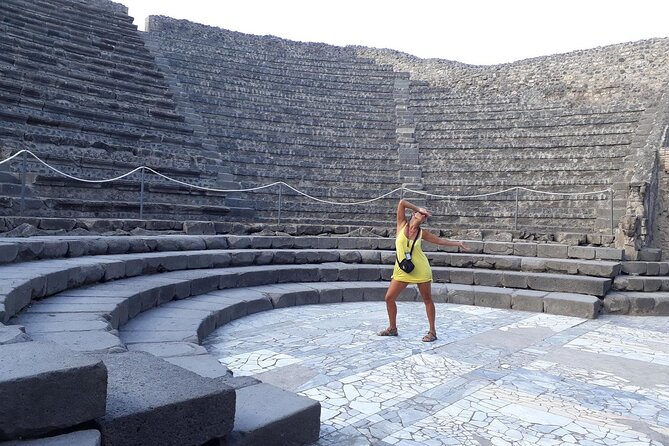
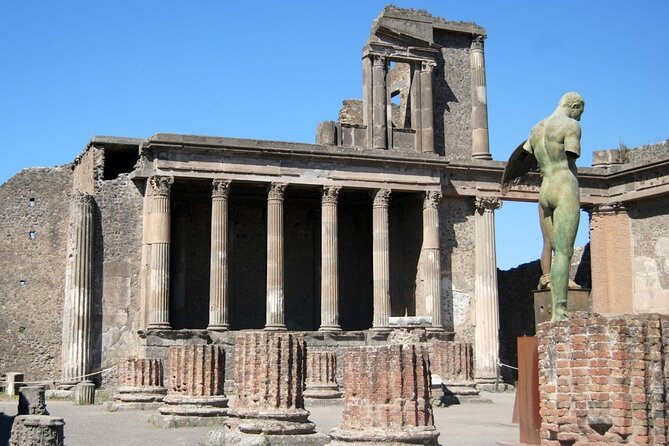
Your first major ruins stop is the Forum of Pompeii. This is not just a pretty square. It was the center where political life, religion, and commerce overlapped. If you want a quick mental model of Pompeii, start here.
The Forum is also a reminder of Pompeii’s scale and power. The stop description calls it one of the best preserved forums of ancient Italic cities. Even in a guided sprint, you can spot why it mattered: it is the main gathering space, not a side street.
A practical note: the Forum stop is labeled 15 minutes and entry here is free. You are still paying for your overall Pompeii access ticket, but you are not paying extra per structure. That is useful because it keeps the “cost per photo” low.
More Naples tours, ruins, coast days, and city experiences to compare





The Macellum market: everyday food and repair after disaster
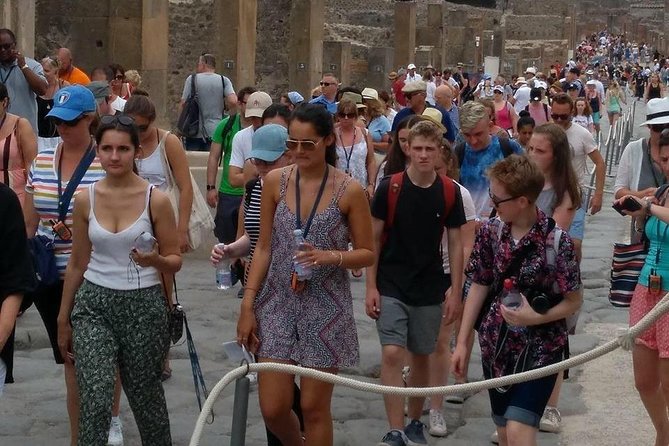
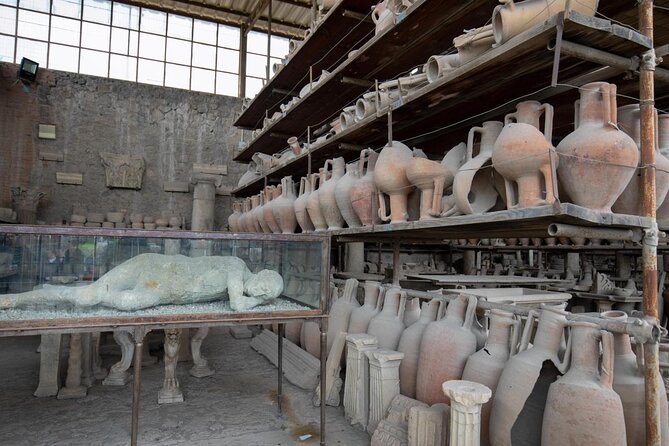
Right after the Forum comes the Macellum. This was Pompeii’s main provision market, essentially a place where food and daily supplies moved through the city.
What makes this stop especially meaningful is the story of rebuilding. The Macellum went through multiple phases. Then came the earthquake of 62 CE, which damaged large parts of Pompeii, including this market. Excavations show the building was still not fully repaired by the time the eruption hit in 79 CE.
That detail changes how you look at the ruins. You start seeing Pompeii as a living city in mid-recovery, not a museum frozen instantly. Even without going into deep academic explanation, this one point helps you connect the scale of destruction to the reality that people were trying to fix things before disaster arrived.
Casa del Fauno: luxury in the Roman Republic style
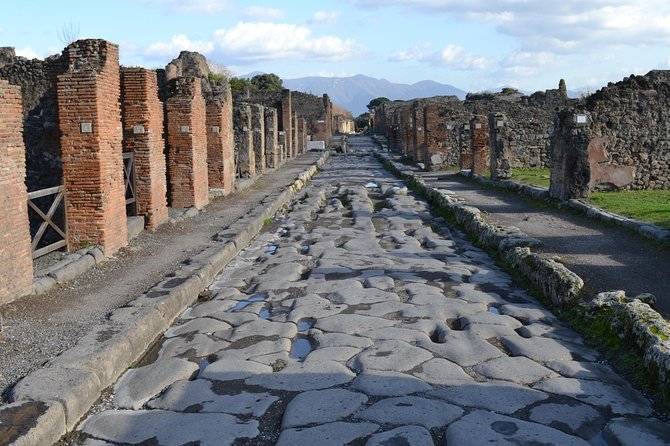
Next is the Casa del Fauno (House of the Faun), one of Pompeii’s standout private residences. The description notes it was built during the 2nd century BC and was among the largest and most impressive houses in Pompeii.
This is where the tour shifts from public city life to elite domestic life. The house is also connected to art, with the description calling out that it housed many major pieces of art. It is framed as one of the most luxurious aristocratic houses from the Roman Republic period, and it is presented as a strong reflection of that era better than most evidence from even Rome.
From a visitor standpoint, this stop can be a great balance if you are worried Pompeii will feel too repetitive. Markets, theaters, and public squares can blend together. A big house breaks that pattern and helps you understand the social layers of the city.
The Casa del Fauno stop is about 15 minutes, and it is listed with free admission for viewing. Again, you are not buying separate tickets, so you can stay focused on what you see.
Teatro Grande: performances that weren’t designed to disappear
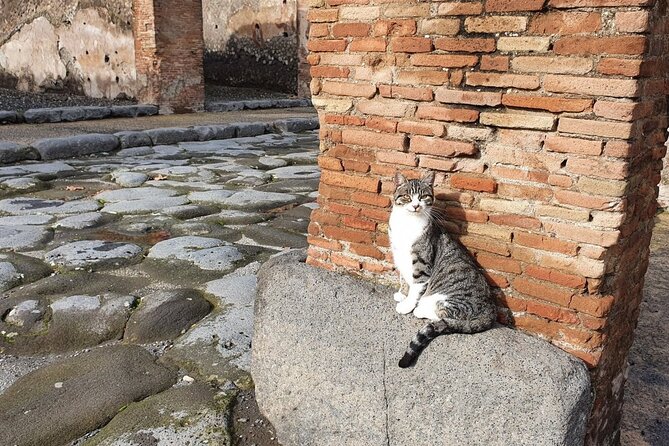
Then you head to the Teatro Grande, a Roman theater also buried by the eruption and later uncovered through excavation.
The stop description lists the kinds of performances staged there, including comedies, mimes, pantomimes, and the atellane. Even if you do not know Roman theater history, that range helps you picture the sound and motion of the place. This is not only a stone shell. It is a space designed for public entertainment.
A practical thing to remember: theaters can be visually confusing because you are looking at architecture rather than narrative scenes. A good guide helps you understand how the space likely worked and what the seating and stage areas meant. The tour’s overall design, with a licensed guide and short, targeted stops, is built for exactly that kind of orientation.
Via dell’Abbondanza: Pompeii’s main street for people-watching
Your final ruin stop is the Via dell’Abbondanza, the lower Decumanus. If you want one place where Pompeii feels most like a city street, this is the one.
The name comes from a bas-relief that adorns a fountain placed near the Forum. That small detail is useful because it tells you Pompeii is not only about big monuments. It is also about street-level decoration and references that made everyday space feel intentional.
This road connected major city nuclei between the Forum and Porta Sarno, and the stop description lists key neighbors along the way, including the Stabian Baths, the Theaters, the Temple of Isis, and the Amphitheater. The Via also functions like a guided sampler of Pompeii’s different zones, so even in a short visit, you get a sense of how everything links.
The tour notes that this route is the liveliest way through the excavations, with many of the most beautiful houses, some with two floors. It also calls out residences of wealthy Pompeian bourgeoisie, including houses such as Casa del Criptoportico, Casa dei Casti Amanti, Casa di Giulio Polibio, Casa di Loreius Tiburtinus, Casa della Venere in Conchiglia, and Villa di Giulia Felice.
If you want a single “walk away with a strong mental picture” memory, Via dell’Abbondanza is likely it. It is where the city starts to feel connected rather than chopped into separate exhibits.
Guide language and how to get the most out of the 15-minute stops
The tour includes an entrance accompanied by a licensed multilingual tourist guide, with language options listed as English and Italian. The experience is offered in English, so if English is your plan, you are set.
One review noted that French was not the default option, so if that matters to you, confirm before you go. With a timed route, you want to understand the guide’s explanations clearly, because the stops are short.
How to make it work on the day: pick one or two topics you care about, then listen for them at each stop. For example, you can focus on:
- what Pompeii was doing before the eruption (public life, markets, repairs after the 62 CE earthquake)
- how social status shows up in architecture (private luxury versus public buildings)
- how entertainment shaped public life (theater and performances)
That way, even with tight stop times, you leave with more than photos. You leave with connections.
Group size, pacing, and what you should expect from timing
With 25 travelers max, the tour can move quickly without feeling chaotic. Still, this is a half-day schedule, so it will feel structured. Each main stop is around 15 minutes, and the entrance is about 5 minutes, meaning you should be ready to keep moving.
Also remember this is sharing transport. Pickup time is a window, and the tour data openly notes that variables like traffic and delays can affect timing. In the same way, the operator assigns time limits to keep the day on track, and if they cannot reach a pickup location in time, they may change, cancel, or postpone activities if necessary. That is not meant to scare you. It is a realistic look at how shared logistics work.
My practical advice: arrive on time for pickup, and keep your day flexible. If you treat this as a planned city sprint, you will enjoy it more.
What to bring so Pompeii does not run the show
Pompeii in daylight can be harsh. The tour checklist is straightforward, and you should treat it like a minimum kit:
- hat
- water
- sunscreen
- camera
- wind protective clothing
Even if the weather looks mild at 9:00 am, you can still feel the sun over a few hours. Water is the simplest upgrade to comfort. And if you hate being distracted by bag mess, bring a small daypack so you can grab what you need during the route.
Who this Pompeii tour plus transfer is best for
This is a smart fit if you:
- want a guided Pompeii highlights route without organizing transportation
- are staying in the towns around Naples included in the pickup zone
- prefer structure, with short stops and clear explanations
- like the idea of mixing public ruins (Forum, theater) with private-life ruins (Casa del Fauno)
It may not be ideal if you:
- are staying in central Naples proper and do not want to add an extra train step to reach the pickup zone
- need a language other than English or Italian, because French is not presented as a standard option
- want a slow, self-paced wandering day where you can spend 30 to 60 minutes reading every sign
Final verdict: should you book it?
I’d book this Pompeii tour plus transfer if your priority is a well-run half-day with the logistics handled and a guide to connect the dots. The route hits the Forum, a market, a luxury house, a theater, and Via dell’Abbondanza, which gives you a balanced taste of both public and private Pompeii.
If you book, go in with one clear mindset: Pompeii highlights, not every corner. Budget the €22 Pompeii entry ticket separately, pack the sun-protection basics, and accept that sharing shuttles use pickup windows. Do that, and this becomes one of the easiest ways to see why Pompeii still feels alive, even after 79 AD.
FAQ
Is the Pompeii entrance ticket included in the tour price?
No. The Pompeii entrance ticket is not included and costs €22.00 per person.
What time does the tour start?
The listed start time is 9:00 am.
Where does pickup happen?
Pickup is available from many accommodations in towns such as Castellammare di Stabia, Torre Annunziata, Pompei, Scafati, Sant’Antonio Abate, Angri, S. Maria la Carità, Gragnano, Pimonte, Agerola, Vico Equense, Seiano, and Meta. The tour specifically notes no pickup from Naples.
How does pickup timing work?
Pickup is in sharing mode. The pickup time you see is the starting point, with a window of 30 minutes. You will be asked to be ready at the agreed time.
What language is the guide?
The tour includes a licensed multilingual tourist guide with English and Italian language options, and the experience is offered in English.
What should I bring for the day?
Bring a hat, water, sunscreen, a camera, and wind protective clothing.
More City Tours in Naples
More Tours in Naples




More Tour Reviews in Naples

Not for you? Here's more nearby things to do in Naples we have reviewed










Tour Reviews, compared.
 ★ 4.8Pompeii: Entry Ticket and Guided Tour with an ArchaeologistFrom $3519,459 reviews
 ★ 4.2Pompeii: Entry Ticket with Optional Audio GuideFrom $2612,360 reviews
 ★ 4.8Pompeii: Small Group Tour with an ArchaeologistFrom $4012,264 reviews
 ★ 4.3Pompeii Ruins & Mount Vesuvius Day TourFrom $12011,459 reviews
 ★ 4.6Sorrento, Positano and Amalfi Full-Day TourFrom $10710,988 reviews
 ★ 5.0Sorrento, Positano & Amalfi Coast – Small Group TourFrom $768,643 reviews
 ★ 4.6Catacombs of San Gennaro Entry Ticket & Guided TourFrom $157,941 reviews
★ 5.0Pompeii Small Group Tour with an ArchaeologistFrom $356,593 reviews
★ 4.6Catacombs of San Gennaro Entry Ticket & Guided TourFrom $157,941 reviews
★ 5.0Pompeii Small Group Tour with an ArchaeologistFrom $356,593 reviews
Browse the lists this tour appears in