
Tour review · TOUR REVIEWS
Secret Herculaneum: The Hidden Treasure of Ancient Roman Civilization
Herculaneum feels like time travel. This tour takes you through one of the best-preserved Roman cities from 79 AD, buried by Vesuvius, where you can still see streets, house interiors, and everyday details. It is UNESCO, and it is much more manageable than Pompeii, so you get real meaning in a short visit.
I especially like how the guide blends site-by-site archaeology with simple explanations, so you understand what you are looking at instead of just snapping photos. And I love that it is a small group experience, often capped at 10, which makes it easier to ask questions and hear the story clearly.
One drawback to plan for: the visit involves walking around an outdoor archaeological park and there can be stairs and uneven ground, so wear sturdy shoes and be ready for some level changes. If you have specific accessibility needs, report wheelchair requirements at least 24 hours ahead.
Key highlights worth planning for
- Archaeologist-guided route through the most informative parts of Herculaneum, with English commentary
- Small group size (max 10), which keeps the pace human and questions welcome
- Best-preserved city blocks: houses, rooms, doors, fresco colors, and civic spaces you can actually interpret
- Standout interiors and objects such as Casa dei Cervi (deer sculptures) and the Neptune and Amphitrite mosaic
- Salone della Barca di Ercolano: the charred boat pavilion, a rare “what survived” moment
- Free map tip: you can pick up a map at the park kiosk for better self-exploration after the tour
Herculaneum in 2 hours, without the overwhelm
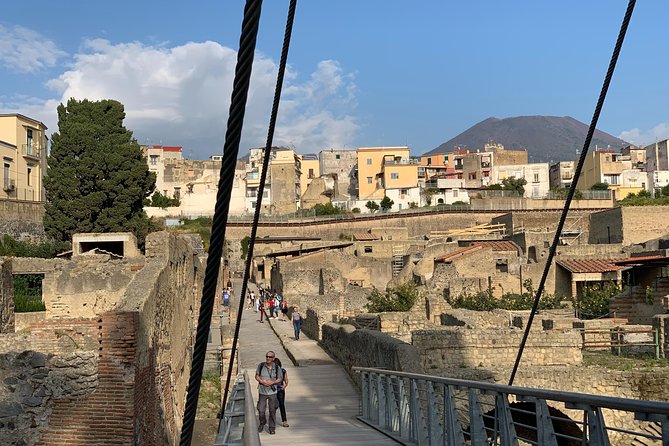
If you want Roman daily life, Herculaneum is a smart choice because it is compact and unusually intact. Pompeii is bigger, louder, and more spread out. Herculaneum is smaller, and the big selling point here is how much of the original urban layout still reads clearly, even down to doors, rooms, and street patterns.
The tour is about 2 hours, and the pace reflects that. You do not get stuck in one long stop. Instead, you move between key areas and let the guide connect the dots, so you leave with a mental map of how this town worked, where people gathered, and what wealthy households displayed.
Because everything is so close together, this works well as a “must-do” day activity even if you are also seeing Naples, Mt. Vesuvius, or taking the train in and out.
You can also read our reviews of more tours and experiences in Naples.

Price and value: what you pay, what you still need
The tour price is $34.84 per person. What that includes is the certified guide plus an archaeologist, and you receive a mobile ticket for the tour itself.
What is not included is the park entrance. Plan on paying €16.00 per person for the Archaeological Park of Herculaneum. So your real all-in cost is roughly the tour price plus that entrance fee.
Is it worth it? For many people, yes, because you are paying for interpretation. Herculaneum is preserved, but it is also full of details that are easy to overlook if you are walking alone. A good guide helps you notice what matters: the civic buildings, the housing layout, and the “why” behind the artifacts and artwork.
Meeting at the Ticket Office: how to start smoothly
You start and end at the Herculaneum Ticket Office (80056 Ercolano). The experience is near public transportation, which matters because the area is walk-based once you reach the site.
Here is a practical tip that came up in real-world experience: show up early and check in correctly before the start time. Small groups can still lose time if people arrive late, because the schedule is built around starting together and moving through the park efficiently.
Also, plan your morning or afternoon around footwear. Expect paved paths in places, but also stairs and steps when you move between structures and viewpoints.
Stop-by-stop: what you will see and why each part matters
Parco Acheologico di Ercolano: the city you can read
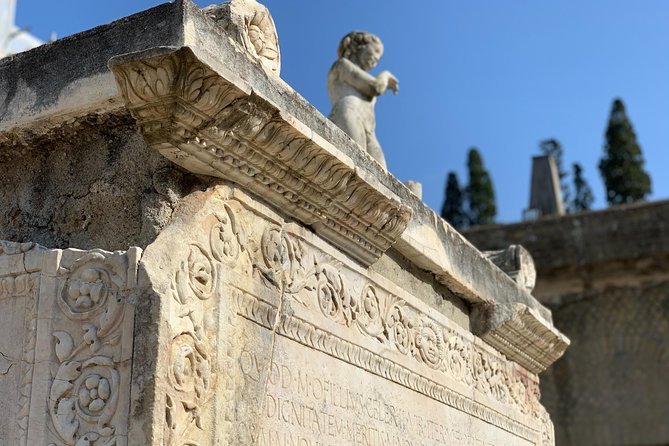
You begin at the main area of the Archaeological Park of Herculaneum, a UNESCO site and one of the best-preserved ancient cities in the world. The story starts with the eruption of Mount Vesuvius in 79 AD, when the town was buried, and it was only later excavated.
What makes this opening stop powerful is how much “city texture” you can still see:
- house interiors and room layout
- doors and thresholds that help you understand movement through spaces
- workshops and everyday objects
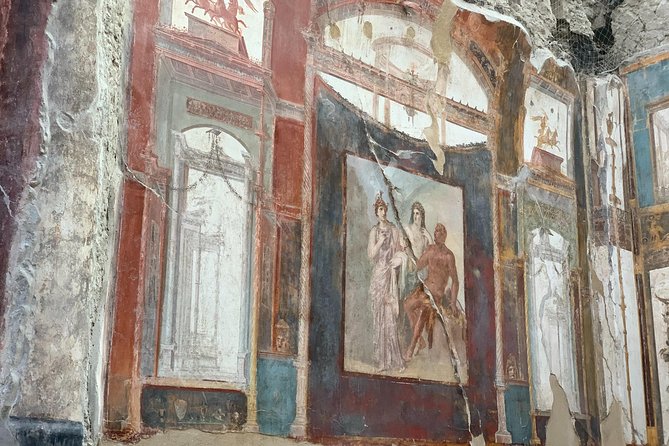
- frescoed walls with warm original colors that remain surprisingly legible
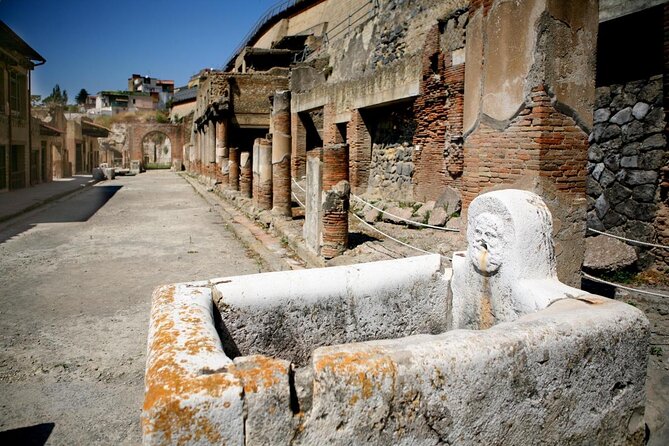
As you walk along the paved streets with the guide, you get a feeling for daily life that is hard to get from photos alone. Instead of viewing ruins as disconnected walls, you see them as a functional neighborhood.
A minor consideration: because the focus is interpretation, you may want to keep your phone put away for a few minutes at a time. The best understanding often comes when you pause and look at the exact surfaces and arrangements your guide points out.


The ancient waterfront: the beach that anchored a Roman town
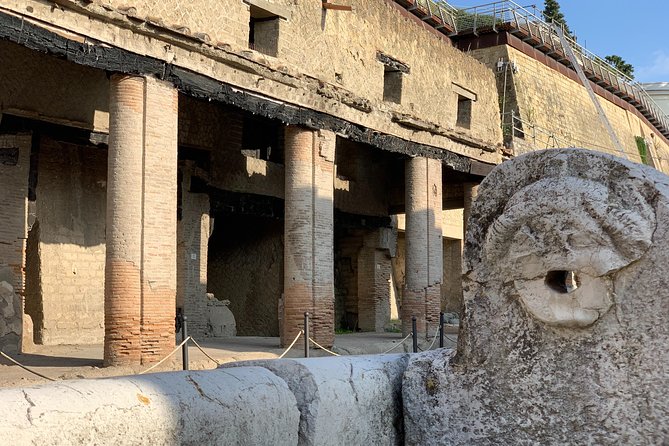
Next comes a short look at the ancient beach. This is described as the only waterfront of an almost entirely preserved Roman city, and it is a key emotional shift from “houses and streets” to “how people lived with the sea.”
Even if you already understand the Romans were big traders, standing near the shoreline idea helps you grasp why certain houses and civic features faced the water. It also sets up the next viewpoint stop, where status and landscape meet.
La Terrazza di M. Nonio Balbo: a sea-facing statement
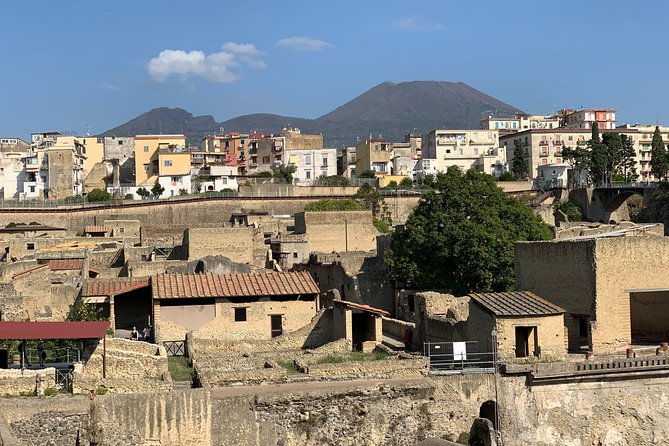
Then you head to La Terrazza di M. Nonio Balbo, a terrace connected to Marco Nonius Balbo, one of the city’s most prestigious citizens and patrons. The terrace offered a view over the sea as the town existed at the time.
This stop is short, but it helps you understand Roman social design. In many sites, “where you lived” was a kind of public identity. Here, the built environment visually rewards prominence.
If you like architecture, pay attention to how the terrace frames the horizon. It is a reminder that these ruins were not “inland mystery blocks.” They were part of an active coastal town.
Casa dei Cervi: why the deer sculptures still pull you in
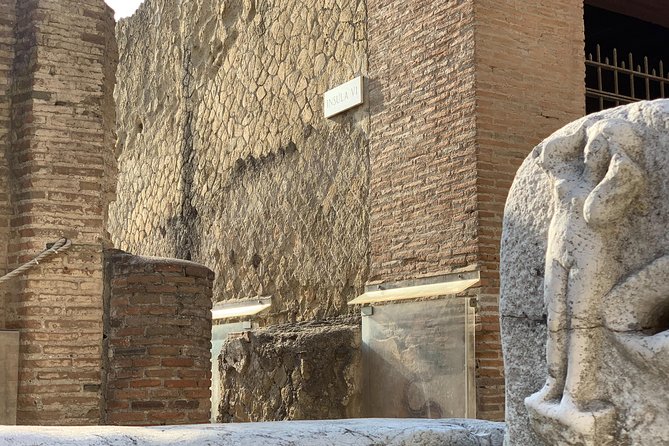
Casa dei Cervi, or the House of Deer, is one of the richer and finest residences found within the excavation area. It gets its name from two marble groups showing deer being attacked by dogs.
What I like about this stop is that it gives you a tangible symbol of wealth and taste. It is not just “a big house.” It is a house with a specific decorative theme that tells you how owners wanted guests and neighbors to experience their space.
A good guide also helps you connect the artwork with the broader household layout, so you understand where it would have been seen and how the interior spaces were used.
Partem Domus lignea, Casa del Tramezzo di Legno: the wooden partition story
Partem Domus lignea, also known as Casa del Tramezzo di Legno, is named for a folding wooden structure discovered in the house. The function was to separate the splendid atrium from the tablinum, basically the homeowner’s study.
This is the kind of detail that changes how you visualize Roman daily life. A partition implies controlled visibility. It suggests how privacy, formal reception, and work space were managed.
The drawback to keep in mind: the interest here is in structural clues. If you rush through without looking where the guide directs you, you might miss the point of the reconstruction. Slow down for this one, even if the stop feels brief.
Casa di Nettuno e Anfitrite: mosaic power in a merchant’s home
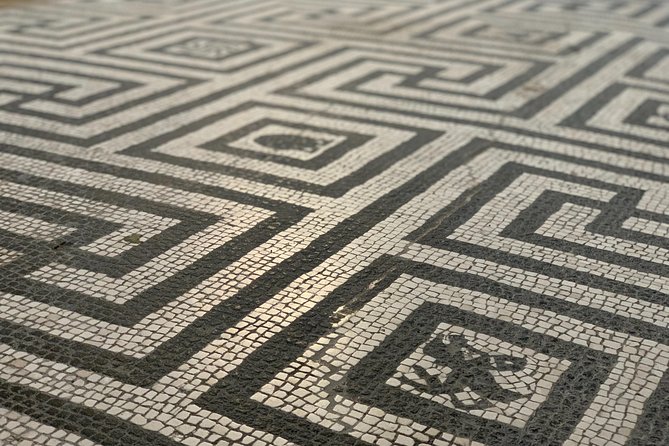
Then you see Casa di Nettuno e Anfitrite, a wealthy merchant’s home featuring a beautiful mosaic of Neptune and Amphitrite, the sea figure and her companion.
This mosaic matters for two reasons. First, it shows how elite taste could translate into visual storytelling. Second, it connects your earlier beach and terrace impressions to household culture. Even in a private home, the sea theme carries meaning.
If you are a fan of art, bring your attention here. Mosaics are easy to admire from one angle and forget to study. Let the guide show you how the figures are composed and why this artwork was a big deal in its setting.
Casa Sannitica and the oldest-dwelling perspective
Casa Sannitica is often described as one of the most popular remains in Herculaneum, and the reason is age. It is considered one of the oldest dwellings on the site.
What this does for your understanding is simple: it gives you a time-depth layer. Instead of thinking all of Herculaneum is frozen in the final moment, you can sense how places evolve over time, even before 79 AD.
This is also where the site’s compact layout becomes an advantage. You can compare eras without a long cross-town hike.
The decumanus maximus: the big street and why it mattered
You then walk through the decumanus maximus, the main street of Roman cities. In Herculaneum, it housed the most prestigious houses on its sides.
This is a key “how cities organize power” stop. Streets were not just roads. They were social stages. When you see the remains along the main street, you get a clearer picture of how status concentrated and how walking paths reinforced daily visibility.
If you like city planning, look at how the street aligns with surrounding structures. Your brain starts turning ruins into a working town grid.
College of the Augustales: emperor worship, local ritual
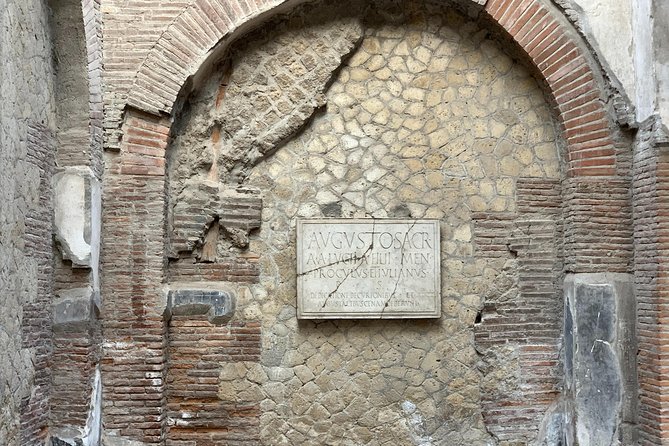
Next is the College of the Augustales. This sacellum is a building from Roman times used for rites of worship of emperors, tended by Augustal priests.
This part of the tour is valuable because it broadens your view beyond private homes and street life into public religious practice. You can walk through the remnants and understand that “religion” in this town was tied to the emperor and local community roles.
It also helps explain why Roman civic identity did not stop at politics. It lived in ritual spaces too.
Casa d’Argo: the hundred-eyed figure in a peristyle
At Casa d’Argo, you learn the home’s name comes from a now-disappeared fresco that decorated the peristyle, featuring Argo Panoptes, the giant with a hundred eyes.
This stop is less about a surviving masterpiece on the wall and more about how archaeologists identify meaning from what remains. Even the absence becomes informative. The lesson here is that restoration and interpretation are part of the archaeology, not an afterthought.
A practical tip: if you like myth and symbolism, keep your ears open on this one. The guide’s explanation is what makes the legend relevant to the building layout.
Salone della Barca di Ercolano: the charred boat pavilion
Finally, you reach the Salone della Barca di Ercolano, the boat pavilion. This is where a charred boat, found along the beach of Herculaneum during excavations in 1981, is preserved.
This is often a highlight because it is so immediate. You are not only looking at architecture. You are looking at an object that connects directly to daily movement, fishing, transport, or commerce.
You also leave with a stronger understanding of why Herculaneum is so extraordinary. The eruption did not just bury a city. It froze relationships between people, objects, and the sea long enough for archaeologists to recover them.
The guide matters: examples of what makes this tour work
The biggest praise in this kind of tour is not the ruins. It is the person in front of you. Names that show up in guiding experiences include Luigi, Ornella, Riccardo, Arcangelo, Raffaele, and Corrado.
Across these different guides, the consistent strengths are:
- clear explanations that make the features readable
- humor that keeps the tour from turning into a lecture
- archaeologist-level context that helps you understand the effects of the eruption, and how Roman life functioned before it
One caution from real experience: if you are sensitive to volume or have trouble hearing, choose to sit closer when you can, and do not be shy about asking the guide to repeat a point. Some guides can be a bit soft spoken, even when they are very good at what they do.
What to do after the tour: map and a quick bite nearby
Once you finish, you can use the park kiosk to your advantage. There is often a free map available at the entry kiosk, and it can help you return to areas you found especially interesting.
If you want food right after, there is a small restaurant across from the park entrance that has shown up as a solid, convenient stop, especially for meatballs. It is the kind of simple nearby meal that makes a day feel complete without turning it into another production.
Should you book Secret Herculaneum?
Book this tour if you want:
- a high-impact Roman experience in about 2 hours
- archaeologist-led interpretation so you understand what you are seeing
- a manageable site layout where you can learn without extreme walking
Skip it or consider an alternative if:
- you do not want any walking on steps and uneven ground
- you prefer self-guided ruins with minimal stopping
- you hate structured pacing and want to linger for long periods in one room
For most people, Secret Herculaneum is a smart value because you are paying for expertise, not just entry. Add the park entrance fee and you still get a compact route with memorable “wow” moments, especially the boat pavilion and the preserved house interiors.
More Tour Reviews in Naples
Not for you? Here's more nearby things to do in Naples we have reviewed







Tour Reviews, compared.
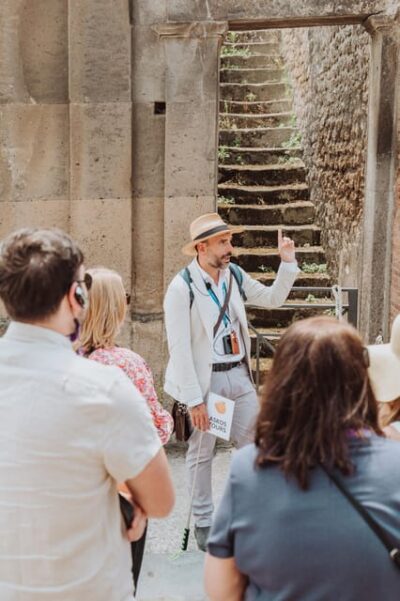 ★ 4.8Pompeii: Entry Ticket and Guided Tour with an ArchaeologistFrom $3519,459 reviews
 ★ 4.2Pompeii: Entry Ticket with Optional Audio GuideFrom $2612,360 reviews
 ★ 4.8Pompeii: Small Group Tour with an ArchaeologistFrom $4012,264 reviews
 ★ 4.3Pompeii Ruins & Mount Vesuvius Day TourFrom $12011,459 reviews
 ★ 4.6Sorrento, Positano and Amalfi Full-Day TourFrom $10710,988 reviews
 ★ 5.0Sorrento, Positano & Amalfi Coast – Small Group TourFrom $768,643 reviews
 ★ 4.6Catacombs of San Gennaro Entry Ticket & Guided TourFrom $157,941 reviews
★ 5.0Pompeii Small Group Tour with an ArchaeologistFrom $356,593 reviews
★ 4.6Catacombs of San Gennaro Entry Ticket & Guided TourFrom $157,941 reviews
★ 5.0Pompeii Small Group Tour with an ArchaeologistFrom $356,593 reviews
Browse the lists this tour appears in