
Tour review · TOUR REVIEWS
Sorrento, Positano and Amalfi Coast in One Day From Naples
One day, three cliff towns, nonstop wow. This fast, well-paced coast circuit from Naples strings together Sorrento, Positano, and Amalfi with live English commentary and comfort on the roads. You get big-picture views, plus enough time in each place to actually walk and look around.
I especially like two things: the calm opening in Meta, with its above-and-below character, and the way Sorrento centers on Piazza Tasso and Corso Italia before you finish at the port-viewpoint area. It’s the kind of route that helps you understand the coast instead of just speeding past it.
One possible drawback: it’s a long day with short stays, and Positano’s steep steps mean you should be ready for hills, not a flat promenade.
Key highlights worth planning around
- Meta starts the day quietly, perched over the Gulf of Naples, before the crowds build elsewhere.
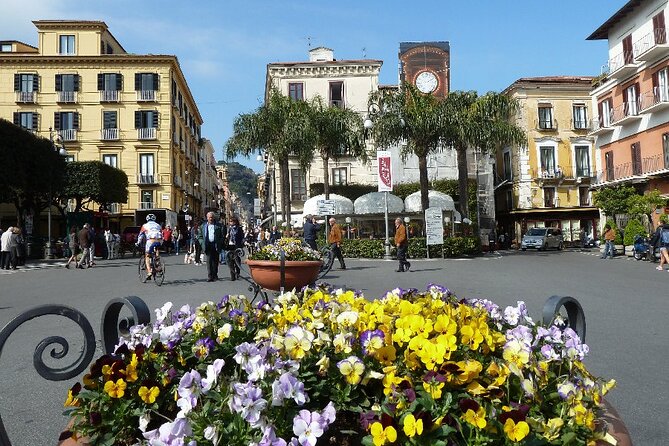
- Sorrento is built for walking, with Piazza Tasso, Corso Italia, and sea views from the Villa Comunale area.
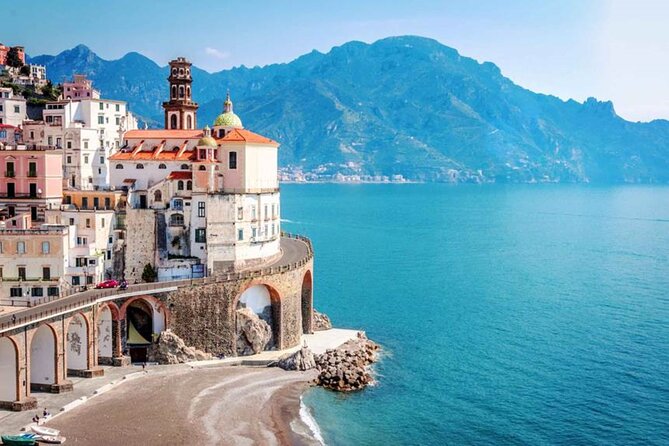
- Positano gives you the steep-town feel fast, with its rockside houses and stairway-to-beach setup.
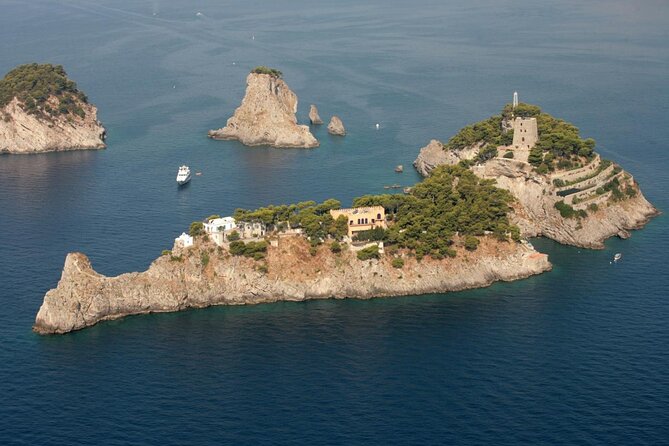
- Li Galli islets are part of the Positano picture, including Gallo Lungo and the neighboring named rocks.
- Furore adds UNESCO-style drama, a fjord-like valley look along the Amalfi Coast.
- Small group size with a cap of 19, plus an English live guide and air-conditioned comfort.
A one-day Amalfi Coast loop from Naples that actually fits
This is the kind of trip you take when you want the highlights without adding a hotel move. The timing is long, roughly 8 to 9 hours, but the route makes sense: you start on the Sorrento peninsula, then work your way along the Amalfi Coast toward Amalfi itself.
The practical win is transportation. You’re in an air-conditioned vehicle with private transportation and live commentary on board in English. That matters on this coastline, where the views are jaw-dropping, but the roads are also the point where you appreciate having someone else handling the driving.
The day is designed for seeing a lot, not lingering for hours in one town. If you love beaches and slow meals, you’ll need to accept quick stops. If you love views and street wandering, this format can feel perfect.
More Naples tours, ruins, coast days, and city experiences to compare


Meta: a quiet peninsula stop with Gulf-of-Naples views
Meta is a municipality on the Sorrento peninsula, sitting along the coast with a foothold in the mountains behind it. Even though the municipality isn’t divided by strict political borders, people commonly describe it as Meta above (trees and inner areas) and Meta below (the area facing the coast). It’s a small detail, but it helps you “read” what you see once you’re there.
You’ll also see how the place is shaped: Meta rises around 111 meters above sea level and includes coastal stretches plus mountainous terrain, including the hamlet of Alberi and part of the Lattari Mountains. Translation for your day: you get a viewpoint-feeling start without needing a full morning.
At the practical level, a short stop here works because it breaks up the momentum. Before you hit the busier postcard towns, Meta gives you a chance to breathe, look out toward the Gulf of Naples, and get oriented to how the peninsula sits above the sea.
Sorrento: Piazza Tasso, Corso Italia, and the port viewpoint at Villa Comunale
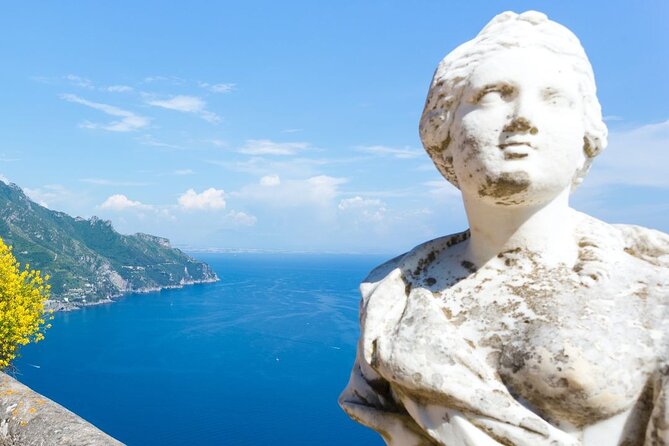
Sorrento is the classic anchor town of the peninsula, built on a terrace high above the water. It’s known for villas, hotels, parks and gardens, and citrus groves, but the way you’ll experience it is street-level and view-level.
Your time centers on Piazza Tasso and Corso Italia, with Corso Italia running toward the Duomo area. From there, you reach the sea through narrow streets packed with shops. The appeal here is simple: you don’t need a map to feel the place. You can just follow the street flow, glance into boutiques, and keep checking over your shoulder for sea views.
The strongest view is from the Villa Comunale area, which looks out over the port and the wider Gulf of Naples. With about 1 hour 30 minutes, aim to do a “walk and look” loop rather than try to cover everything. I’d prioritize:
- A quick wander from Piazza Tasso toward Corso Italia
- Then leaving yourself enough time at the Villa Comunale viewpoint area to enjoy the panorama
Also, there’s a good historical through-line you’ll hear in the commentary. The area takes its name from Sorrento territory, and you’ll get the broad sweep of Greek origins followed by Roman domination. You don’t need museum time to benefit from that context. It makes the streets feel like layers, not just scenery.
Positano’s steep stair towns and why 1 hour can still work
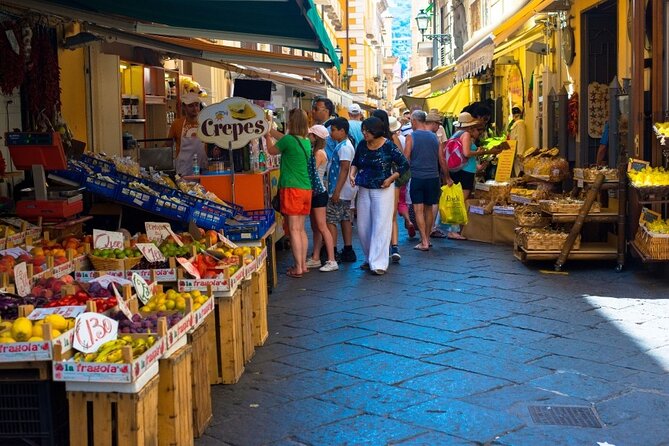
Positano is dramatic by design. Houses cluster on the rock, often shaped like blocks, stacked on steep steps that descend toward the beach. Alleys and long staircases connect it all, so even a short walk can feel like a miniature adventure.
The payoff is in the sudden visuals. If you’re arriving along the coastal road from Sorrento or Amalfi, you get panoramic views from above. If you’re seeing it from the sea approach, the effect is different and equally strong. The point is, Positano sells the coast from multiple angles, and the trip format lets you catch at least one of those “wow” moments.
Time-wise, the stop is about 1 hour. That’s not much, but it’s enough to do one smart loop:
- Pick one higher viewpoint direction and stay focused there
- Then work your way down a bit for streets and photo angles
- Avoid the trap of trying to “see everything,” because the stairs will steal time fast
You’ll also hear the Roman connection. Around the first century AD, Romans built maritime villas here, including Positano. The place’s name is linked to a villa connected to Posides Claudi Cesaris, a freedman of Emperor Claudius, which is associated with the older form Posidianum. When you know that, the town’s sea orientation stops feeling accidental.
A detail that adds texture to the Positano experience is what you see nearby: Li Galli islets. The largest is Gallo Lungo, shaped like an elongated island around 400 meters long with variable width, including a rough measurement around 100 meters near the center. Other named islets you may hear about include La Rotonda and Dei Briganti, and the area is associated with places like La Castelluccia. They’re covered with grass and shrubs, and the information also notes seasonal daffodils. It’s the kind of fact that makes the coastline feel alive, not just photographed.
Furore: UNESCO village drama in a fjord-like valley
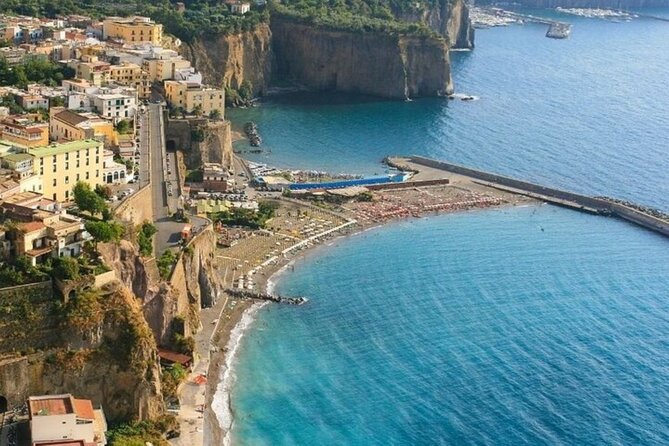
Right along the Amalfi Coast mood, Furore brings a different kind of spectacle. It’s described as one of the most picturesque villages on the coast and is listed as a UNESCO World Heritage Site. The headline feature is the fjord-like setting, but what makes it memorable is the way the town is “stitched” into the valley.
You’ll see the image: houses clinging to the slopes of the Lattari Mountains, wedged between overhanging rocks and vegetation that grows on rock walls. The text even frames it like a living nativity scene, which is a good mental cue for what you’re looking at, especially if you’re seeing it from a road viewpoint.
The info also points to Fiorduva, a wine associated with the area, noted as one of the more appreciated wines. You won’t need a wine detour for the stop to be worthwhile. The village setting does the work.
For your planning, treat Furore as a “pause and look” moment. It’s not about covering a checklist of attractions. It’s about getting your eyes recalibrated after the steep-town feel of Positano, and then linking that to the larger Amalfi Coast story.




Amalfi: legends, Roman remnants, and what time lets you do
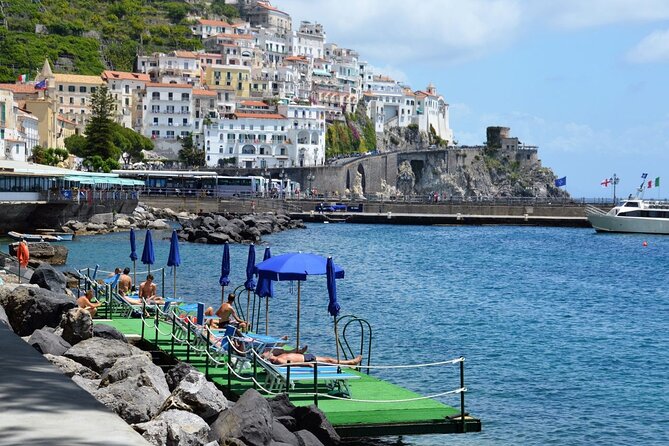
Amalfi has a myth-and-archaeology mix. The origins are described through legends of founding, but the common thread is Roman origin. You’ll hear about archaeological remains from the imperial age, including a nymphaeum tied to a villa likely built around the time of Emperor Tiberius.
Even the name has layers. The toponym “Amalfi” is said to be of Latin extraction, and one origin story connects it to Melfi, a Lucanian maritime village abandoned by Roman refugees in the 4th century AD. Another possibility mentioned is a Roman gens surname, Amarfia. Whether you remember every detail or not, it gives you a sense that Amalfi has been shaped by sea power and shifting populations.
With about 1 hour 30 minutes, I’d focus on two practical goals:
- Walk through the center area at a relaxed pace, letting the streets pull you
- Use viewpoint moments or open squares to orient yourself to where the sea sits relative to the town
This is also where the day’s rhythm matters. After Meta, Sorrento, and Positano, Amalfi can feel like the “settle in” stop, even if it’s still quick. The live commentary helps here by stitching together how each town’s geography affects its architecture and everyday life.
The roads and timing: comfort, views, and the driver factor
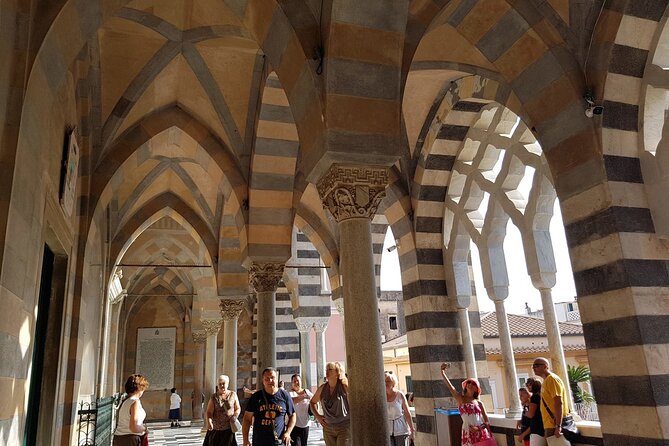
The Amalfi Coast is famous for views, but it’s also famous for roads that make you glad you’re not driving. This tour uses an air-conditioned vehicle and includes private transportation, which is exactly what you want when you’re traveling between cliff towns.
The commentary is live and in English, so you can listen without constantly checking your phone for context. And from the experience feedback tied to this operator, the driver Mario gets serious credit for handling the roads with skill, described as an incredible navigation job. That’s not a small thing. On a day like this, driver confidence translates into a smoother experience for you.
Timing is the trade-off. You’ll spend a portion of the day on the road, and there’s a built-in sense that the stops are meant to be seen, not conquered. If your goal is to photograph viewpoints and enjoy short walks, you’ll likely feel satisfied. If your goal is long beach lounging, you might feel rushed.
Price and what you get for $153.78 per person
At $153.78 per person, you’re paying for more than “a seat on a bus.” What’s included is practical:
- Air-conditioned vehicle
- Private transportation
- All fees and taxes
- Live commentary on board
And the day is organized around multiple towns, which is usually where day-trip costs add up. You’re also not handling entrance fees for the stops, since the schedule notes Admission Ticket Free for the points listed.
Not included is also important:
- Lunch
- Tips
So, for value, I think about it like this: you’re buying convenience, route coordination, and a guide who can explain what you’re seeing while you travel. You’re responsible for your own food, and you should budget for that plus tip money.
This can be a strong deal if you would otherwise pay for separate transport or miss out on the context a guide provides. It also helps that the group size is capped at 19 travelers, with a minimum requirement of 4 people.
Who this one-day coast trip suits best
This experience fits best if you:
- Want Sorrento, Positano, and Amalfi in one day from Naples
- Prefer guided route context over DIY navigation
- Are comfortable with short city walks and hills, especially in Positano
- Like the idea of mixing viewpoints with brief wandering, rather than long stays
It might not be the best match if you strongly prefer slow travel, require long time in just one town, or hate stair-heavy walking. Positano is beautiful, but it’s built vertically.
Should you book this Amalfi Coast one-day tour?
Yes, I’d consider booking if your priority is big coastal highlights with English live commentary and easy transport. The route makes sense geographically, and the mix of towns adds variety, from Meta’s calmer start to Sorrento’s pedestrian-friendly core, then Positano’s stair-town drama and Amalfi’s legend-and-ruins context.
I’d also book if you want a day plan that keeps you from stress-driving. You’re paying for coordination and comfort, not just for sights.
Before you go, plan for the reality of time and walking. Wear shoes with grip, expect hills and stairs, and bring your own lunch plan or a snack strategy since lunch is not included.
If that sounds like your kind of day, this is a smart way to do the Amalfi Coast without turning your trip into a logistical project.
FAQ
How long is the tour from Naples?
It runs about 8 to 9 hours.
What is the price per person?
The price is $153.78 per person.
Is the tour offered in English?
Yes, the live commentary on board is in English.
What’s included in the tour price?
It includes an air-conditioned vehicle, private transportation, all fees and taxes, and live commentary on board.
What is not included?
Lunch and tips are not included.
Are there admission tickets to pay at the stops?
The stops listed are marked as Admission Ticket Free.
What group size should I expect?
The tour requires at least 4 people and has a maximum of 19 travelers.
What happens if the weather is poor?
This tour requires good weather. If it’s canceled due to poor weather, you’ll be offered a different date or a full refund.
Can I cancel for free?
Yes. You can cancel up to 24 hours in advance for a full refund.
More 1-Day Tours in Naples



More Tour Reviews in Naples
Not for you? Here's more nearby things to do in Naples we have reviewed








Tour Reviews, compared.
 ★ 4.8Pompeii: Entry Ticket and Guided Tour with an ArchaeologistFrom $3519,459 reviews
 ★ 4.2Pompeii: Entry Ticket with Optional Audio GuideFrom $2612,360 reviews
 ★ 4.8Pompeii: Small Group Tour with an ArchaeologistFrom $4012,264 reviews
 ★ 4.3Pompeii Ruins & Mount Vesuvius Day TourFrom $12011,459 reviews
 ★ 4.6Sorrento, Positano and Amalfi Full-Day TourFrom $10710,988 reviews
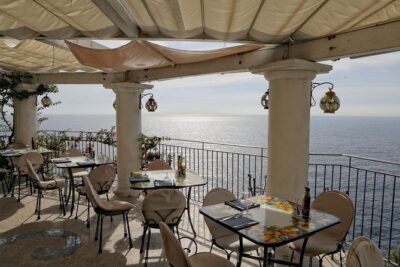 ★ 5.0Sorrento, Positano & Amalfi Coast – Small Group TourFrom $768,643 reviews
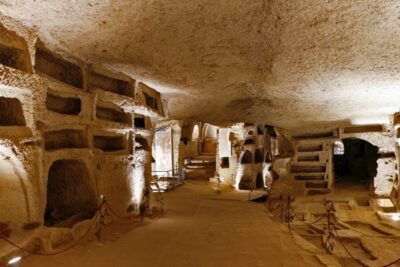 ★ 4.6Catacombs of San Gennaro Entry Ticket & Guided TourFrom $157,941 reviews
★ 5.0Pompeii Small Group Tour with an ArchaeologistFrom $356,593 reviews
★ 4.6Catacombs of San Gennaro Entry Ticket & Guided TourFrom $157,941 reviews
★ 5.0Pompeii Small Group Tour with an ArchaeologistFrom $356,593 reviews
Browse the lists this tour appears in