

Tour review · TOUR REVIEWS
Pompeii: Skip-the-Line Ticket and Virtual Museum
Pompeii can feel close, even before you arrive. This day pairs a skip-the-line entry to Pompeii with a reserved Virtual Museum experience that sets the scene before you walk the ruins. You spend your time in the heart of Campania, moving from Roman street-level details to an eruption finale.
I like two things a lot. First, the Virtual Museum helps you see how the Forum, baths, and amphitheater worked when they were whole, not just when they’re broken. Second, once you’re at Pompeii, you’re free to explore at your own pace across more than 50 hectares, from public fountains and aqueduct remnants to private houses, businesses, and statues.
One possible drawback is that this is not a guided day. The ticket gives entry and the Virtual Museum, but it does not include a guided tour or an audio guide, so you’ll need to be comfortable exploring independently. Also, the Virtual Museum experience can be hit or miss, with one past booking calling the presentation outdated.
Key things to know before you go
- Skip-the-line entry to Pompeii, so you can spend more of your limited time walking the site.
- Reserved Virtual Museum ticket to build context before you see Forum-level street scenes.
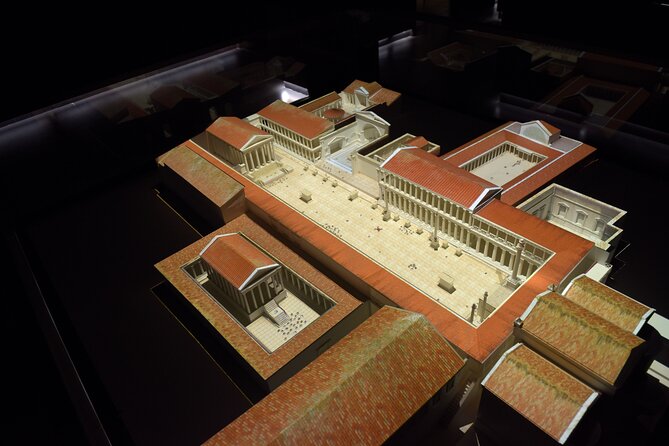
- Animated 3D reconstructions of major areas like the Forum, baths, and amphitheater.
- Self-paced Pompeii route across more than 50 hectares, including aqueduct and fountain remnants.
- Not included extras like a guided tour, audio guide, and Villa dei Misteri access.
Meeting at IBT Center next to Chalet Donna Lucia
This is a straightforward, one-stop meeting setup. Report to the office called IBT Center/Touristation, next to Chalet Donna Lucia. If you’re coming from Naples, Sorrento, or along the Amalfi Coast, double-check how you’ll reach the meeting point early, because you’re on a tight one-day schedule.
The day is designed around timing. You’ll have access to Pompeii via the skip-the-line ticket, and you’ll also have a reserved slot for the Virtual Museum. Because Pompeii is popular and entry windows can fill, this combination is what helps you avoid losing your day to queues.
One more practical note: you need an ID card or passport for all participants. Leave it in an easy-to-reach place, not at the bottom of your day bag.
More Naples tours, ruins, coast days, and city experiences to compare


Virtual Museum first: 3D Pompeii and the Vesuvius ending
The Virtual Archaeological Museum is the “prequel” part of the day. Instead of starting cold at Pompeii’s ruins, you get to watch animated reconstructions and multimedia video segments that recreate key parts of the city.
What you’re shown matters. The Virtual Museum focuses on the most important public spaces you’ll later recognize on foot, including:
- the Forum area (where you’ll see columns and doorways still hinting at daily city life),
- the public baths (with reconstructions that help explain how people used them),
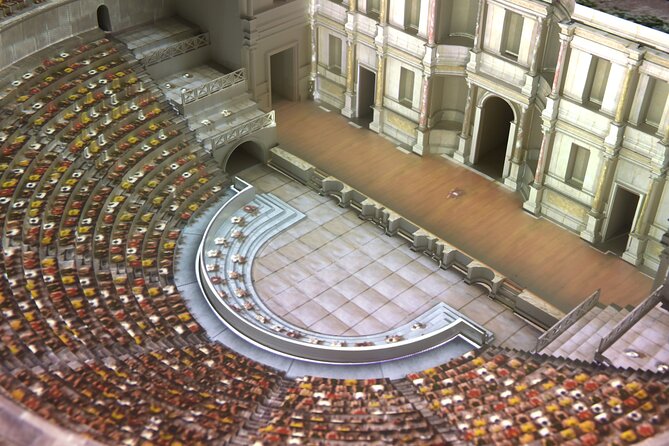
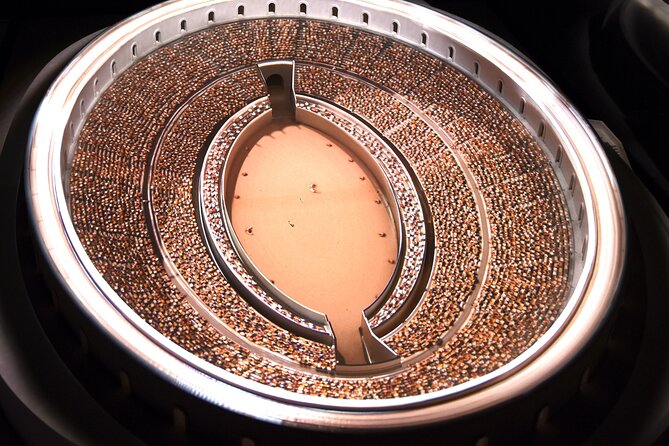
- the amphitheater and a dramatic theater setting (built for crowds and performances),
- and surviving traces like fresco remnants you can later spot in the houses and businesses.
Then comes the emotional closer. The Virtual Museum ends with the spectacle of Vesuvius erupting in 79 AD, the event that ended the city. If you’ve only ever seen Pompeii from photos, this eruption piece gives you an idea of how sudden and total that end was.
Now, the balanced view. The Virtual Museum has strong fans, especially for language support. One booking praised a Virtual Museum session in French right at the start of the excursion, and that helped them visualize Pompeii before walking the ruins. But there is also at least one complaint that the presentation felt outdated. So if multimedia is your top priority, keep expectations realistic: it’s a helpful primer, not a guarantee of perfect modern tech every time.
Pompeii on foot: Forum streets, aqueduct remnants, baths and homes
After the Virtual Museum set-up, you walk Pompeii for yourself. Your ticket covers entrance to the archaeological site, which spreads over more than 50 hectares. That’s a big footprint, so think of this day as a long stroll through layers of Roman daily life, not a quick highlights loop.
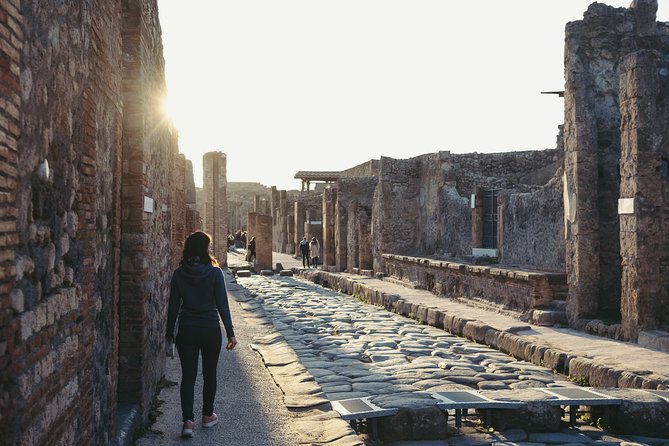
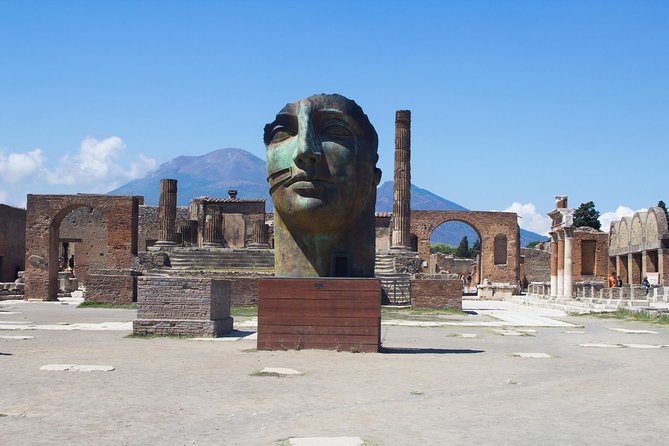
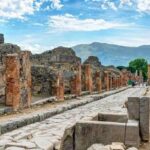
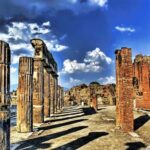
Start with the Forum area mindset. The Forum is the center of civic activity, and Pompeii still gives you enough structural cues to imagine what once filled the space. You’ll see remnants of columns and doorways, and with Mount Vesuvius in the background, you get a clear sense of where the city sits and how the landscape would have shaped daily routines.
From there, you wander streets and side areas where the city’s infrastructure shows up in small but powerful ways:
- remnants of the aqueduct,
- street fountains,
- public areas tied to daily movement.
Then you move into the human-scale Pompeii zones. You’ll encounter traces of:
- public baths,
- private houses,
- businesses and workshops,
- and statues that help bring the streets back to life.
A major reason Pompeii works so well as an on-site experience is that so many buildings are still “readable.” The city layout is preserved enough that you can connect what you watched in the Virtual Museum to what you’re seeing in stone and plaster fragments.
One caution: because this experience is self-paced, it’s easy to spend too long in the first few areas and feel rushed later. I suggest deciding early what you care most about, then using the rest of the day to fill in gaps.
Amphitheater and theater: where crowds gathered
Pompeii is famous for its public entertainment, and this ticket includes the chance to connect what you see with what you learned in the Virtual Museum.
The amphitheater area is a standout. Even in ruin form, it communicates volume and crowd energy. The seating geometry and the way the space channels people helps you understand why spectators would have filled it.
You’ll also see remnants tied to a dramatic theater setting. This is one of those “now you get it” moments. Without context, amphitheaters and theaters can blend together. With the Virtual Museum reconstructions first, you’re more likely to notice how the spaces would have functioned during performances.
And don’t ignore the visual detail you can still find in Pompeii’s surviving traces, including colored fresco remnants in houses and business areas. These fragments can feel small, but they’re exactly what stops Pompeii from becoming just a pile of old stones. They’re evidence of taste, wealth, and daily aesthetic choices.
Price and value: $60 for entry plus Virtual Museum
At $60 per person, this is priced for travelers who want two specific benefits: reduced waiting and a context-building prelude.
Here’s what that cost is doing for you:
- You’re getting skip-the-line entry to Pompeii, which is huge when crowds are heavy.
- You’re also getting a reserved ticket for the Virtual Museum, meaning you’re not forced to gamble on timing.
What you are not paying for is equally important. This experience does not include a guided tour or an audio guide, and it also does not include Villa dei Misteri entry. Food and drinks aren’t included either, and transportation isn’t included, so your day still requires planning for meals and getting yourself to the meeting point.
Is it good value? If you’re happy to explore on your own and you want a “learn first, walk second” flow, yes. If you want a knowledgeable guide narrating the site in real time, you may feel like you’re doing extra work with interpretation.


Practical tips so your one day doesn’t get messy
This is a simple product, but Pompeii days can go sideways if you ignore small rules.
Bring: your passport or ID card.
No-luggage rule: luggage or large bags are not allowed. If you’re traveling light, you’re already ahead.
Food and drinks: not included, so plan what you’ll eat before you’re hungry and tired.
No pets, no smoking, no alcohol or drugs: follow the rules to avoid delays.
Pets: regular pets are not allowed. Small dogs are permitted inside the archaeological area, but they must be kept on a leash and carried when inside buildings. If you’re bringing a dog, plan for frequent pick-up moments.
Also note that the activity is listed as non-refundable, so only book if you’re confident your timing works.
One small perk: you receive a city map and Wi-Fi. That matters because Pompeii is easier when you can quickly check where you are and choose what to see next.
Who this Pompeii ticket suits best
This is a strong fit if you’re:
- traveling independently and comfortable exploring without a guide,
- the kind of person who likes context before you hit major sights,
- short on time and want to maximize the day with skip-the-line entry,
- interested in public spaces and city life, not just a single monument.
It may be less ideal if you want an interpretation-heavy experience led by a human guide, or if multimedia content is your main reason for booking. In that case, you might feel the day moves at your pace in a way that leaves you guessing when you want answers.
If you’re visiting Pompeii for the first time, the Virtual Museum approach is especially useful. The reconstructions and 3D segments help you recognize what matters, so the ruins feel less like random fragments.
Should you book this Pompeii plus Virtual Museum ticket?
If you want a day that goes: understand the city first, then see it with your feet, this is a good way to do it. The skip-the-line ticket is the big practical win, and the Virtual Museum adds the missing layer of how major spaces would have looked and worked.
I’d book it when:
- you’re short on time and want to avoid waiting,
- you’re okay with a self-paced visit,
- and you like learning in a modern format before you walk the site.
I’d hesitate when:
- you strongly prefer an on-the-ground guide and live commentary,
- you’re sensitive to multimedia quality and tech consistency,
- or you’re planning to add extras like Villa dei Misteri, since it is not included.
If you decide to book, the best move is simple: go in with a plan for what you want to see most, then use the Virtual Museum as your compass.
FAQ
How long is the Pompeii visit?
The duration is listed as 1 day. Starting times depend on availability, so check the available slots before you pick one.
Where do I meet for the tour?
Meet at the office called IBT Center/Touristation, next to Chalet Donna Lucia.
What is included in the ticket?
You get a skip-the-line ticket for the Pompeii archaeological site, a reserved ticket for the Virtual Museum, a city map, and Wi-Fi.
Is there a guided tour or audio guide included?
No. A guided tour and an audio guide are not included.
Is Villa dei Misteri included?
No. Entrance to Villa dei Misteri is not included.
What do I need to bring?
You need a passport or ID card. ID is required for all participants.
Are pets allowed?
Pets are not allowed. Small dogs are permitted inside the archaeological area only if they are on a leash and carried when inside buildings.
More Tickets in Pompeii Archaeological Site


More Tour Reviews in Pompeii Archaeological Site

Not for you? Here's more nearby things to do in Pompeii Archaeological Site we have reviewed





Tour Reviews, compared.
 ★ 4.8Pompeii: Entry Ticket and Guided Tour with an ArchaeologistFrom $3519,459 reviews
 ★ 4.2Pompeii: Entry Ticket with Optional Audio GuideFrom $2612,360 reviews
 ★ 4.8Pompeii: Small Group Tour with an ArchaeologistFrom $4012,264 reviews
 ★ 4.3Pompeii Ruins & Mount Vesuvius Day TourFrom $12011,459 reviews
 ★ 4.6Sorrento, Positano and Amalfi Full-Day TourFrom $10710,988 reviews
 ★ 5.0Sorrento, Positano & Amalfi Coast – Small Group TourFrom $768,643 reviews
 ★ 4.6Catacombs of San Gennaro Entry Ticket & Guided TourFrom $157,941 reviews
★ 5.0Pompeii Small Group Tour with an ArchaeologistFrom $356,593 reviews
★ 4.6Catacombs of San Gennaro Entry Ticket & Guided TourFrom $157,941 reviews
★ 5.0Pompeii Small Group Tour with an ArchaeologistFrom $356,593 reviews
Browse the lists this tour appears in