
Tour review · TOUR REVIEWS
Pompeii private tour with expert guide in archaeology
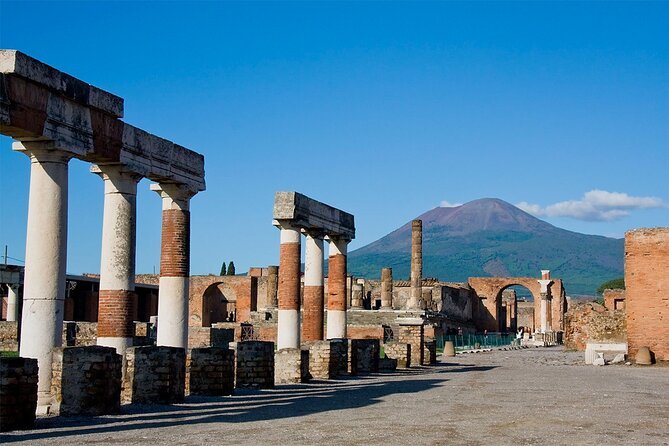
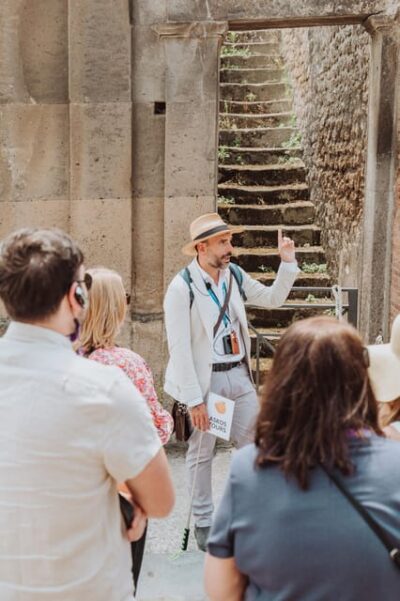
Pompeii makes more sense with a guide. I like how this private setup turns scattered ruins into a clear walk through daily life, explained by an archaeologist. You start at the Pompeii Archaeological Park and hit the big public areas plus the places that show how people actually lived.
Two highlights I really value are the gladiator training area and the Forum, because they anchor the story in power, entertainment, and civic life. One drawback to consider is that the tour is about 2 hours and the park entrance ticket is not included, so you’ll need to budget separately for admission.
Key points at a glance

- Expert guide archaeologist focused on how Pompeii worked day to day, not just what you’re looking at
- Private group up to 8 so you can move at a pace that fits your interests
- Gladiators, theater, baths, and the Forum packed into one efficient 2 hours
- Red light district stops with erotic frescoes explained in context, not just shock value
- Patrician Domus with frescoes and mosaics showing how wealth looked inside homes
- Plaster casts of the eruption victims included before you wrap at the Forum
Pompeii feels like a puzzle until someone translates it

Pompeii is one of those places where the stones look dramatic, but your brain can still feel slightly lost. Streets branch off, buildings sit open, and everything is frozen mid-event. That’s exactly why I think a private archaeologist guide is such strong value here.
This tour is designed for understanding. The guide is an expert in archaeology and Pompeii specifically, so you’re not stuck just reading signs. You get a guided story of everyday life from around 2,000 years ago, moving through the city’s main public spaces and then into the areas that reveal how people socialized, worked, relaxed, and showed status.
You can also read our reviews of more guided tours in Pompeii

Price and what you really pay for
The price is $302.34 per group, up to 8 people, for about 2 hours. If you split it across a full group, it can feel very reasonable for a private, archaeologist-led experience. If it’s just two or three of you, it’s still a solid choice, but you’ll feel the cost more.
Two cost details matter for your planning:
- The Archaeological Park entrance fee is not included. Admission is €19.00 per booking.
- Pick-up and drop-off by minivan is also not included, though you can book it separately through Pompeigrandtour.
So the value question becomes simple: do you want Pompeii explained by an archaeologist in a private format? If yes, this is priced in a way that can work for small families, groups of friends, or couples who hate wandering without direction.
Meeting at Coffee Shop Vittoria, then straight into the park
You meet at Coffee Shop Vittoria, Via Mare, 80045 Pompei NA, Italy. The tour ends back at the same meeting point, with the guided visit ending at the Forum. After that, you can choose to keep exploring on your own or return to the exits with the guide.
This structure is practical. You get a guided route through the most meaningful parts of the ancient city, then you’re not locked into every single stop. If you want more time in one area, you have the flexibility to stay longer where your interests landed.
The tour is offered in English, and it’s a private group, so only your party participates.
Stop 1: Pompeii Archaeological Park, where daily life comes into focus
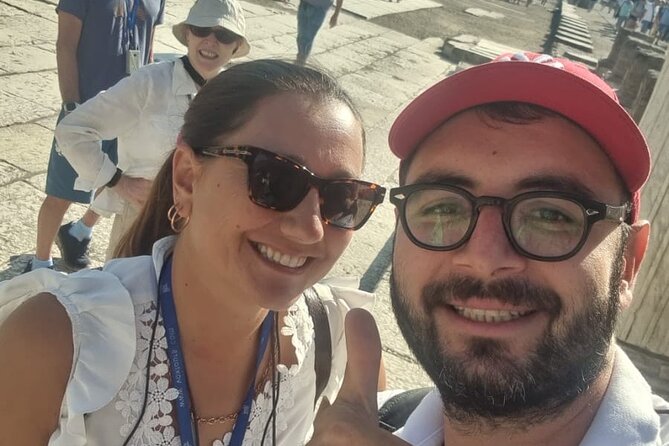
The tour begins at Pompeii Archaeological Park with your expert guide. Think of this as your orientation and story framework. The guide’s job is to help you connect what you see to what people did there. That might sound abstract, but it changes everything once you start moving.
You’re not just looking at ruins. You’re walking through a sequence of places that made Pompeii function:
- training and entertainment venues
- social and street-level commerce
- public bathing culture
- the Forum, the center of public life
- homes that show wealth through decoration
And crucially, you also visit the plaster casts of victims preserved in time during the Vesuvius eruption, so the story doesn’t stay only in entertainment mode.
Gladiators and the training school, entertainment with real stakes

One of the first stops is the school and training place of gladiators. This is a great early anchor because gladiators were a major public spectacle in Roman cities. When you understand the training space and its purpose, the whole idea of staged combat becomes clearer, not just a headline.
In a place like Pompeii, it’s easy to miss the meaning of a space if you don’t know what to ask. With an archaeologist guiding you, the gladiator area is treated like evidence of daily routines and social priorities, not a dramatic ruin for photos.
Practical consideration: you’ll likely be moving through uneven archaeological surfaces. The tour is listed as moderate physical fitness, so if walking long distances on uneven ground is an issue for you, plan accordingly.
You can also read our reviews of more private tours in Pompeii


Theater time, how public culture shaped the city
Next you visit the theater. This stop complements the gladiator area nicely. Gladiators were big, but so was staged performance and public gatherings. With a guide, you’re able to place the theater in the broader pattern of how Pompeii hosted crowds and events.
I like that this tour doesn’t treat buildings as isolated. The theater works better when it’s linked to the city’s social rhythm, and the archaeologist guide helps you connect the dots as you move.
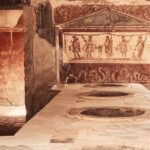
Main streets with taverns and shops, the city at sidewalk level
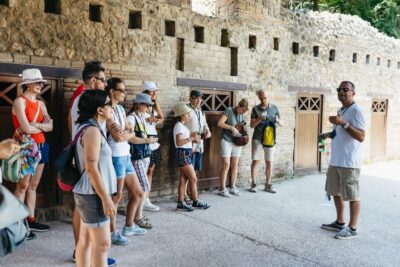
Then you move along the main streets with ancient taverns and shops. This is where the experience becomes more human. Public buildings are impressive, but street life is what makes a city feel real.
Guided context helps you interpret what these spaces likely meant day to day. Instead of just seeing doorways and platforms, you’re considering commerce, casual meeting spots, and daily routines that would have filled these streets.
If you’re the type who gets excited by everyday details, this segment is a strong reason to choose a guided tour rather than self-paced wandering.
The Baths and a 2,000-year-old spa culture

You also visit the Baths, described as a 2,000-years-old spa. Baths mattered in Roman life. They were about hygiene, social time, and routine, all rolled into one.
A guide adds value here because bathing spaces can look repetitive from a distance. In a guided format, you’re better able to understand how the layout served people, and why the baths weren’t a minor feature of Pompeii. They were part of how people lived.
If you want the city’s rhythm, this is a key stop. It slows the story down from spectacle to routine, which makes everything you’ve already seen feel more complete.
The red light district and famous erotic frescoes
One of the most talked-about areas is the red light district with famous erotic frescoes. This stop can make people uneasy if they only expect a polite museum visit. But with an archaeologist guide, you’re guided through it with context, not just shock.
What I like about including this area is that it pushes beyond the obvious highlights. Pompeii wasn’t only monumental architecture and public performances. It also included private life and taboo subjects, visible through frescoes that show what people found meaningful and acceptable to depict.
Consideration: if you prefer your ruins purely educational and very formal, this erotic fresco segment may feel more personal and intense than other stops. For many people, that contrast is exactly why Pompeii feels so real.
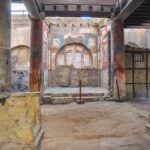
A patrician Domus, mosaics and frescoes that signal status
You then visit a house of rich Roman patricians (Domus), focusing on frescoes and mosaics. This is where wealth becomes visible in art and interior decoration.
A guided approach matters because you’re not just looking at decoration. You’re learning how elite homes expressed identity. When someone explains what you’re seeing, mosaics and painted walls become evidence of social structure, taste, and daily living inside a different class of home.
If you love architecture, art details, or just want a break from outdoor ruins, this segment is a well-placed change of pace.
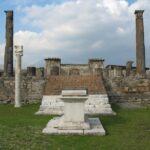
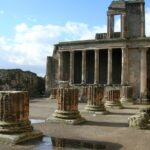
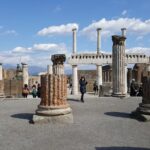
The Forum: social life, temples, and the city’s main market
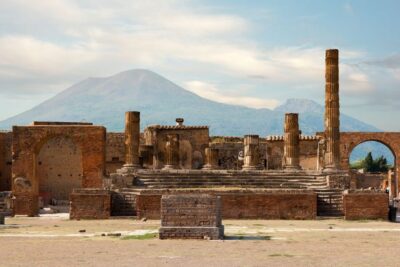
The tour ends at the Forum, which is described as the center of social life, with key buildings, plus temples places of worship and the main market of the city.
The Forum is the right place to end because it ties together everything you’ve seen. Street life feeds into public routines. Entertainment and public venues lead back to civic space. Wealth and homes reflect back on how people interacted in shared areas.
Two parts of the Forum experience stand out for me as most important:
1) You get a guided understanding of how the Forum worked as a social hub.
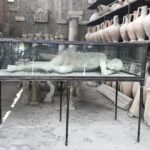
2) You also see the plaster casts of the victims crystallized at the time of the Vesuvius eruption.
That eruption-stop is heavy, and it should be. Pompeii isn’t only about what was impressive. It’s also about what was lost, and these casts make the tragedy immediate. A guide helps you handle the emotional impact without turning it into trivia.
After the guide, keep exploring or head back out
Once the guided tour ends at the Forum, you can decide what to do next. The plan is flexible: you can continue the visit yourself, or return to the exits with the guide.
This matters because Pompeii rewards choice. Some people want to linger in areas that sparked curiosity, while others want to wrap the visit cleanly and not rush the final stretch. Either way, you get a guided base layer that makes self-paced exploring much easier.
Logistics that matter in a private Pompeii tour
This is a private tour, so it’s just your group. That means you get fewer interruptions and a smoother rhythm. It also helps if your group has mixed interests, because the guide can adjust what you spend time on within the set route.
Language is English, and the tour is listed as suitable for people with moderate physical fitness. Service animals are allowed. It’s also described as near public transportation, which can help if you are not booking minivan pick-up.
One more point: the tour is commonly booked about 32 days in advance. That tells me demand is real, so if your dates are fixed, you’ll want to lock it in early.
Who this Pompeii experience is best for
This tour fits best if you want:
- Expert archaeology guidance through the most meaningful parts of Pompeii, not a random walk
- A tight 2-hour route that still includes big contrast points, gladiators, baths, erotic frescoes, and elite homes
- A private format for up to 8 people, which can be good value when shared
- A guided approach to the serious moments, especially the plaster casts of Vesuvius victims
It’s also a good match if you’re with kids or a group that needs structure, as long as everyone is comfortable with moderate walking on uneven archaeological ground.
If you prefer total freedom and don’t want any curated route at all, you could do Pompeii on your own. But if you want the ruins to click into place, this is the cleaner route.
Should you book this private archaeologist Pompeii tour?
I think you should book it if your main goal is understanding. Pompeii is famous, but it still needs a translator. This tour’s strength is the way it links sites into a single story of daily life, ending in the Forum where public life, worship, commerce, and the Vesuvius tragedy converge.
Book it especially if your group includes at least a few people. With a group price and a private archaeologist guide, the math gets friendlier when you’re closer to the up to 8 capacity, and you still get the benefits of a private pace.
If you want a very long Pompeii day, this might feel short. It’s about 2 hours, and it ends at the Forum, so you’ll likely want to continue on your own afterward if you want extra time in specific areas.
FAQ
How long is the Pompeii private tour with an expert archaeologist?
It lasts about 2 hours.
Is the Pompeii entrance ticket included in the tour price?
No. The entrance fee to the Archaeological Park of Pompeii is €19.00 per booking.
What is the price, and how many people can be in the group?
The price is $302.34 per group for up to 8 people.
Is pick-up and drop-off included?
Pick-up and drop-off by minivan is not included. You can book minivan service separately through Pompeigrandtour if you want.
Where do we meet for the tour?
You meet at Coffee Shop Vittoria, Via Mare, 80045 Pompei NA, Italy.
What does the guided route cover inside Pompeii?
It includes the gladiators training area, the theater, main streets with taverns and shops, the Baths, the red light district with erotic frescoes, a rich patrician Domus with frescoes and mosaics, and the Forum area including temples and the main market, plus plaster casts of Vesuvius victims.
What happens after the guide ends the tour at the Forum?
The guided tour ends at the Forum. You can continue exploring on your own or return to the exits with the guide.
What is the cancellation policy?
You can cancel for a full refund up to 24 hours before the experience start time.
More Guided Tours in Pompeii



More Tours in Pompeii

More Tour Reviews in Pompeii
Not for you? Here's more nearby things to do in Pompeii we have reviewed





Tour Reviews, compared.
 ★ 4.8Pompeii: Entry Ticket and Guided Tour with an ArchaeologistFrom $3519,459 reviews
 ★ 4.2Pompeii: Entry Ticket with Optional Audio GuideFrom $2612,360 reviews
 ★ 4.8Pompeii: Small Group Tour with an ArchaeologistFrom $4012,264 reviews
 ★ 4.3Pompeii Ruins & Mount Vesuvius Day TourFrom $12011,459 reviews
 ★ 4.6Sorrento, Positano and Amalfi Full-Day TourFrom $10710,988 reviews
 ★ 5.0Sorrento, Positano & Amalfi Coast – Small Group TourFrom $768,643 reviews
 ★ 4.6Catacombs of San Gennaro Entry Ticket & Guided TourFrom $157,941 reviews
★ 5.0Pompeii Small Group Tour with an ArchaeologistFrom $356,593 reviews
★ 4.6Catacombs of San Gennaro Entry Ticket & Guided TourFrom $157,941 reviews
★ 5.0Pompeii Small Group Tour with an ArchaeologistFrom $356,593 reviews