
Tour review · TOUR REVIEWS
Pompeii Private Tour with an Archaeologist and Skip The Line – 3 hours
Pompeii reads like a story here. This private archaeologist-led walk in Pompeii is built to save your time and point your eyes at the details that matter, from Odeon to the Forum. Guides like Eliana Sandretti (and others such as Luisa and Amadeo) also use everyday scenes, so the ruins feel less like random stones and more like 79 AD streets.
I especially love two things. First, the stop-by-stop pacing works well for a place this large, with brief, targeted time at each highlight instead of aimless wandering. Second, the guides are flexible, so you can steer the conversation toward architecture, daily life, or the eruption story while still seeing the core sights.
One consideration: you will walk a lot on uneven ground, with stairs and potentially slippery surfaces. Bring grippy shoes and plan for sun and heat, especially if you’re sensitive to long outdoor stretches.
Key takeaways before you go
- Private, archaeologist-guided pacing keeps you from losing time in the maze.
- A route that hits major landmarks fast, from theaters to baths to the Forum.
- Focused town-life stops (markets, street food, laundry) help Pompeii feel real.
- Skip-the-line help is request-based, so handle ticket steps before your tour.
- A strong guide makes the difference, including help with mobility needs when needed.
Pompeii made practical with a private archaeologist
Pompeii is one of those places where going solo can feel like looking at a city map with no key. You see walls and arches, sure, but you might miss why the buildings are placed where they are, or how people actually moved through their day.
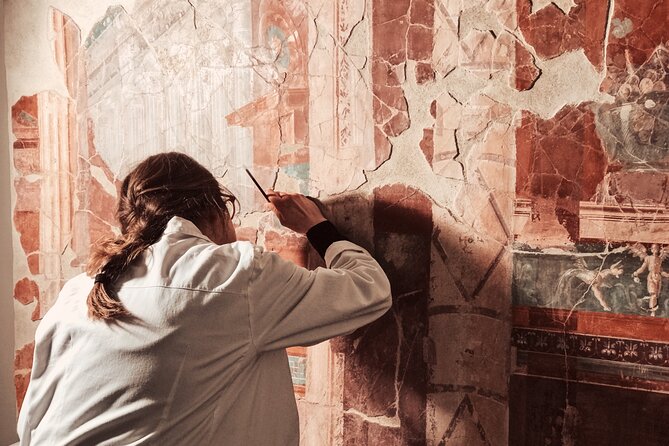
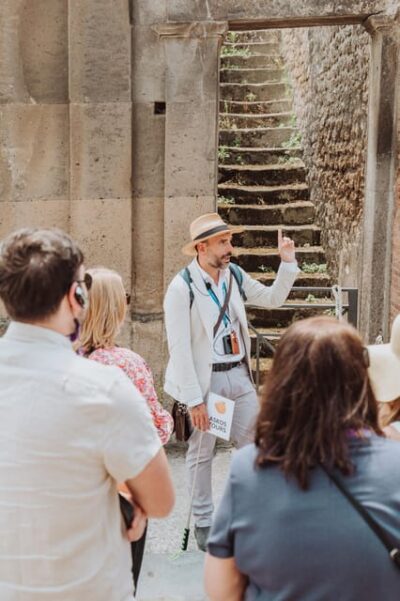
That’s where a specialized archaeologist guide matters. In a short 3 hours, they guide your attention to the right scale, textures, and layout cues. You also get instant context, like how a theater area ties into the surrounding neighborhoods, or how the Forum area functioned as a civic and legal hub.
And since it’s private, you’re not stuck waiting for the slowest person in the group or rushing to keep up. The tour structure gives you momentum, and the guide’s explanations fill in the blanks.
You can also read our reviews of more private tours in Pompeii

Starting at Porta Marina: how the route stays efficient
Your tour begins at Hortus Pompei, Restaurant & Garden Bar at Piazza Porta Marina Superiore (Via Villa dei Misteri, Piazza Esedra, 1 area). It’s a useful starting point because the route is set up to flow across the site rather than bouncing all over.
The plan generally runs from Porta Marina Superiore to Porta Marina Inferiore, which means you get a sense of Pompeii as a connected city. You’re not constantly backtracking, and you spend your time at sites you can actually orient yourself around.
A big win here is pacing. Many stops are short, like 5 to 10 minutes, but they’re timed so you still get to see the “signature view” and then move on. This is exactly what you want in Pompeii, where one “extra long” pause can turn your whole day into a sprint.
Odeon to Teatro Grande: the theaters that changed the mood
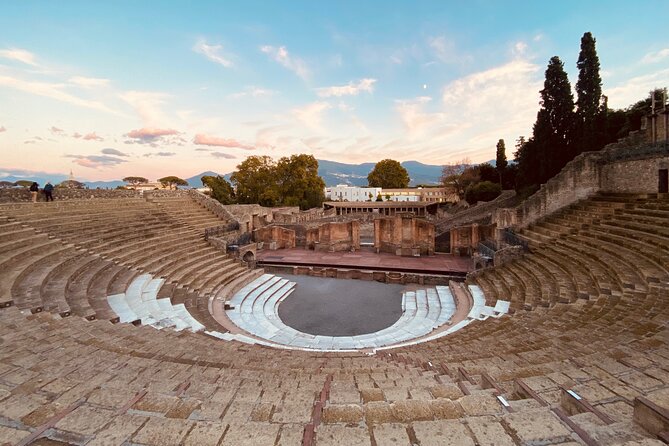
The route quickly introduces you to Pompeii’s entertainment venues, starting with the Odeon (small theater) and then moving to the Teatro Grande (large theater).
Even if you’re not a theater person, these spots are a smart anchor for understanding Pompeii. The theaters show you how public culture worked, where crowds gathered, and how architecture guided movement and sight lines. The small theater is quick but valuable, and the large theater gives you the bigger picture.
What to watch for:
- How the spaces are shaped for viewing and acoustics
- The relationship between the theater areas and nearby streets
Drawback to consider: theaters involve open-air walking and steps. If you go in the hottest part of the day, this is where you’ll feel it, so water breaks matter.
The main street feel: from civic life to daily commerce
After the theaters, you move into the heart-of-city experience: Pompeii’s main street. This is one of those moments where you can start seeing Pompeii as a lived-in place instead of isolated monuments.
From there, the tour includes stops tied to daily routines and practical infrastructure, including:
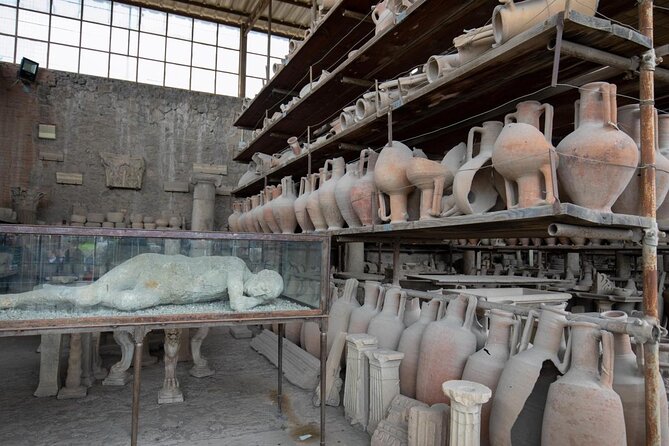
- Granai del Foro, an archaeological deposit connected with storage in the Forum area
- Macellum, the meat and fish market
- Edificio di Eumachia, tied to the wool trade
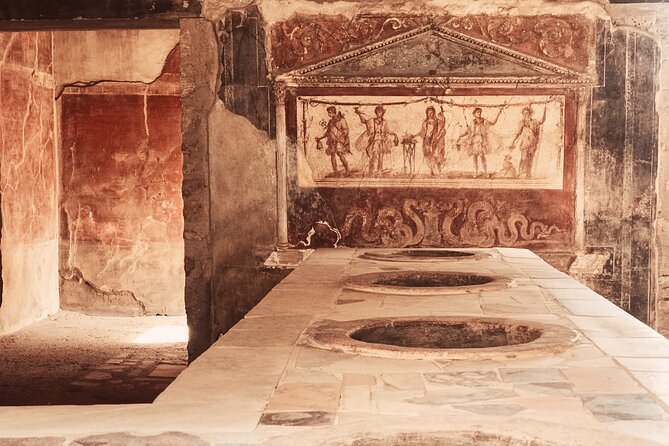
- Termopolio di Vetuzio Placido, a take-away food spot
- Fullonica di Stephanus, a laundry area
These are some of the most memorable parts of Pompeii for me because they answer a question most people don’t ask until they’re there: what did ordinary people do all day?
Practical note: markets and food-related spots are where you’ll want to slow down and let the guide explain the layout. Even brief stops can make the difference between seeing “ruins” and understanding how a system functioned.
Baths and the Forum: where public routine met authority
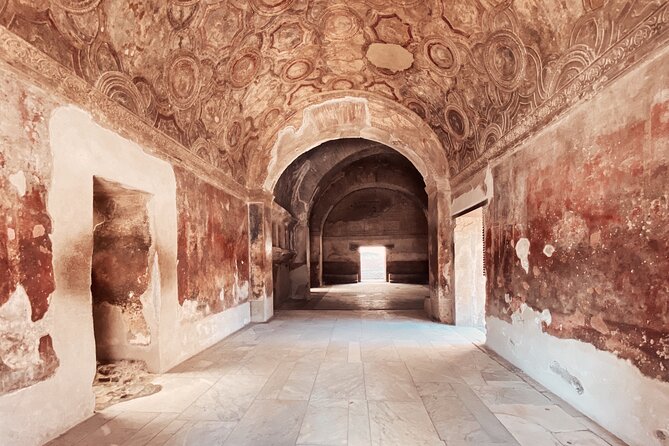
Next up, you get a major Roman lifestyle building block: the Stabian Baths (Terme Stabiane). You’ll spend around 15 minutes here, and it’s time well used. Baths weren’t just for hygiene. They were social space, exercise space, and a place to talk, gossip, and return to normal life after work.
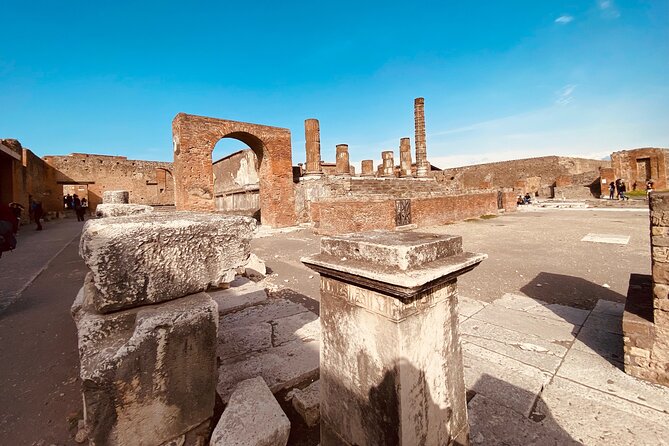
Then the tour moves into the Forum area, including:
- Foro di Pompei
- The Basilica court of justice (a civic and legal setting)
This is Pompeii at its most “systems-level.” The Forum shows you civic order, while the court space adds the legal and administrative layer. If you’re trying to understand why the city is organized the way it is, this cluster helps a lot.
What I like about this part of the route is the contrast. Baths are human-scale routine. The Forum is political and public authority. When you see both back-to-back, Pompeii becomes easier to read.
More Naples tours, ruins, coast days, and city experiences to compare


Temples, gladiators, and the Lupanar: the social edges of Pompeii
This is where Pompeii stops being neutral and turns into real human complexity.
You’ll see the Temple of Jupiter and the Temple of Venus during the walk. Temples help explain belief and public symbolism, but they also mark the city’s social geography.
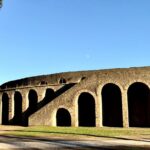
Then comes a particularly vivid stop: the area near the quadriporticus of the theaters, tied to the idea of gladiators’ barracks. It’s a short stop, but it changes how you picture the entertainment world. Instead of thinking only about the performance, you start thinking about preparation, training, and the people who lived in that orbit.
Finally, you visit the Lupanar, Pompeii’s brothel area. The time here is brief, but it’s an important part of the story because it shows that Roman cities included commerce, services, and harsh realities alongside public monuments.
A consideration: if this topic makes you uncomfortable, you can still appreciate it historically. Just set expectations that Pompeii does not sanitize its past.
Houses and mosaics: where art meets daily space
The tour saves some of its most “wow” moments for the homes.
You’ll stop at Casa del Poeta Tragico, where you can spot the famous Cave Canem mosaic. Even when you only spend a few minutes there, the image lands because it’s direct and playful, a small sign of personality in a place destroyed by disaster.
Later, you’ll move to Casa del Menandro, known for frescoes and mosaics. This stop is longer, around 20 minutes, and it gives you enough time to understand that Pompeii’s homes were decorated, lived in, and built with taste, pride, and social meaning.
If you’re the type who likes details, this is where the guide can make you feel like you’re reading the house like a book. Look for how decoration and layout reflect status and routine.
Tickets, skip-the-line, and the part people get wrong
Here’s the key logistics piece. The experience includes help for entrance steps and skip-the-line on request in advance, with a note that there’s a link for buying entrance tickets in advance.
At the same time, the Pompeii entrance fee for adults is listed as 19 euros per person, and it’s shown as not included. There’s also mention that skip-the-line works when handled through the right ticket process.
So what should you do?
- Treat ticket prep as part of your plan, not an afterthought.
- If skip-the-line matters to you, make sure your request is sent in advance.
- Double-check what is covered in your booking versus what you personally pay for park entry.
I’m calling this out because Pompeii is one of the most common places where a small misunderstanding turns into a delay. The guides can help you navigate the site, but the ticket step is your responsibility.
What the price gets you in a 3-hour private format
The cost is listed at $302.32 per group for a 3-hour private tour. That sounds steep if you compare it to a basic public walking tour.
But in this format, your money is buying:
- A specialized archaeologist guide
- A private route that keeps you moving toward the most important highlights
- Time saved versus building a DIY plan
- A chance to ask questions without feeling like you’re holding up a busier group
The biggest value question is how many people are in your booking. Pricing is shown as “up to 1,” but private tours in practice can involve small groups. If your party is more than one person, the cost per person drops quickly.
If you’re traveling solo and still want the experience, you should go in with the mindset that you’re paying for a tailored, high-efficiency tour, not just a walking guide.
Who this tour is best for
This Pompeii private tour makes the most sense if you:
- Want focused time in a huge archaeological park
- Like archaeology and want context tied to daily life, not just famous monuments
- Prefer not to navigate on your own
- Want a guide who can adapt to interests, and can help with pacing when needed
I’d also recommend it if you’re short on time. Pompeii deserves more than a quick visit, but a 3-hour private structure helps you get a “first read” of the city that makes a later return easier.
Should you book this Pompeii private tour?
If you want a Pompeii visit that feels organized, story-driven, and efficient, I think this is a strong choice. The route hits the anchors, then layers in markets, baths, civic spaces, mosaics, and houses so you leave with a sense of how people actually lived.
Book it if:
- You care about a guide who can explain architecture and everyday life
- You want help with skip-the-line steps
- You’re okay walking on uneven ground for a few hours
Consider skipping it if:
- You want a flexible, open-ended self-guided day
- You hate logistical planning around tickets
One more thing to keep in mind: the experience requires good weather. If conditions don’t cooperate, you’ll be offered a different date or a full refund.
FAQ
How long is the private Pompeii archaeologist tour?
It’s about 3 hours.
Is this tour private?
Yes, it’s a private tour/activity with only your group participating.
What language is the tour offered in?
The tour is offered in English.
Where does the tour start and end?
It starts at Hortus Pompei, Restaurant & Garden Bar (at Piazza Porta Marina Superiore) and ends back at the same meeting point.
Does the tour include Pompeii entrance tickets?
The adult entrance fee for Pompeii is listed as 19 euros per person, and entrance fees are shown as not included in the tour price. The experience includes guidance for entrance tickets and skip-the-line on request in advance.
Are meals or drinks included?
No, meals and food and drinks are not included.
Is skip-the-line included automatically?
Skip-the-line is available but only on request in advance.
What is the cancellation policy?
You can cancel up to 24 hours in advance for a full refund.
What if weather is bad?
The experience requires good weather. If it’s canceled due to poor weather, you’ll be offered a different date or a full refund.
More Private Tours in Pompeii



More Tours in Pompeii


More Tour Reviews in Pompeii

Not for you? Here's more nearby things to do in Pompeii we have reviewed







Tour Reviews, compared.
 ★ 4.8Pompeii: Entry Ticket and Guided Tour with an ArchaeologistFrom $3519,459 reviews
 ★ 4.2Pompeii: Entry Ticket with Optional Audio GuideFrom $2612,360 reviews
 ★ 4.8Pompeii: Small Group Tour with an ArchaeologistFrom $4012,264 reviews
 ★ 4.3Pompeii Ruins & Mount Vesuvius Day TourFrom $12011,459 reviews
 ★ 4.6Sorrento, Positano and Amalfi Full-Day TourFrom $10710,988 reviews
 ★ 5.0Sorrento, Positano & Amalfi Coast – Small Group TourFrom $768,643 reviews
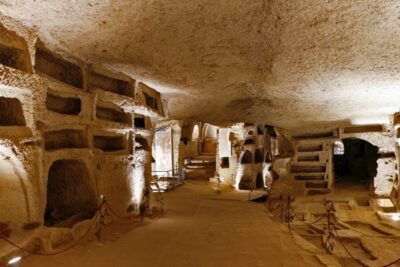 ★ 4.6Catacombs of San Gennaro Entry Ticket & Guided TourFrom $157,941 reviews
★ 5.0Pompeii Small Group Tour with an ArchaeologistFrom $356,593 reviews
★ 4.6Catacombs of San Gennaro Entry Ticket & Guided TourFrom $157,941 reviews
★ 5.0Pompeii Small Group Tour with an ArchaeologistFrom $356,593 reviews
Browse the lists this tour appears in