
Tour review · TOUR REVIEWS
Small Group Guided Walking Tour of Ancient Pompeii Highlights
Pompeii is powerful, even in a short walk. What makes this tour work is the skip-the-line access plus a tightly planned route that hits the big ruins without turning your day into a queue simulator. I like the small group size, which makes it easier to hear your guide, ask questions, and keep moving at a human pace. The main catch is simple, be on time. You need to show up at the meeting point about 10 minutes early because the entrance tickets are booked for a specific time, and the guide won’t wait.
Over roughly 2 hours, you cover five must-see stops, including major theaters and a Roman bath complex buried by the 79 AD eruption of Vesuvius. You get a professional guide and entrance tickets, plus a mobile ticket, so you can focus on walking ancient streets and actually understanding what you’re looking at. One more consideration: this is a guided tour, not a free pass into the ruins. Your confirmation is for walking with the guide using the scheduled entry.
Key things to know before you go
- Skip-the-line entry is guaranteed, so you spend more time inside and less time waiting outside.
- Max group size is 18, which usually means better attention and smoother pacing.
- You’ll walk the original ancient streets, so comfortable shoes are not optional.
- Your tour ticket is guidance-only, not a standalone ticket you can use to wander on your own without the guide.
- Radio audio is used (small ear piece), which helps you follow along without shouting across the group.
- It ends back at the meeting point, so you can easily plan gelato, snacks, or extra exploring right after.
Why a small-group Pompeii walk beats doing it alone
Pompeii is not one of those places where you can wing it and feel smart five minutes later. The ruins are spread out, and without context you can end up seeing stones, not a city. This tour solves that with a focused route and a guide who explains what matters at each stop, not a nonstop lecture.
With a group capped at 18, you’re not constantly stuck behind strangers or trying to see over hats. The pacing also stays realistic for a short visit. You still get a feel for daily life, from public performances in the theaters to bathing in Roman complexes, then into more private spaces like the Lupanar.
If you’re traveling with teens, this is the kind of schedule that tends to hold attention. The stops are short, the information is tied to what you’re seeing in front of you, and the group stays small enough for real questions.
You can also read our reviews of more walking tours in Pompeii


Meeting point, mobile ticket, and the 10-minute rule
The tour starts at Coffee Shop Vittoria Via Mare, 80045 Pompei NA, Italy. It ends back at the same meeting point, which is convenient if you want to add on extra time afterward.
Bring your confirmation details from booking. You’ll receive confirmation at the time of booking, and the tour uses a mobile ticket. The practical part: show up early. You’re told to arrive 10 minutes before the starting time, and the guide will not wait if your group is late. Entrance tickets are booked for a set time, so late arrivals can mean losing your entry slot.
One more detail that matters: this is not a ticket to the ruins by itself. It’s a guided tour confirmation that you can use only with the guide. If you want to roam independently before the tour begins or skip out early, you’ll likely need separate entry arrangements.
The 2-hour route that actually covers Pompeii’s highlights
This is a guided walking tour of Pompeii’s most important and recognizable sites, mapped into five timed stops. Total time is about 2 hours, and each stop is designed to give you context without dragging on in the heat.
The route includes admission tickets at each stop, so you are not hunting for separate entry. It also includes guaranteed skip-the-line access, which is a huge value add when lines can eat hours.
Here’s what that looks like stop-by-stop, and what you should watch for as you move through.
Stop 1: entering UNESCO Pompeii with a guided orientation

Your first stop is at Private Tours of Pompeii, and it’s tied to visiting Pompeii as a UNESCO World Heritage site. You get about 30 minutes here, with admission included.
I like this start because it helps you get your bearings fast. Pompeii can feel like a maze of walls and doorways at first glance. Early on, your guide sets up what you’re about to see and why it survived. They help you connect the ruins you’re about to walk past to real Roman life.
Practical tip: use this time to ask any big-picture questions. Once you start moving toward the theaters and baths, you’ll get more out of the details if you already understand the city layout and the eruption context.
Stop 2: Teatro Grande, a 5,000-seat stage for Roman drama
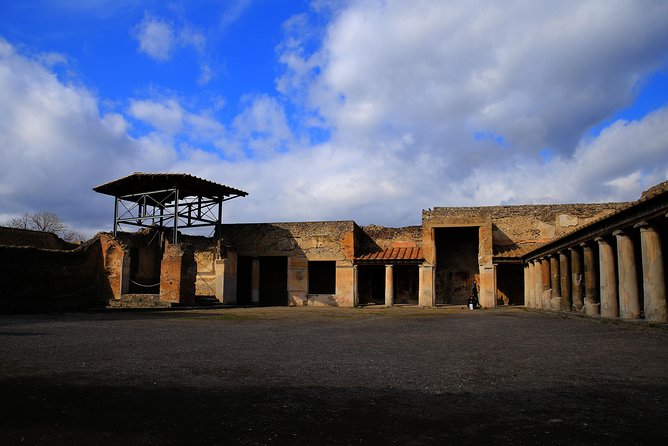
Next up is Teatro Grande, an open-air theater with about 5,000 seats. You get about 20 minutes here, with admission included.
This stop is where Pompeii feels like a living entertainment city, not just an outdoor museum. The guide helps you imagine crowds, performances, and the social role of the theater in Roman public life. Even if you know Roman history in broad strokes, the physical scale of Teatro Grande makes the story click.
What to pay attention to:
- The seating layout and how the open-air design changes the experience compared to a closed theater.
- How the architecture supports views and sound outdoors, which your guide can connect to what would have happened in use.
If you visit during hot months, this stop is also a good one to keep an eye on timing. Open-air ruins can feel intense in the sun, so having a guide-led pace helps.
You can also read our reviews of more guided tours in Pompeii





Stop 3: Odeon and Teatro Piccolo, the smaller counterpoint
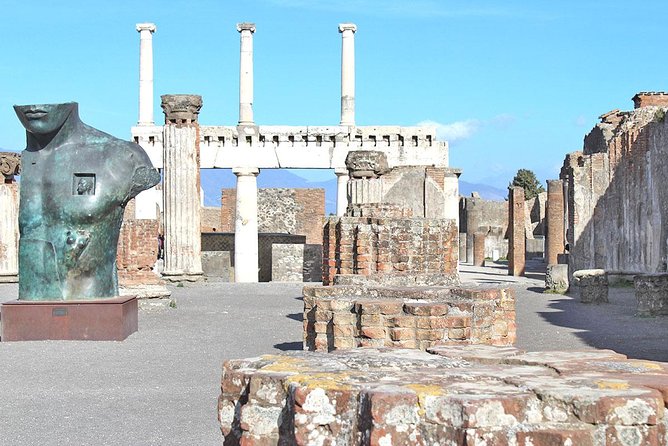
Then you move to Odeon, also called Teatro Piccolo, with seating for around 800 people. This is another 20-minute stop with admission included.
I like the contrast here. After seeing a massive venue, Teatro Piccolo feels more intimate. It’s the kind of shift that helps you understand Pompeii’s public culture was not one-size-fits-all. Different audiences, different types of performances, and a different feel in the space.
This is also a nice pause in the walk. You’re still in theater territory, but it’s different enough that you don’t feel like you’re seeing the same thing twice.
Stop 4: Terme del Foro baths, where daily routine meets catastrophe
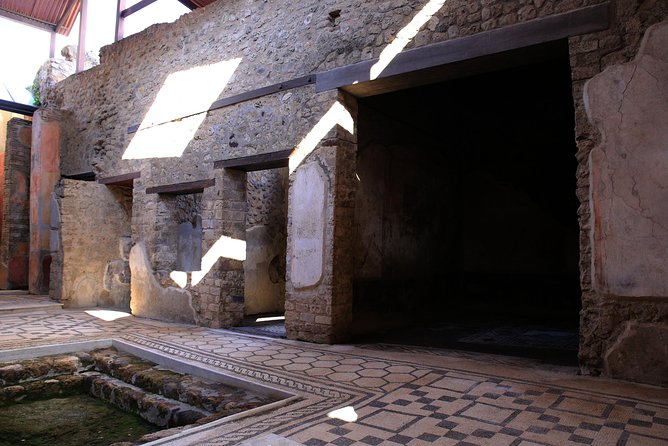
Your next stop is Terme del Foro, a Roman bath complex buried by the eruption of Vesuvius in 79 AD. You get about 20 minutes, with admission included.
Baths are a smart anchor site because they represent daily life. This is where you start to understand Pompeii was not only about big public events like theater. It was also about routine, hygiene, gathering, and social talk.
Your guide’s explanation here makes the architecture more meaningful. You’ll be looking at spaces that were designed for different purposes, and the stop connects those details to what caused the city to freeze in time.
Practical note: baths can be visually busy, and the guide is key for keeping you oriented. If you want to take photos, do it, but also take a second to look away from the phone. The whole point of a guided stop is learning how to interpret what you’re seeing.
Stop 5: Lupanar, the appointment-house world and its surviving frescoes
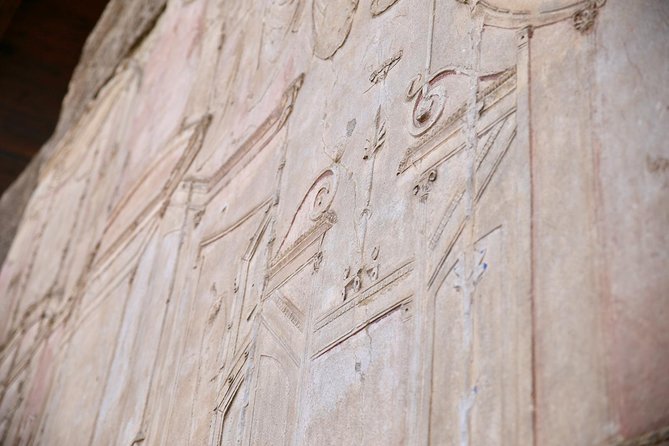
The final stop is Lupanar, an area often described as appointment houses or brothels, with some frescoes still visible. You get about 30 minutes here, with admission included.
This is the stop that can surprise people, but in a good way. The guide helps you understand what the frescoes and layout were communicating. You’ll see how Roman private spaces were decorated and how art and signage could fit into an underground economy of services.
Keep it respectful. Pompeii is full of human details, including the uncomfortable ones. The value here is context, not shock value.
Also, this stop has enough time built in that you can slow down. If your goal is real learning, don’t rush it. Let the guide explain what the imagery likely meant before you start interpreting on your own.
The guide makes the difference, from Lello to Italo to Susanna
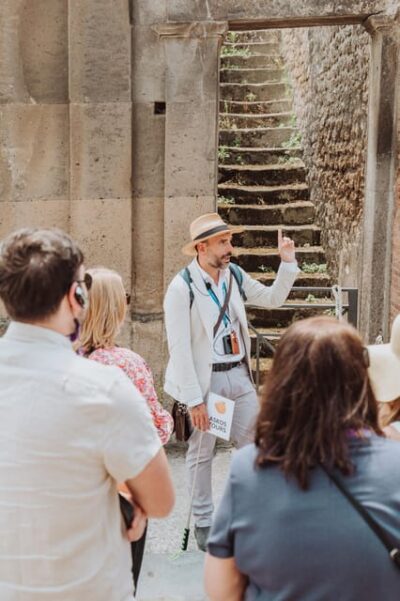
The best part of this tour is the person leading it. The guides are not just reading facts from a sign. They bring stories and make connections so the ruins feel like places people used.
In particular, I’ve found that archaeologist-type guides, like Lello, can turn stone walls into clear explanations. You can walk away feeling you understood more than what’s visible on the surface. Other guides, like Italo, tend to blend friendliness and humor with sharp detail. That mix matters in Pompeii, because it’s easy to get fatigued quickly.
There’s also a strong theme around communication. I really appreciate the clear direction and the use of an audio system, so the guide’s voice comes through in your ear piece. It’s not distracting, it just keeps everyone connected to the same point.
One more human note: I’ve heard about Susanna showing kindness when someone was delayed by about half an hour. Even so, you should still follow the 10-minute early rule. The ticket time window is real, and groups move as a unit.
Price and value: what $107.23 buys you in Pompeii
At $107.23 per person, this tour is not the cheapest way to do Pompeii. But you are buying several practical advantages at once:
- Professional guide leading you through specific sites, not just a generic overview.
- Guaranteed skip-the-line access, which saves time and stress.
- Entrance tickets included, so you’re not paying extra at each stop.
When you add those up, it becomes easier to justify the price, especially if you only have a short window in Pompeii. Two hours plus entrance plus a guide is a solid use of time, and that matters more than people expect when travel days are packed.
Also, the small group size is part of the value. You get more attention per person than you would on the largest buses and roaming crowds.
What to wear and bring for Pompeii’s original streets
The dress code is smart casual. That sounds fancy, but it really means practical clothing you can move in. The tour instructions stress comfortable shoes because you will be walking on the original ancient streets.
Bring:
- Comfortable walking shoes with good grip.
- Sun protection for open-air areas, especially if you’re visiting in summer.
If you’re sensitive to heat, plan water and snacks for afterward. Drinks and lunch are not included, and you’ll likely be grateful for your own plans after the tour ends.
If you’re traveling with children, they must be accompanied by an adult. Service animals are allowed too, and the meeting area is near public transportation.
Pacing and whether you can explore more after
This tour ends back at the meeting point. Many people use that as a launchpad for extra self-guided time. The timing structure also helps: you see five high-value stops first, so you’ll recognize what you want to return to without wasting time.
One nice thing is that the information is paced. It isn’t an all-day slog. You get enough explanation to make you better at looking around, then you can choose to continue at your own speed.
Who this tour is best for
This is a great fit if you want:
- A structured highlights route in a short time.
- Small group attention and a guide who connects what you see to how Pompeii worked.
- Skip-the-line entry so your day does not get eaten by queues.
It’s also a good choice for teens. The stops are varied, and the guide-led format keeps the story moving.
You might consider a different format if:
- You want to spend the whole day wandering and you already have strong background knowledge.
- You’re hoping for a long, slow walk with deep stops at every single street corner. This tour is designed for efficiency and highlights.
Should you book this Pompeii walking tour?
I’d book it if you’re visiting Pompeii for a limited time and you care about understanding more than just taking photos. The mix of skip-the-line access, entrance tickets included, and a small group route through major sites is strong value for $107.23.
I’d think twice if you hate tight schedules, dislike guided walking tours, or can’t commit to arriving on time. The success of the tour depends on staying together, especially because the entrances are booked for specific times.
If you like guided context, Pompeii will feel clearer, more human, and honestly more fun. You’ll finish with a better sense of the city, not just scattered ruins.
FAQ
How long is the Pompeii guided walking tour?
The tour lasts about 2 hours.
What stops are included in the itinerary?
The tour includes: Private Tours of Pompeii (UNESCO site), Teatro Grande, Odeon (Teatro Piccolo), Terme del Foro, and Lupanar.
Is skip-the-line access included?
Yes. The tour includes guaranteed skip-the-line access.
Are entrance tickets included?
Yes. Entrance tickets are included for the stops on the itinerary.
What should I bring or wear?
Wear smart casual clothing and comfortable shoes, because you will walk on original ancient streets. Drinks and lunch are not included.
Can I cancel for a full refund?
Yes, you can cancel up to 24 hours in advance for a full refund. If you cancel less than 24 hours before the start time, the amount paid is not refunded.
More Walking Tours in Pompeii

More Tours in Pompeii


More Tour Reviews in Pompeii

Not for you? Here's more nearby things to do in Pompeii we have reviewed







Tour Reviews, compared.
 ★ 4.8Pompeii: Entry Ticket and Guided Tour with an ArchaeologistFrom $3519,459 reviews
 ★ 4.2Pompeii: Entry Ticket with Optional Audio GuideFrom $2612,360 reviews
 ★ 4.8Pompeii: Small Group Tour with an ArchaeologistFrom $4012,264 reviews
 ★ 4.3Pompeii Ruins & Mount Vesuvius Day TourFrom $12011,459 reviews
 ★ 4.6Sorrento, Positano and Amalfi Full-Day TourFrom $10710,988 reviews
 ★ 5.0Sorrento, Positano & Amalfi Coast – Small Group TourFrom $768,643 reviews
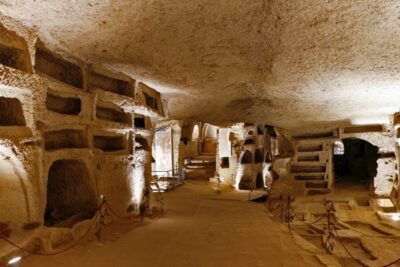 ★ 4.6Catacombs of San Gennaro Entry Ticket & Guided TourFrom $157,941 reviews
★ 5.0Pompeii Small Group Tour with an ArchaeologistFrom $356,593 reviews
★ 4.6Catacombs of San Gennaro Entry Ticket & Guided TourFrom $157,941 reviews
★ 5.0Pompeii Small Group Tour with an ArchaeologistFrom $356,593 reviews
Browse the lists this tour appears in