
Tour review · TOUR REVIEWS
Pompeii and Herculaneum Small Group Tour with an Archaeologist
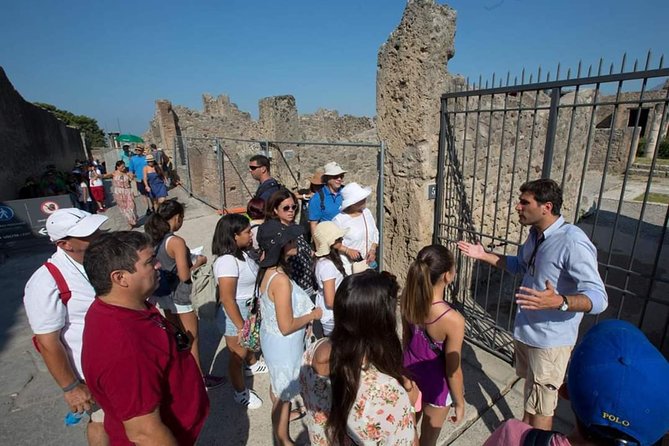
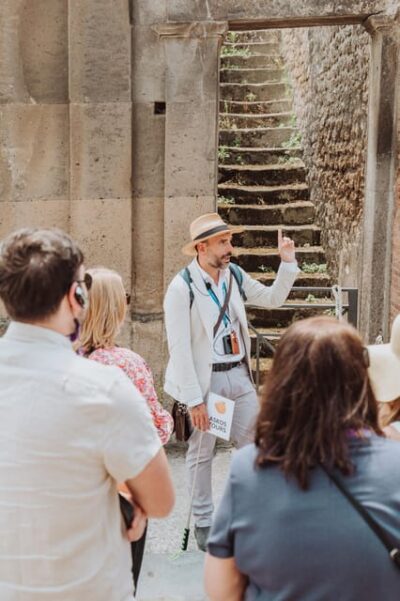
Pompeii and Herculaneum in one day works. What makes this tour special is the archaeologist-led storytelling, plus skip-the-line entry to both sites. You get the big sights, but also the why behind the houses, baths, and public spaces.
I also love the practical setup. You travel between Pompeii and Herculaneum with built-in transport (train if you start in Pompeii, minibus if you start in Naples, Sorrento, or Rome), and the group max is 20 with headsets so you can actually hear the guide.
One thing to keep in mind: the time at Pompeii can feel tight. With a guided walk through major highlights, you will see a lot, but you may want to return later if you like slow wandering.
Key things that make this tour worth your time
- Archaeologist-guided Pompeii and Herculaneum, with real explanations of how life worked in Roman cities
- Headsets for everyone, so you do not lose the story when the group moves
- Skip-ticket-line entry plus tickets included for both sites
- Two strong site visits: Pompeii for big set pieces and Herculaneum for remarkably preserved detail
- Built-in transfer between ruins, by train from Pompeii or by minibus from Naples, Sorrento, and Rome
- Small group size (max 20), which makes questions feel normal, not awkward
Why Pompeii and Herculaneum together feels smarter than separate trips
I get it. You see Pompeii on posters, postcards, and t-shirts. But Herculaneum is the side of the story that often surprises people. Pompeii is larger and more dramatic, but Herculaneum is smaller and tends to feel more intimate. You see houses with preserved wall surfaces and details that make you think, not just look.
This tour lines those two experiences up in one day. You start with Pompeii’s major public spaces and most iconic neighborhoods, then move on to Herculaneum for the houses, baths, and buildings that look startlingly “finished.” The key value is that an archaeologist guide helps you connect the dots between the sites, instead of treating them like two separate photo walks.
And yes, the price is also easier to justify when you realize what is included. You are paying $77.09 per person for guided time at both sites, headsets, and admission tickets to both. The entry ticket costs are listed as 20 euros for Pompeii and 16 euros for Herculaneum (with reduced pricing for some EU citizens aged 18 to 25). In other words, a big chunk of the price is already covered before you even count the guide and transport.
You can also read our reviews of more tours and experiences in Pompeii.



Getting set up fast, so you lose less time to logistics
The day starts with a meeting point that matches your option. Depending on where you begin:
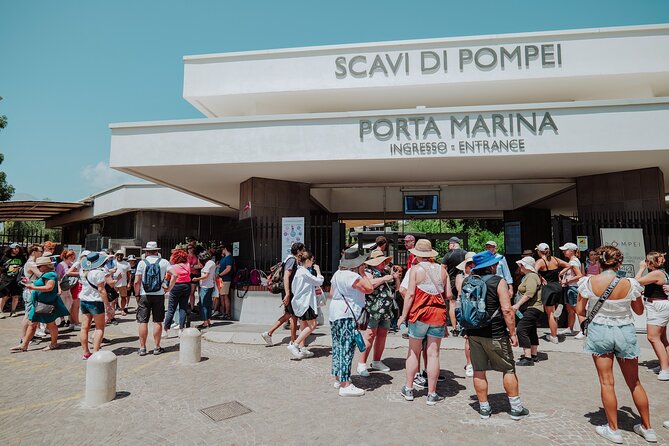
- Pompeii option meets at Porta Marina Superiore
- Naples and Rome options meet at Starhotels Terminus
- Sorrento option meets at Piazza Angelina Lauro
From there, the tour is designed to reduce friction. You do not waste time hunting for a map, and you do not lose your focus to ticket lines. The guide also keeps the group moving in a way that is meant to fit both sites into a single day.
One small detail that matters more than you might think: the tour includes headsets for all participants. Pompeii and Herculaneum can be loud or echoing, and groups can drift. Headsets keep the explanation close, which makes it easier to follow along even when you are stopping to look at something up close.
Pompeii highlights: what you actually see and why the stops matter
The Pompeii portion is guided for about two hours, and it is built around major landmarks plus a few household stops where you can spot daily-life details. This is not the type of tour where you disappear into backstreets for hours. Instead, it is a tight, well-chosen sampler that gives you a framework.
Basilica, the sheltered portico for everyday business
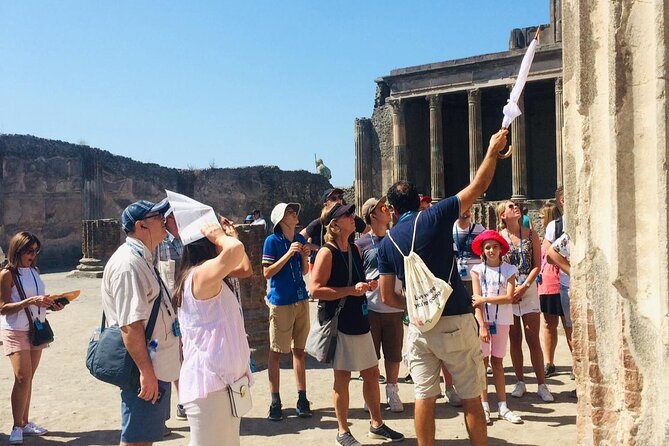
You start at a Basilica, described as an open portico used for merchants and everyday activity. Even in ruins, the idea makes sense. This is where people came to transact, wait, gossip, and move around. When you learn that, the space stops looking like random stone and starts looking like a public living room.
Foro de Pompeya, the main square
Next is the Forum (for a quick look). This is Pompeii’s central public space, and the stop works best if you pay attention to how it would have directed foot traffic. The Roman city is all about movement, and the Forum is the hub.


Walk the main street, so the city layout clicks
There is a short walk through the main street, which is one of the best “mental anchors” you can get on a first visit. Pompeii is huge. A guided layout helps you understand what is connected and what is just nearby.
House of Menander, where wealth shows in design
You then hit a classic household stop, the House of Menander. It is singled out for architecture, decoration, and contents. This is where I like the archaeologist approach. It is easy to admire mosaics and frescoes. It is harder to understand what kind of status those details signaled, and that is where the guide adds value.
Granaries of the Forum: practical space, plus grisly casts
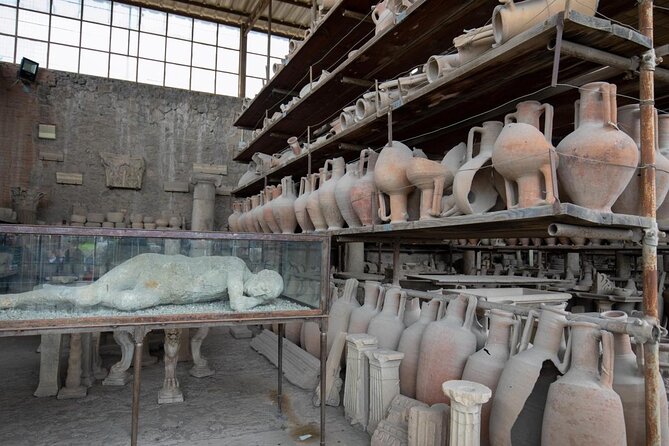
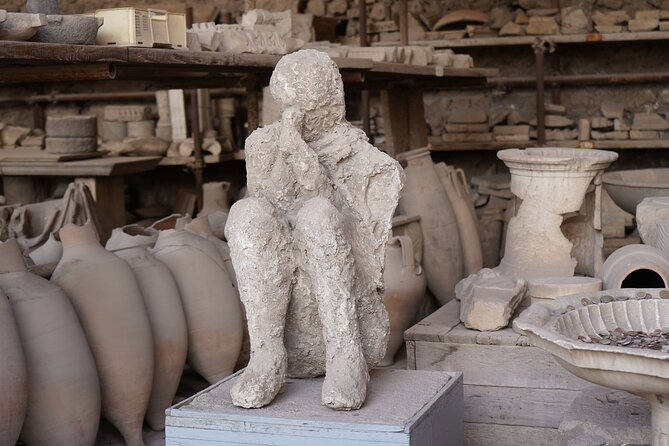
The granaries of the Forum are practical buildings with notable features, including marble tables and baths for fountains at house entrances. You also see casts mentioned in the stop description, including victims of the eruption, plus a dog and a tree casts. That mix is emotionally heavy but historically important, and it helps explain the eruption beyond a single dramatic moment.
Stabian Baths, ancient thermal life in a big complex
The Stabian Baths (Terme Stabiane) are described as the oldest thermal complex in Pompeii, spanning a vast area. Baths are one of the best ways to understand Roman routines. You are not just seeing architecture, you are seeing how people organized time, conversation, cleanliness, and social life.
Lupanar, Pompeii’s famous brothel
The Lupanar is the most famous brothel stop in Pompeii. The fact that it is included tells you the guide will not sugarcoat the city. If you want a fully human picture of daily life, this kind of stop matters. It is also a reminder that Pompeii was not staged like a museum, it was a working city.
House of the Faun, a major private residence
The House of the Faun is one of the largest private residences in Pompeii. You can treat it as a centerpiece or a study in how homes expressed power. Either way, it is one of those stops that gives you a clear sense of scale, even if your time is limited.
Odeon (Teatro Piccolo) and Teatro Grande
You also see the Odeon (Teatro Piccolo) and the Teatro Grande, with the latter described as Pompeii’s most important theater. Roman theaters are not just entertainment. They are community identity, political signaling, and a place where the city gathered.
A quick reality check on timing
Pompeii is massive. A two-hour highlight tour gives you the essentials, but it will not satisfy your inner wanderer if you love spending hours in just one neighborhood. Some guides and groups are better at keeping you moving without losing the story, and the headsets help, but you should still expect a faster pace than independent visiting.
Lunch break: convenient, but choose your mindset
You get a short lunch break between sites, and meals and drinks are own expense. The tour description mentions a break before transfer.
One review note you should treat as a heads-up: some people felt the lunch stop in a mall area killed the vibe. On the other hand, the provider clarified the logic was to avoid tourist traps around the archaeological area, and they describe it as offering a range of lunch options, including familiar pizzerias.
My practical advice: go in with low expectations and plan for convenience. If you can, bring snacks. If you have food preferences, eat early or eat light. Pompeii is draining in warm weather, and you will want energy for Herculaneum walking.
Transfer to Herculaneum: train or minibus, and what it changes
This is one of those details that can make or break your day.
- If you start in Pompeii, you reach Herculaneum using the included Circumvesuviana train ticket, about 30 minutes plus a 10-minute walk, with your guide.
- If you start in Naples, Sorrento, or Rome, you travel by modern minibus directly to the Herculaneum archaeological site.
In plain terms, both options can work well. The train option may feel more authentic, since you are using the local commuter line. The minibus option may feel smoother, especially if you would rather avoid figuring out station transfers.
Either way, you are not stuck alone in transit. That matters, because time is tight when you are doing both sites.
Herculaneum with an archaeologist: the part that sticks in your mind
Once you arrive, the guide takes the group directly to the Ticket Office of the Herculaneum ruins. Access differs by starting city:
- By minibus (Naples, Sorrento, Rome): direct drop-off near the entrance
- By train (Pompeii option): about a 10-minute walk from Ercolano Scavi station
The Herculaneum guided visit is about two hours, with entry tickets included.
House of the Deer, named for the marble stags
You start with the House of the Deer, named for marble statues of stags or deer found in the peristyle. This is a great kind of stop for first-timers. The name gives you a visual hook, and then the guide can explain how decorative items fit into daily life.
La Terrazza di M. Nonio Balbo, a benefactor’s story in stone
Next is La Terrazza di M. Nonio Balbo. The highlight here is social memory: Balbus is described as a major benefactor restoring and building public buildings, honored after his death. The long inscription mentioned in the stop description is exactly the kind of thing an archaeologist guide can unpack so it does not feel like random Latin.
College of the Augustales, religion and civic identity
You also visit the College of the Augustales. The stop notes a possible connection to the cult of Emperor Augustus and the headquarters of the Collegium Augustalium. Even if you do not care about names, the point is how public buildings reflected loyalty and civic structure.
Casa del Rilievo di Telefo, a house with its own access
Then comes Casa del Rilievo di Telefo, unusual for having its own private access to the adjoining Suburban Thermae to the south. It is a small detail, but it reveals how elite living worked: comfort and convenience were built into the layout.
Partem Domus lignea and the wooden partition
You see Partem Domus lignea (Casa del Tramezzo di Legno), described as important for an elegant wooden partition that remained. This is one of those “wait, how is that possible?” moments, and it helps explain why Herculaneum feels different. Pompeii has preserved plenty, but Herculaneum can feel almost shockingly intact.
House of the Skeleton, the human remains that drove the name
The House of the Skeleton is named from human remains found in a second-floor room in 1831. It is a somber stop, but it is also honest history. It grounds the city in reality instead of only aesthetics.
Central Thermae, separate entrances for men and women
You also see the Central Thermae, built around the beginning of the 1st century AD, and divided into men’s and women’s baths with separate entrances. This is where you get a clearer sense that Roman daily life followed rules and routines, not just leisure.
House of the Black Salon, luxury with carbonised traces
Next is House of the Black Salon, noted for a monumental entrance that retains carbonised remains of the doorposts and lintel. That detail hits because it is evidence, not decoration. You can see the aftermath, and the guide can connect it to the preservation story.
Casa Sannitica and Casa del Bel Cortile: different house styles
You then visit Casa Sannitica, with a typical Samnite arrangement, and Casa del Bel Cortile, one of Herculaneum’s most original houses with a courtyard and stone balcony instead of an atrium. These stops help you see Herculaneum as a town of distinct lifestyles, not one uniform “rich house pattern.”
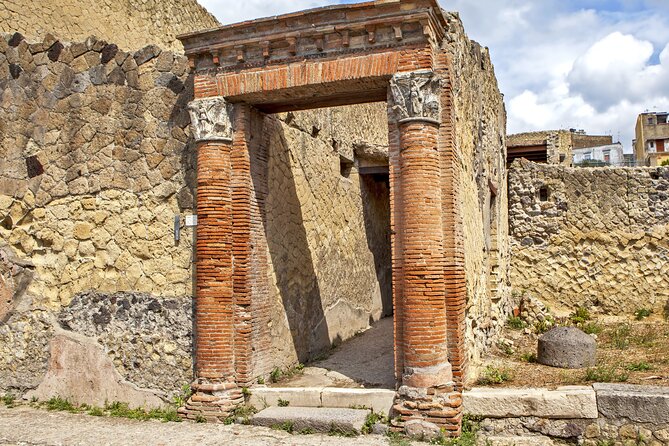
House of the Grand Portal: frescoes, columns, and charred wood remains
Finally, you reach House of the Grand Portal, with various environments, columned areas, frescoes, and charred remains of wooden parts. It is a strong closer because it combines architecture with evidence of destruction and preservation.
When Herculaneum shines, it is because you get context
What makes this section work is that the tour is not just listing buildings. It is connecting the layout, the decorative choices, and the social meaning. In review feedback, guides like Diego and Antonio (and others such as Michele, Paulo, Gianni, and Alfredo) are praised for turning Roman life into something you can picture. That is exactly what you need in Herculaneum, where many visitors would otherwise stare at walls and wonder what to look at.
The return at the end: plan your next move carefully
The tour end depends on your departure option:
- Naples option: return transport to Naples
- Sorrento option: return transport to Sorrento
- Rome option: drop-off at Naples station for Rome travelers
- Pompeii option: you end directly in the Herculaneum ruins area
That last one matters. If you start in Pompeii, you might not get help getting back to Pompeii at the end of the day. So check your chosen option, especially if you planned to self-transfer afterward.
How I’d decide if this tour fits your style
If you want a fast, guided “greatest hits” day with real explanations, this is a strong match. You also get an advantage if you hate the mental load of transportation and ticket logistics. The headsets and skip-line access are not flashy, but they make the day smoother.
This tour is especially suited to:
- First-timers who want both Pompeii and Herculaneum without juggling trains and timing
- People who like guided context, not just photos
- History fans who want to understand how public spaces, homes, and baths worked
If you are the type who likes to linger for detail and read everything on your own, you may feel rushed at Pompeii. You may end the day wanting more time in one place, and Herculaneum deserves that kind of follow-up too.
Should you book this Pompeii and Herculaneum small-group tour?
Yes, with a couple of smart expectations.
Book it if you want archaeologist-led insight, small-group pacing, and tickets plus transfer handled for you. The included entry to both sites plus the train or minibus logistics make the value feel more real than many add-on packed tours.
Maybe choose a different format if you want long, slow time inside Pompeii itself. Two hours there is enough for the big landmarks, but it is not enough to fully savor a city that feels like a maze.
My best practical tip: wear shoes that can handle uneven stone, bring water, and treat lunch as a recharge, not the highlight. Then let the guide do what guides do best, translate ruins into daily life.
FAQ
How long is the tour?
The Pompeii and Herculaneum small group tour runs approximately 6 to 11 hours, depending on your option and the day’s schedule.
Is it only in English?
Yes. The tour is offered in English.
What is included in the ticket price?
Included items are guided tour service in both Pompeii and Herculaneum, headsets, and admission tickets for Herculaneum and Pompeii (including the Pompeii express entry tickets). Transport is also included based on your meeting option, plus a Circumvesuviana one-way train ticket from Pompeii to Herculaneum if you start in Pompeii.
How do I travel between Pompeii and Herculaneum?
If you start in Pompeii, you go by Circumvesuviana train (about 30 minutes plus a 10-minute walk) with your guide. If you start from Naples, Sorrento, or Rome, you travel by modern minibus with your guide directly to Herculaneum.
Where do we meet for different departure options?
Meeting points are listed as:
- Pompeii (Porta Marina Superiore)
- Naples and Rome (Starhotels Terminus)
- Sorrento (Piazza Angelina Lauro)
Are meals included?
No. Meals and drinks are not included, and lunch during the day is an own expense break.
What are the site entry ticket costs?
Herculaneum entry is listed as 16 euros for adults and 2 euros for EU citizens aged 18 to 25. Pompeii entry is listed as 20 euros for adults.
Is the tour suitable for people with visual impairments?
The tour is not recommended for visually impaired guests unless they are accompanied by a dedicated personal assistant.
Can I get a refund if I cancel?
Yes. The tour offers free cancellation. You can cancel up to 24 hours in advance for a full refund.
More Tours in Pompeii

More Tour Reviews in Pompeii
Not for you? Here's more nearby things to do in Pompeii we have reviewed







Tour Reviews, compared.
 ★ 4.8Pompeii: Entry Ticket and Guided Tour with an ArchaeologistFrom $3519,459 reviews
 ★ 4.2Pompeii: Entry Ticket with Optional Audio GuideFrom $2612,360 reviews
 ★ 4.8Pompeii: Small Group Tour with an ArchaeologistFrom $4012,264 reviews
 ★ 4.3Pompeii Ruins & Mount Vesuvius Day TourFrom $12011,459 reviews
 ★ 4.6Sorrento, Positano and Amalfi Full-Day TourFrom $10710,988 reviews
 ★ 5.0Sorrento, Positano & Amalfi Coast – Small Group TourFrom $768,643 reviews
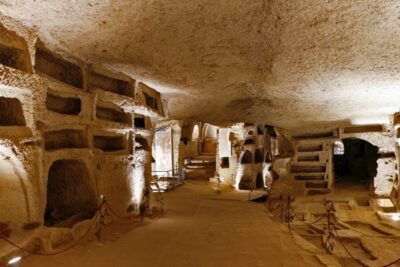 ★ 4.6Catacombs of San Gennaro Entry Ticket & Guided TourFrom $157,941 reviews
★ 5.0Pompeii Small Group Tour with an ArchaeologistFrom $356,593 reviews
★ 4.6Catacombs of San Gennaro Entry Ticket & Guided TourFrom $157,941 reviews
★ 5.0Pompeii Small Group Tour with an ArchaeologistFrom $356,593 reviews
Browse the lists this tour appears in