
Tour review · TOUR REVIEWS
Pompeii 3 Hours Walking Tour Led by an Archaeologist
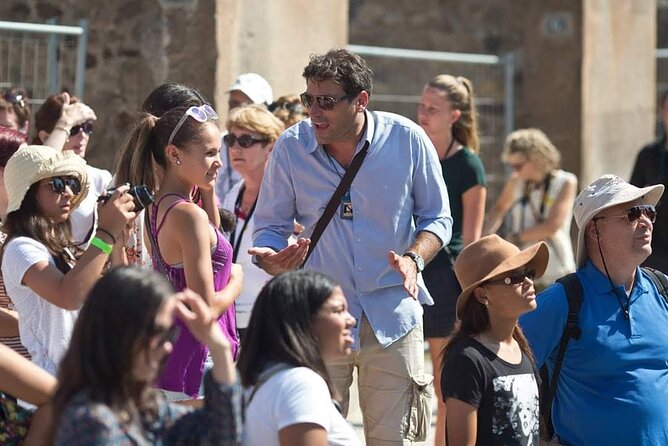
Pompeii feels frozen in time. This 3-hour private walking tour uses an archaeologist-led approach to help you connect the dots across Pompeii’s public spaces, homes, and everyday life. You’ll move at a good pace and hit the city’s most meaningful anchors without trying to wrestle the ruins alone.
I like two things a lot. First, you get a true specialist guide style, with names showing up in feedback like Daniela Mantice and Monica, plus other expert guides such as Antonella, Lia, Nicoletta, and Anna Sorrento. Second, the route makes sense for first-timers, pairing major architecture like the Basilica and theaters with social life like the Lupanar and the Stabian Baths.
One consideration: Pompeii is vast and very exposed, with minimal shade. If you’re sensitive to heat, plan your day around cooler hours and bring sunscreen and a hat.
Key highlights to know before you go
- Private, only your group: you can ask questions and keep the focus on what interests you.
- Archaeologist-led interpretation: reviews point to strong teaching and clear explanations.
- A smart 3-hour route: you see the Forum area, major houses, bath complexes, and both theaters.
- Admission covered for the paid stops: including Pompeii Archaeological Park and the Granaries area where tickets apply.
- Meet-up that’s easy to find: the guide holds an Askos Tours sign at Porta Marina Superiore.
- Rain or shine operation: the plan keeps moving in real weather.
A 3-hour Pompeii route that actually works
Pompeii can overwhelm you fast. You arrive, you see walls and arches and floors, and suddenly you’re guessing what you’re looking at. This tour helps you avoid that. In about 3 hours, you get a guided path that hits the places that teach you how the city functioned: where people met, where they bathed, where the wealthy lived, and where entertainment happened.
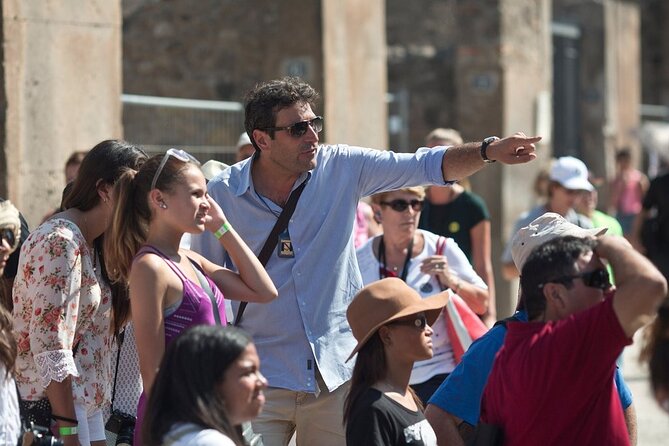
You also get a private setup. That matters more than it sounds. When you’re not in a large crowd, you can ask follow-ups, linger when something clicks, and get answers tied to what you’re standing next to.
The other big win is the balance of “big public buildings” and “human scale details.” You’ll look at theaters, but you’ll also walk past the spots where Roman daily life got social. That’s the difference between seeing ruins and understanding them.
You can also read our reviews of more walking tours in Pompeii


Meeting at Porta Marina Superiore, plus luggage storage
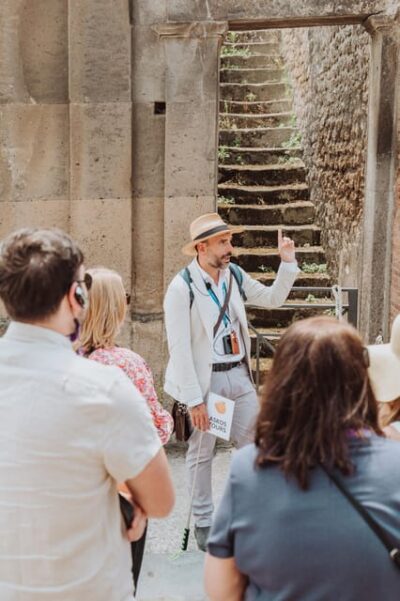
Meet-up is set at the entrance area inside Pompeii called Porta Marina Superiore. The guide holds a sign with the company name Askos Tours on top, so you’re not playing the location lottery.
Your tour starts at Via Villa dei Misteri, 1, 80045 Pompei NA, Italy, and ends there as well. That loop is practical when you want a clean finish back near your starting point.
One handy perk: there’s a safe luggage store at the meeting place for free. If you’re carrying day bags, umbrellas, or a jacket for later, you can drop it and walk more comfortably.
And after the tour, the guide can help you with practical directions for how to get back to your accommodation or the closest train station. That’s especially useful in a place where transport signage can feel a little chaotic.
What an archaeologist-led guide changes in Pompeii
I love Pompeii when someone translates it into ordinary life. This tour leans into that. The guiding concept is that you’re not just looking at stone and mosaics, you’re learning how people lived, worked, and gathered. Reviews strongly point to a teaching style that’s clear and stays on topic.
The guide team backgrounds show variety in the feedback. Some names are associated with archaeology credentials, including Monica, mentioned as having a PhD in archeology. Other guides are described as art historians, like Daniela Mantice. Either way, the consistent thread is explanation that connects architecture to behavior, and details to larger Roman patterns.
One review also noted that not every guide may present as an archaeologist on paper, but the archaeology knowledge still came through strongly. So if you care a lot about a specific credential, you can ask about the guide profile when booking. Either way, the goal here is practical interpretation you can follow while you’re walking.
Stop 1: Pompeii Archaeological Park and the first orientation
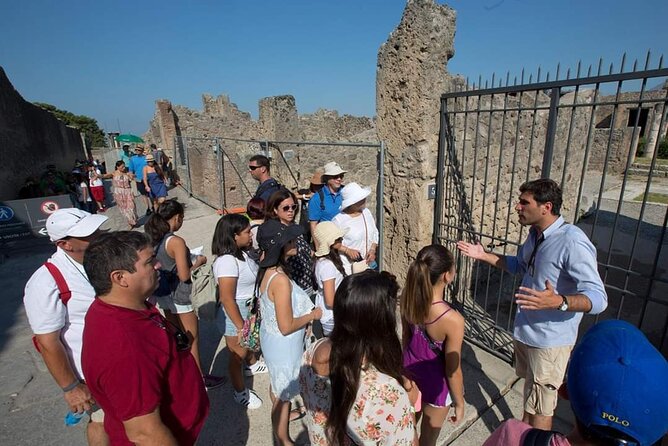
Your first stop is at Pompeii Archaeological Park, meeting at Porta Marina Superiore. You’ll spend about 10 minutes here, and the admission ticket for the site is included.
This moment matters because Pompeii is not laid out like a neat museum floor plan. A good orientation early helps you stop feeling like you’re just moving between random ruins. A specialist guide can point out what to watch for as you enter: street alignment, building types, and the logic of public versus private spaces.
If you’re the kind of visitor who wants context before you start taking photos, this is the right place to start.
Stop 2: Basilica, a shelter for merchants and activity
Next up is the Basilica, about 20 minutes. This was an open portico area that sheltered merchants and other activities.
Stand here and you can almost map the social rhythm. The idea is simple: people needed a covered meeting and trading space that still kept airflow. This is where commerce and public movement meet, and it’s a key piece for understanding how the Forum zone worked.
Because this stop is 20 minutes, you get enough time to appreciate the scale and function rather than just snap a picture and move on. The admission ticket is listed as free for this stop, which is nice given how tight the tour timing is.
More Naples tours, ruins, coast days, and city experiences to compare

Stop 3: The Forum square, the city’s main meeting point
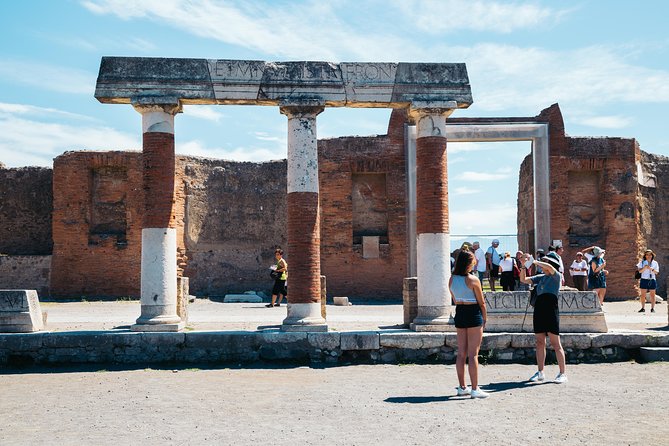
Then you’re in the Foro de Pompeya area for about 20 minutes. This is the ancient main square.
This is the heart of Pompeii’s public life. Think of it as the place where civic business and everyday conversation overlapped. Even if you’ve never studied Roman cities, a guide can help you see how squares acted like information hubs and gathering spaces.
If you like history that feels practical, this stop delivers. It’s not just temples and monuments, it’s a functional space where people would have recognized one another and returned over time.
A walk on the main street, where the city pace comes alive
After the Forum square, you walk through the main street of Pompeii. This is one of the parts I appreciate for first-timers. It gives you a sense of movement and distance, and it helps you understand Pompeii as a lived-in city rather than a collection of buildings.
Even short street segments can do a lot. They show you street width, building relationship to sidewalks, and how people would have navigated daily errands. It also breaks up the “big stop” pattern so you stay engaged.
Stop 4: Granaries of the Forum, plus casts and everyday details
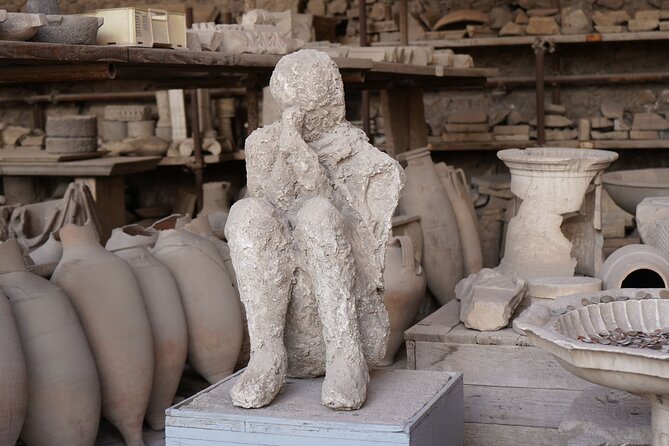
Granaries of the Forum is one of the most interesting stops because it mixes infrastructure with stark storytelling. You’ll spend about 20 minutes here, and admission is included for this stop.
In the granary area, you can see marble tables and baths for fountains that adorned entrances of houses. That might sound odd at first, but it’s exactly the kind of detail that turns stone into behavior. It shows how entrances were decorated and how water features fit into daily movement.
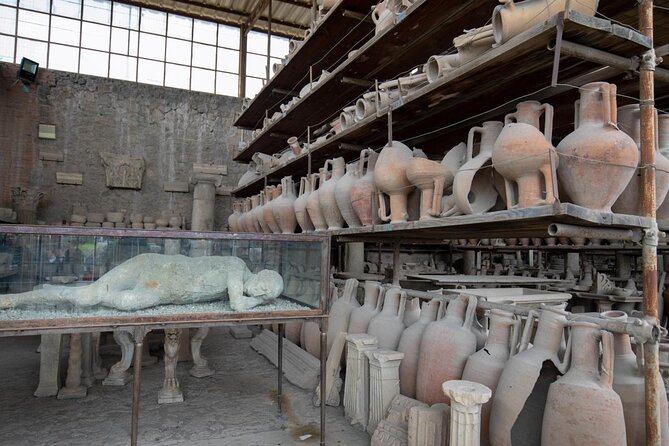
You’ll also encounter casts of eruption victims, including those of a dog and a tree. This is a sobering segment, and it’s the kind of place where a trained guide helps you avoid getting lost in the shock and instead understand what you’re seeing in a meaningful way.
This is one of the stops where the tour’s specialist interpretation matters most.
Stop 5: House of Menander, a luxury home with visual storytelling
Next is the House of Menander, about 20 minutes. The tour frames it as one of the richest and most magnificent houses in Pompeii in terms of architecture, decoration, and contents.
You’ll learn how wealthy domestic spaces worked, not just what they looked like. Houses like this are a snapshot of social status, taste, and daily routine. The architecture and decoration aren’t random. They’re designed to impress visitors and reflect the owner’s identity.
This stop is listed as free for admission. In a 3-hour tour, that’s a smart use of time because it keeps the ticket-cost coverage from being concentrated only in the few most expensive stops.
Stop 6: Stabian Baths, the oldest thermal complex in the city
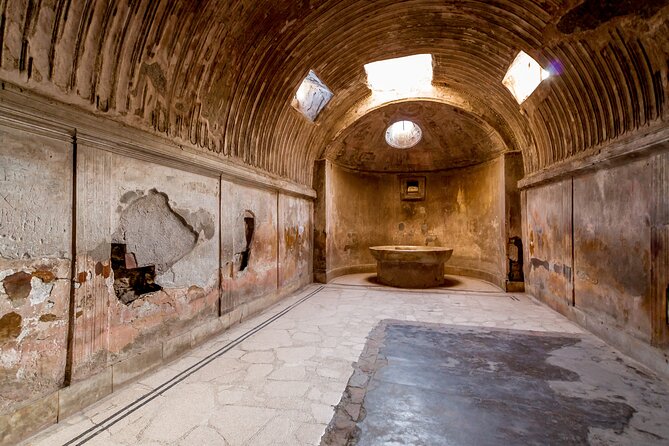
Stabian Baths, also called Terme Stabiane, takes about 25 minutes. It’s described as the oldest thermal complex in Pompeii, occupying a vast area between major local intersections.
This is where Roman daily life gets physical. Baths were not just about cleanliness. They were social hubs, relaxation zones, and routine stops. When you have a guide, you can connect the rooms, movement patterns, and scale to how people spent time.
I’d treat this as more than sightseeing. It’s a chance to understand why a Roman city needed public bathing as a central service, not a luxury.
This stop is free for admission on the itinerary.
Stop 7: Lupanar, Pompeii’s famous brothel
Then comes the Lupanar for about 20 minutes. It’s described as the most famous brothel in the ruined Roman city of Pompeii, and it’s one of the most instantly recognizable “social life” stops in Pompeii.
This can be emotionally uncomfortable depending on your interests and sensitivities. What I appreciate about having a guide is framing. You’re not just looking at a scandalous label. You’re learning how entertainment and commercial sex functioned in the broader economy and street life of the city.
If you want a Roman city experience that includes the real human messiness, this stop is part of that. If you prefer to keep your day lighter, it’s still worth going, but you may want to mentally prepare.
Stop 8: House of the Faun, big scale private life
House of the Faun is next, about 20 minutes. This was one of the largest and most impressive private residences in Pompeii.
This is the kind of stop where scale can hit you. Large houses usually mean major wealth and a lifestyle built around hosting, processional movement, and controlled access. A guide helps translate layout into daily routine: where people would move, what rooms signaled importance, and how decoration reinforced status.
As with other house stops, the admission is listed as free for this segment. That makes it easier to stay focused on interpretation rather than worrying about timed entry.
Stop 9: Odeon, Teatro Piccolo for a quick theater peek
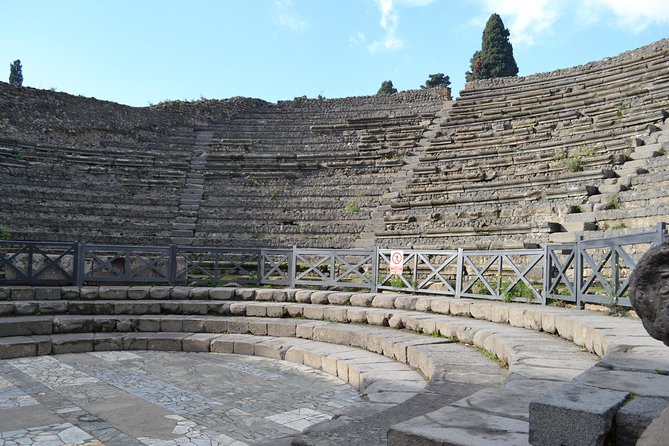
You’ll see the Odeon, also called Teatro Piccolo, for about 5 minutes.
This is a quick hit. The value here is giving you a sense that Pompeii’s entertainment scene wasn’t only one theater. It had multiple performance spaces with different vibes. A guide’s explanation helps you place Teatro Piccolo into the bigger picture, even if you are only stopping briefly.
If you’re short on attention span, 5 minutes is perfect. If you love performance architecture, you might wish the stop were longer, but the tour saves the deeper time for the biggest theater.
Stop 10: Teatro Grande, the main stage in Pompeii
Finally, Teatro Grande takes about 20 minutes and is described as the most important theater in Pompeii.
This is the climax stop for many people because it’s the loudest visual statement in the route. A guide helps you read it as a civic machine. Seats, structure, and placement all relate to how performances drew crowds and created shared experiences.
In a 3-hour private tour, 20 minutes is a strong allocation. You get enough time to look around and understand the theater as a place people used, not a fragment.
Heat and shade reality check for Pompeii
Pompeii is famous, and that also means the ground is usually sunny and exposed. The tour notes minimal shade, and I agree with the practical warning.
Bring sunscreen. Wear a hat. If you think you’ll be okay without it, you’ll likely change your mind once you’ve been walking a while. Also, consider water and a light layer for comfort if you’re traveling during warmer months.
Because the tour runs rain or shine, you might also want a small packable rain layer. Pompeii weather can shift quickly, and you don’t want to end up cold and distracted.
Price and value: what you’re paying for at $256.99
The price is $256.99 per person for an approx. 3-hour private walking tour.
For many people, that sounds steep. But the value angle here is not just “a guide.” You’re paying for a specialist-led route plus admission ticket fees. The itinerary also includes ticket-covered stops like Pompeii Archaeological Park and the Granaries of the Forum, while other sites are listed as free entry.
The other value piece is time efficiency. With Pompeii, you’re paying for someone to handle the where and the what. In real terms, that can mean more understanding per hour and less time wandering without direction.
If you’re a solo traveler, you may feel the cost more strongly. If you’re traveling as a pair or small group, the private format often starts to feel more reasonable because you share the guide time.
Who this Pompeii archaeologist walking tour is best for
This tour is a strong fit if you want:
- A guided hit list of big Pompeii sites in a short window
- A private pace, so questions and clarifications stay on track
- A guide who can explain how architecture connects to Roman daily life
It may be especially good for first-timers who feel nervous about Pompeii’s size. You won’t see everything, but you’ll see enough to create a mental map of the city and understand why each place matters.
It’s also a good option for art and history lovers who like details that go beyond a plaque. Based on the guide names and the way people described their experience, you can expect explanations that connect materials, decoration, and layout to how people lived.
Should you book this Pompeii 3-hour private tour with Askos Tours?
I think it’s a solid choice if you want Pompeii to make sense quickly. The private format, the specialist guide approach, and a route that mixes the Forum, theaters, bath life, and elite houses are a winning combo. You get admission coverage for key paid stops, plus the guide helps with practical directions at the end.
I’d only hesitate if you know heat will derail your day. With minimal shade and a lot of walking, you’ll want to be prepared. Also, because it’s 3 hours, this is not a “see every street corner” plan. It’s a focused circuit meant to teach you the big ideas fast.
If you’re deciding between going it alone and hiring a guide, this tour is one of those cases where guidance pays off fast in Pompeii.
FAQ
How long is the Pompeii 3-hour walking tour?
The tour lasts about 3 hours.
Is this tour private or shared?
It is a private tour/activity, and only your group participates.
What is included in the price?
The tour includes a professional archaeologist guide and admission ticket fees.
Where do we meet and where does the tour end?
You meet at Via Villa dei Misteri, 1, 80045 Pompei NA, Italy. The tour ends at the same address.
What language is the tour offered in, and does it run rain or shine?
The tour is offered in English, and it runs rain or shine.
Is there luggage storage at the meeting point?
Yes. There is a safe luggage store at the meeting place for free.
What is the cancellation policy for a full refund?
You can cancel up to 24 hours in advance for a full refund. If you cancel less than 24 hours before the start time, there is no refund.
More Walking Tours in Pompeii
More Tours in Pompeii




More Tour Reviews in Pompeii

Not for you? Here's more nearby things to do in Pompeii we have reviewed







Tour Reviews, compared.
 ★ 4.8Pompeii: Entry Ticket and Guided Tour with an ArchaeologistFrom $3519,459 reviews
 ★ 4.2Pompeii: Entry Ticket with Optional Audio GuideFrom $2612,360 reviews
 ★ 4.8Pompeii: Small Group Tour with an ArchaeologistFrom $4012,264 reviews
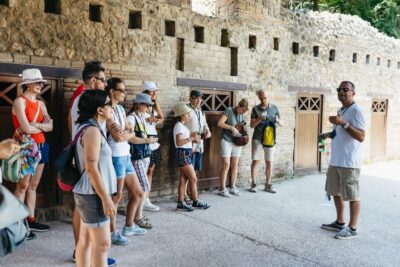 ★ 4.3Pompeii Ruins & Mount Vesuvius Day TourFrom $12011,459 reviews
 ★ 4.6Sorrento, Positano and Amalfi Full-Day TourFrom $10710,988 reviews
 ★ 5.0Sorrento, Positano & Amalfi Coast – Small Group TourFrom $768,643 reviews
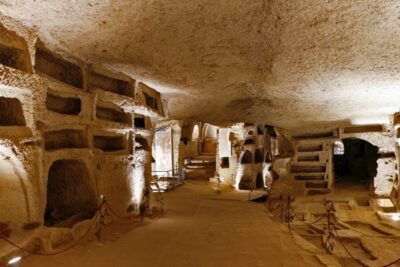 ★ 4.6Catacombs of San Gennaro Entry Ticket & Guided TourFrom $157,941 reviews
★ 5.0Pompeii Small Group Tour with an ArchaeologistFrom $356,593 reviews
★ 4.6Catacombs of San Gennaro Entry Ticket & Guided TourFrom $157,941 reviews
★ 5.0Pompeii Small Group Tour with an ArchaeologistFrom $356,593 reviews
Browse the lists this tour appears in