
Tour review · TOUR REVIEWS
VIP Pompeii Tour including Newly Opened Houses With Archaeologist
Pompeii hits harder with a plan. This VIP tour gets you past the long lines and pairs a walking guide with an art historian style approach, so the ruins feel like real places, not just rocks. I especially like two things: the chance to see newly opened Domus interiors, and the way your guide connects everyday Roman life to what you’re standing in front of. One thing to factor in, though, is logistics: you’ll meet at the café near Porta Marina unless you pay extra for pickup.
If you want Pompeii in a way that feels personal and focused, this tour is built for you. It’s also a good fit if you care about visual details, like frescoes and mosaics, because the Domus stops are the point.
Key things I’d target first
- Skip-the-line entry so you start seeing Pompeii right away
- Newly restored Domus houses opened to the public in 2017, including Domus of Venus and House of Octavius Quartius
- Priority route through the main highlights, from the Forum to theaters and baths
- Rotation of houses based on what’s open that day (you will not see every house at once)
- Strong guide storytelling, with many guides praised for English and keeping momentum
- Smart pacing for real sightseeing, not aimless wandering
VIP Pompeii: what makes this tour feel different
Pompeii can be overwhelming fast. The site is huge, and without a plan you end up chasing random buildings, missing the “why” behind the ruins. This experience works because it saves you one of the biggest headaches, entrance lines, and then uses your time to connect major landmarks to the lives of the people who lived there.
The VIP angle also matters inside the restored sections. You’re not just looking at an outdoor shell. You’re guided through Roman homes where you can focus on art and layout: colonnades, courtyard spaces, garden features, and signature paintings.
And yes, it’s private. So you’re not competing with other groups for attention, photos, or the timing of bathroom breaks.
You can also read our reviews of more tours and experiences in Pompeii.



Meeting point and getting in smoothly at Porta Marina
You meet at Coffee Shop Vittoria, Via Mare, 80045 Pompei (Pompeii). The tour ends back near the start area. This setup is convenient if you’re already staying in central Pompeii, or if you plan to use public transport and arrive on your own.
If you do not want to self-navigate, hotel or port pickup can be arranged for an extra cost. That’s not included, so price-minded travelers should budget time to meet at the café unless pickup is worth it to you.
Practical tip: bring your mobile ticket and plan for walking from the meeting point to the site entrance. Pompeii days are not “sit and look” days.
Skip-the-line entry: your first win
The biggest early benefit is straightforward: guaranteed skip-the-line entrance. That means you avoid the slow start where other visitors are stuck waiting while you’re still deciding where to go first.
With priority entry, your guide can get you to the key areas while your energy is still high. Pompeii is easier to enjoy when the first half of your day is not consumed by logistics.
Also, the tour is offered in English, and the walking route is designed so you get context, not just coordinates.
The walking route: from Forum streets to theaters
Once you’re inside, the tour becomes a guided story of a Roman city, buried and then uncovered. You’ll hear how Pompeii developed from early roots (as early as the 7th century BC) through the city’s daily rhythm.
Stop 1: The Forum (Foro de Pompeya)
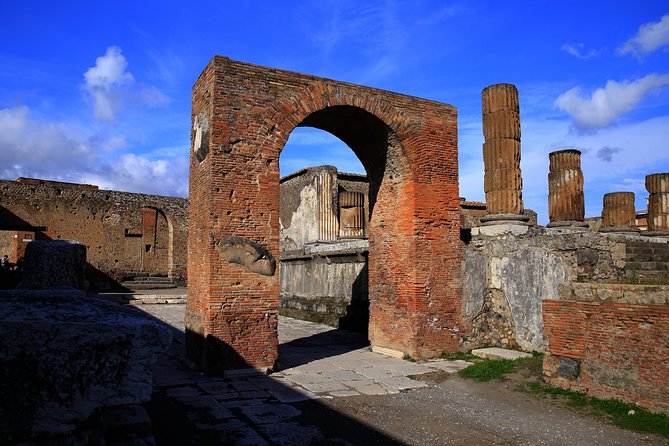
The Forum is the city’s main square and the best starting point for orientation. In about 30 minutes, you’ll walk main streets and end at the core of civic life.
What I like here is the grounding. It’s easier to understand why later buildings mattered once you’ve seen the Forum’s role in commerce, politics, and public gatherings.
A small drawback: the Forum area can feel busy with foot traffic, so it helps if your guide keeps you moving rather than stopping too long in the most crowded corners.



Stop 2: Teatro Grande
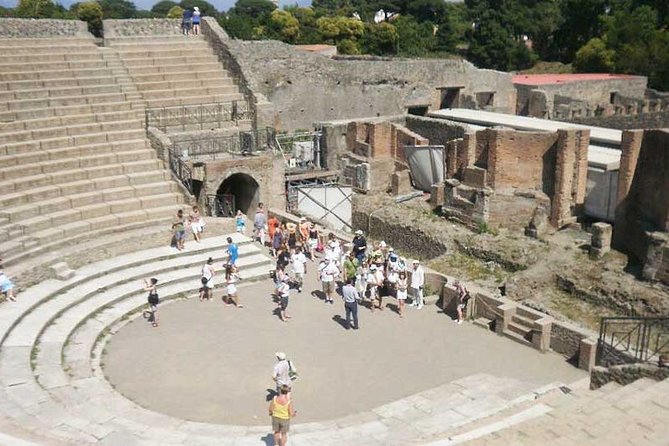
Next comes performance culture, and this is where Pompeii gets surprisingly emotional. The Teatro Grande stop is also about 30 minutes, long enough for your guide to explain what you’re seeing and why Romans cared about public spectacles.
If you love the sound-and-space side of architecture, this is a great pivot point in the tour. You’re not only learning facts, you’re learning how people used the built environment.
Stop 3: Odeon, Teatro Piccolo
The Teatro Piccolo (with the Odeon area) adds a different mood. You’ll get an explanation of the acoustic design, and the guide helps you understand how the space was meant to carry voices.
Even if you’re not an acoustics nerd, the effect is the point. It turns stone into something you can almost hear.
Stop 4: Pompeii Archaeological Park time
After the theater sequence, you shift back into broad “highlights” coverage. The schedule shows Pompeii Archaeological Park time of about one hour in the stop list, but the overall tour is described as around 4 hours and is flexible based on what’s open and how your group is moving.
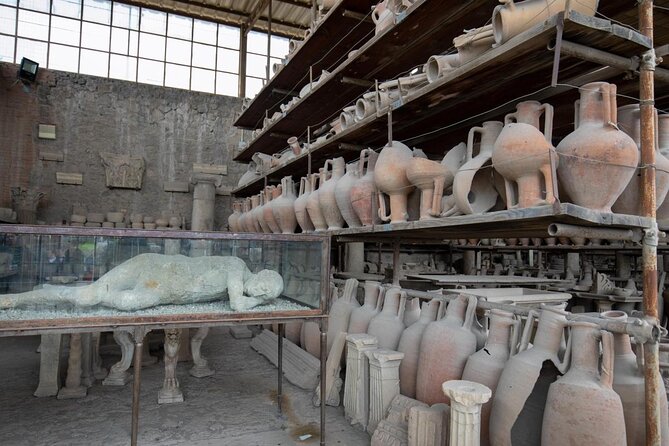
In this segment you’ll be walking through the major showpieces that help explain Pompeii’s burial and preservation. Expect context around the AD79 eruption of Mt. Vesuvius, and then a look at preserved structures like Roman Baths, a Termopolium Capuano (a fast-food style public eating place), and the House of the Tragic Poet. You’ll also stand in awe at the world’s oldest surviving Roman amphitheater.
My advice: if you get even moderately interested in how ancient cities worked, this is the heart of the tour. It’s where Pompeii stops being a “big site” and becomes a functioning city in your head.
Stop 5: Stabian Baths (Terme Stabiane)
Next up: bathing culture. The Stabian Baths stop is about 30 minutes. Baths were social space, daily routine, and health culture rolled into one.
This stop is valuable because it gives you a break from looking at art only. You see everyday infrastructure, and you learn what mattered to ordinary Roman life.
Stop 6: Casa del Menandro
The Casa del Menandro stop rounds things out with domestic life again. It’s about 30 minutes, and it acts like a bridge between public Pompeii and the restored homes that come next.
If you love mosaics and frescoes, this “Roman home” flavor is a strong setup for what follows.
The Domus portion: newly opened houses and rotating interiors
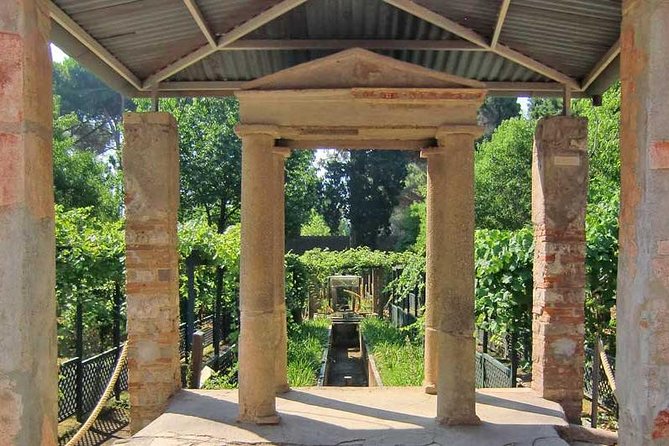
This is why the tour earns the VIP label. The restored “Villas” or Domus are the places where you can see how wealth and taste showed up in daily rooms.
The key detail: the houses are not all open at the same time. Your route is customized based on which houses are open during your visit, and there’s a rotation schedule.
Domus of Venus
One highlight is the Domus of Venus, newly open to the public since March 2017. You’ll see a colonnaded façade, a courtyard, and a famous painting: the Birth of Venus, emerging from a seashell.
This stop is special because the art is the story. Pompeii’s frescoes were not meant to be museum objects. They were decoration in lived spaces. Seeing the domus interiors helps you visualize how Roman elites used imagery to signal status and taste.
House of Octavius Quartius
Next is the House of Octavius Quartius. The standout artwork here is a painting of Narcissus.
I like this pairing because it gives you two different artistic vibes in a single flow: one tied to mythic divinity and beauty, the other to a famous story of reflection and desire. Your guide can tie the paintings to the architecture around them.
Other possible Domus: Fruit Trees and Iulia Felix
Depending on what’s open that day, you might also visit:
- House of the Fruit Trees, known for exquisite frescoes
- House of Iulia Felix, once used as a spa retreat, which makes the connection back to the bath culture even more satisfying
Because the houses rotate, you should treat the Domus section as the best “art-focused” slice of Pompeii you can get in a single trip. If you’re hoping for a specific interior, ask your operator which houses tend to be open on your travel date.
Guides: the real reason people rave about this
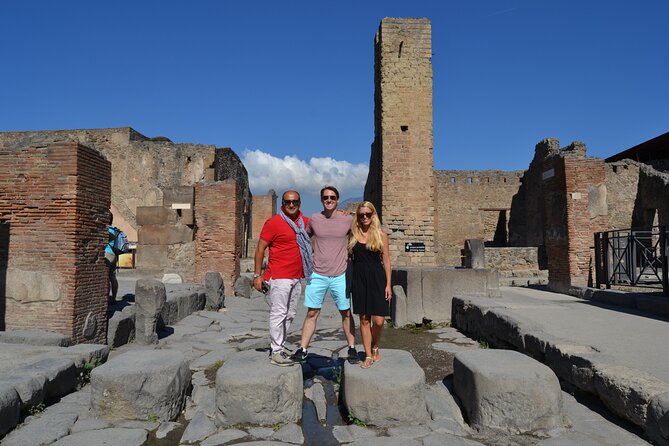
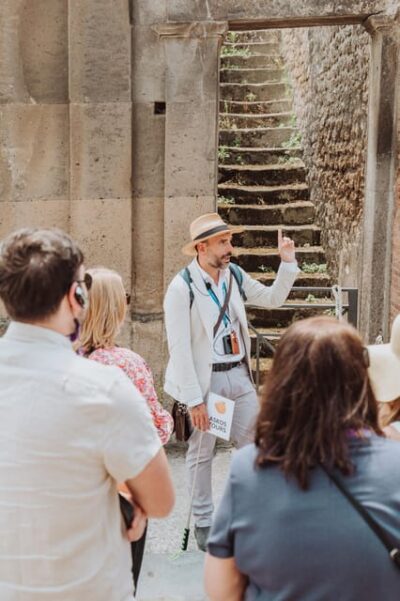
A huge theme across the experience is simple: the guide makes Pompeii feel alive and manageable. You get priority access, but you also get interpretation, storytelling, and a clear route.
Names that show up as standouts include Laylo, Roberta, Raphael, Italo, Antonio, Veronica, Giada, Loretta, Fiorenza, Andrea Fiorello, Rossana, and Barbara. The common thread in praise is not just that they know facts, it’s that they explain what you’re seeing in a way you can use.
Some guides are called out for:
- turning a four-hour walk into something that flies by
- humor that keeps families engaged
- helping with the practical side, like where to pause for photos and when to take a break
One review also flagged a mismatch between expectations and what was advertised for the day (an “archaeologist” expectation versus what felt like an art focus). That’s a reminder to check how the provider describes the day’s specialization when booking, especially if you’re specifically looking for field archaeology credentials.
Who this tour is best for
This VIP Pompeii tour is a strong choice if you:
- want skip-the-line time savings
- care about art details in houses, like frescoes and mosaics
- prefer a private format over large groups
- like a guided story that connects buildings, daily life, and the eruption aftermath
- are traveling with kids and want a guide who can keep attention (many guides are praised for family engagement)
It may be less ideal if you only want a broad “see the highlights” glance and you hate walking. This experience is built for steady walking and close looking.
Value check: $359.22 per person for a VIP day
At $359.22 per person, you’re paying for three things that add up quickly at Pompeii: priority entry, a private guided route, and access to newly restored Domus sections.
If you tried to do Pompeii on your own, you’d still need to solve:
- getting through entry lines
- figuring out the best sequence
- interpreting what you’re looking at
- making time for the newer restored houses that are not always accessible the same way
That’s where value comes from. You’re buying focus. You’re also buying fewer wasted hours.
Also, many people choose this type of tour specifically so they don’t end up with a “we saw some stuff” day. They end up with a structured arc, Forum to theaters to baths, then art-heavy domestic Pompeii.
Things to plan for so the day goes smoothly
Pompeii is physically demanding. Wear comfortable shoes and expect lots of walking on uneven surfaces.
Bring a water bottle. The tour details don’t promise water inside the grounds. One piece of practical advice that keeps coming up is to carry water because options inside can be limited.
If you’re traveling with children, note that children must be accompanied by an adult.
You’ll also need a current valid passport on the day of travel, which matters for entry and processing on some tours.
Finally, if you’re traveling in busy periods, recognize that you’re sharing the site with other visitors. The priority entry helps, but you still enjoy a popular place.
Should you book this VIP Pompeii tour?
Book it if you want Pompeii to feel guided, art-focused, and efficient. The mix of Forum and theaters plus restored Domus interiors is a smart way to get both the big-picture city layout and the human details of how people decorated their lives.
Skip it (or at least double-check expectations) if you want a free-form self-paced stroll, or if you only care about outdoor ruins and not paintings, mosaics, and restored rooms. Also, if you specifically want an archaeologist profile rather than an art historian style interpretation, confirm what the day’s specialist emphasis will be.
If your goal is simple, learn what you’re seeing while saving time on lines, this tour is one of the more sensible ways to do Pompeii without feeling rushed or lost.
FAQ
FAQ
What is the duration of this Pompeii VIP tour?
It runs for about 4 hours.
How much does the tour cost?
The price is $359.22 per person.
Where do I meet the guide?
Meet at Coffee Shop Vittoria, Via Mare, 80045 Pompei NA, Italy.
Is hotel pickup included?
No. Hotel or port pickup can be arranged for an additional cost, but it is not included.
Does this tour include skip-the-line tickets?
Yes. You get guaranteed skip-the-line entrance.
What new houses can I expect to see?
The highlights include the Domus of Venus and the House of Octavius Quartius. Other restored houses may be included based on what is open.
Why might I not see every restored house?
The houses rotate and are not all opened at the same time, so your route is customized based on what’s open during your visit.
What attractions are included during the main Pompeii walk?
You will see major highlights such as the Forum, Teatro Grande, Odeon and Teatro Piccolo, Roman Baths, a Termopolium Capuano, the House of the Tragic Poet, and the amphitheater, plus Stabian Baths and Casa del Menandro.
What should I bring or prepare for the day?
Wear comfortable shoes. Bring a current valid passport. Bring a water bottle, since you may have limited options inside.
Is cancellation free?
Yes. You can cancel for free up to 24 hours in advance for a full refund.
More Tours in Pompeii

More Tour Reviews in Pompeii
Not for you? Here's more nearby things to do in Pompeii we have reviewed








Tour Reviews, compared.
 ★ 4.8Pompeii: Entry Ticket and Guided Tour with an ArchaeologistFrom $3519,459 reviews
 ★ 4.2Pompeii: Entry Ticket with Optional Audio GuideFrom $2612,360 reviews
 ★ 4.8Pompeii: Small Group Tour with an ArchaeologistFrom $4012,264 reviews
 ★ 4.3Pompeii Ruins & Mount Vesuvius Day TourFrom $12011,459 reviews
 ★ 4.6Sorrento, Positano and Amalfi Full-Day TourFrom $10710,988 reviews
 ★ 5.0Sorrento, Positano & Amalfi Coast – Small Group TourFrom $768,643 reviews
 ★ 4.6Catacombs of San Gennaro Entry Ticket & Guided TourFrom $157,941 reviews
★ 5.0Pompeii Small Group Tour with an ArchaeologistFrom $356,593 reviews
★ 4.6Catacombs of San Gennaro Entry Ticket & Guided TourFrom $157,941 reviews
★ 5.0Pompeii Small Group Tour with an ArchaeologistFrom $356,593 reviews