
Tour review · TOUR REVIEWS
Pompeii Archaeological Small-Group tour for 15 people
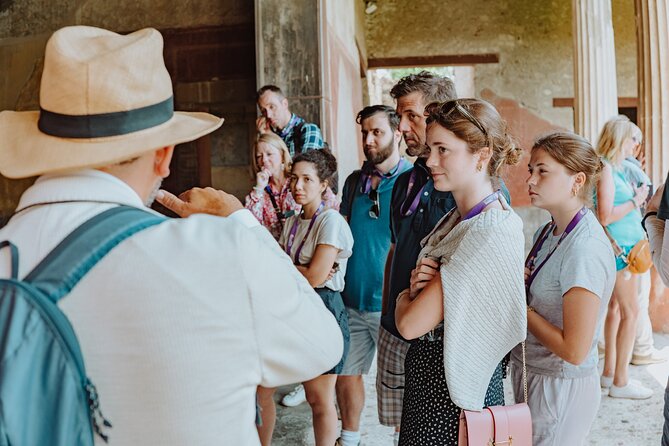
Pompeii, but with a smart plan. This small-group Pompeii tour (max 15) covers the big, memorable sites in about two hours, with licensed guidance that turns ruins into street-level stories. I especially love how the route hits both the public center and private homes, and how the guide explains what you are looking at as you walk. One possible drawback: it is tight and fast, so if you want to linger for photos and slow wandering, you will feel the time pressure.
You get a Pompei Express entrance ticket, plus headsets when the group is larger than 10. That helps when the site gets crowded, and Pompeii often does. At the end, the tour releases you inside the ruins so you can continue at your own pace, which is a great way to balance guided structure with free time.
Key highlights worth your attention
- Max 15 people keeps the pace human and makes questions actually possible.
- Headsets for groups of 10 or more help you hear your guide without craning your neck.
- Pompei Express entrance ticket is included, and several key stops are covered by the admission included in the tour.
- Archaeology-led commentary is a repeat praise point, with guides like Antonella, Camillo Sorrentino, Teresa, and Hugo standing out in reviews.
- A route that mixes public and private Pompeii, from the forum and theater to major houses and the Stabian Baths.
Two hours in Pompeii: small group, big coverage
This is a very practical way to see Pompeii without spending the whole day walking in circles. With a tour size capped at 15, you avoid the worst part of big-group tours: the feeling that you are always sprinting just to stay close to the pack.
The timing matters here. At about 2 hours, you get enough structure to understand the layout, what different buildings were for, and why the “sameness” of Roman walls still tells distinct stories. It is not a slow archaeology seminar. It is a guided walk that helps you decode the city fast.
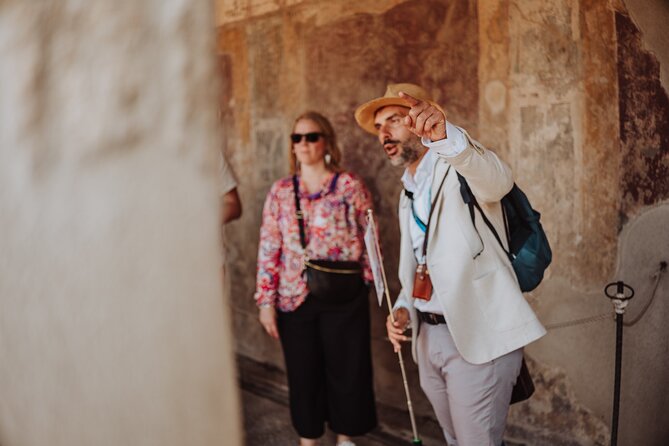
You also get headsets when the group is 10 or more. That is not just comfort. In Pompeii, sound can bounce and people can talk over each other. Headsets make it easier to follow the guide’s explanations as you move from one courtyard or room to the next.
You can also read our reviews of more tours and experiences in Pompeii.

Meeting at Via Villa dei Misteri and finding your Askos guide
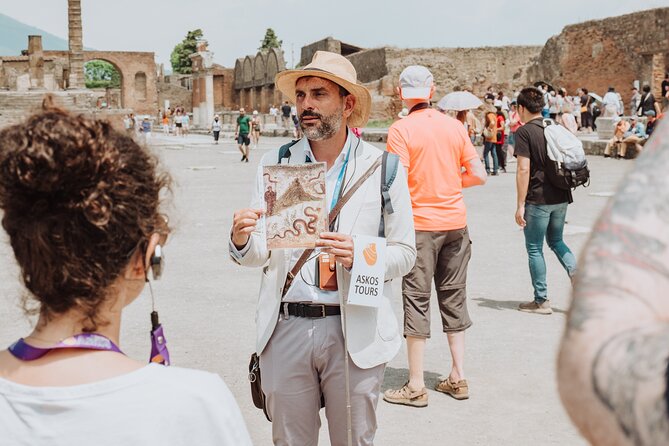
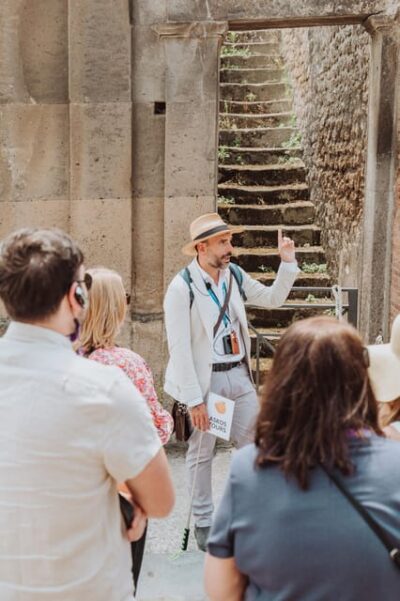
Your day starts at Via Villa dei Misteri, 2. Then, at the first stop, you meet at the main entrance area called Porta Marina Superiore, in front of the Hortus bar & Restaurant. The guide holds an Askos Tours sign, so you can quickly confirm you have the right group.
This sounds minor, but it matters. Pompeii entrances can feel confusing, especially if you arrive right at the start time or you are trying to coordinate with friends. A visible sign and a clear meeting point reduce that first-morning stress.
The tour is offered in English, and the operator notes that service animals are allowed and most people can participate. It also runs near public transportation, so you are not forced into private logistics just to start.
Porta Marina to Vicolo delle Terme: the city’s edges and street life
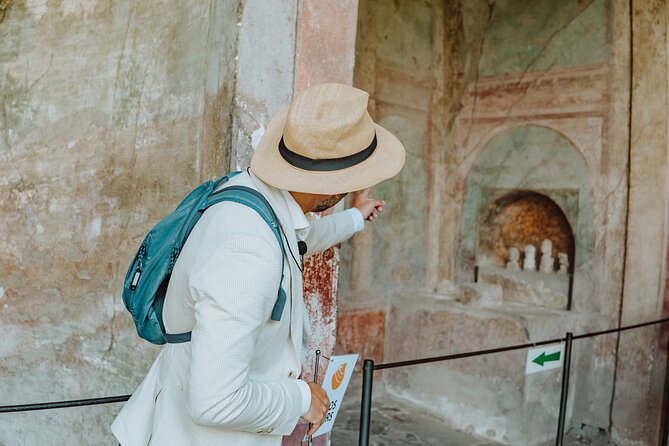
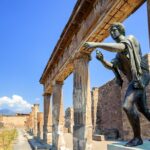
The opening scene is at Piazza Porta Marina, near Porta Marina Superiore. This is a helpful warm-up because it gives you your bearings at the entrance. You are not just paying admission and walking in blind. You are being pointed to how Pompeii is organized.
From there, you move into Vicolo delle Terme, 2. This area includes a basilica that functioned like an open portico, offering shelter for merchants and everyday activity. The value here is that you start seeing Pompeii as a working town, not just a museum of dramatic eruption scenes.
A note on pacing: this is one of the faster parts of the route. It is short, about 10 minutes, so you will get a quick orientation rather than a deep architectural lesson. Think of it as setting the stage.
The Forum at Pompeii: your main-square shortcut to understanding everything
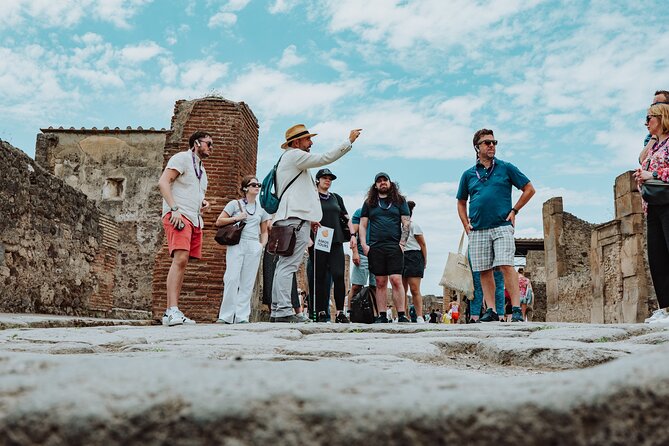
Next comes Foro de Pompeya, the ancient main square. This is the kind of stop that helps you connect the dots. Once you understand the forum as the public heart, the rest of what you see starts to make more sense.
A forum is not just a big open space. It is where civic life happened, where people gathered, where buildings and flows mattered. Standing in the right place with a guide explaining what you are looking at turns vague “ruins” into a readable city plan.
This stop also includes admission as part of the tour, which is a real convenience. You are not juggling ticket rules in the middle of your visit.
Granaries of the Forum: marble details and chilling casts
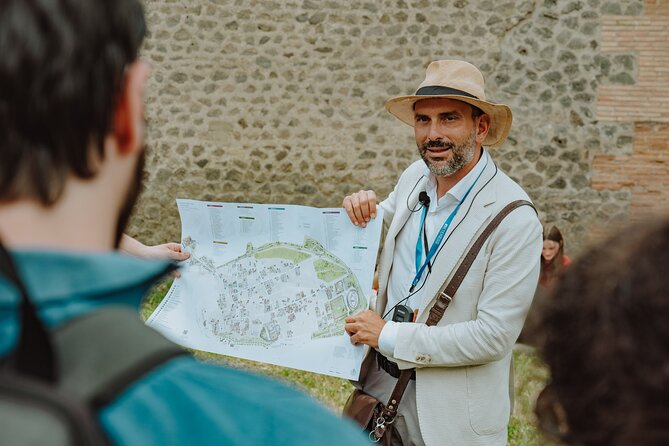
Then you step into the Granaries of the Forum. This is one of those stops where Pompeii’s everyday practicality and human tragedy sit right next to each other.
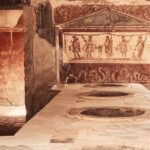
You will see marble tables and features related to baths for fountains that once adorned entrances of houses. That kind of detail is easy to miss on your own, because you are busy staring at the bigger shapes. A guide helps you slow down just enough to notice the refinements.
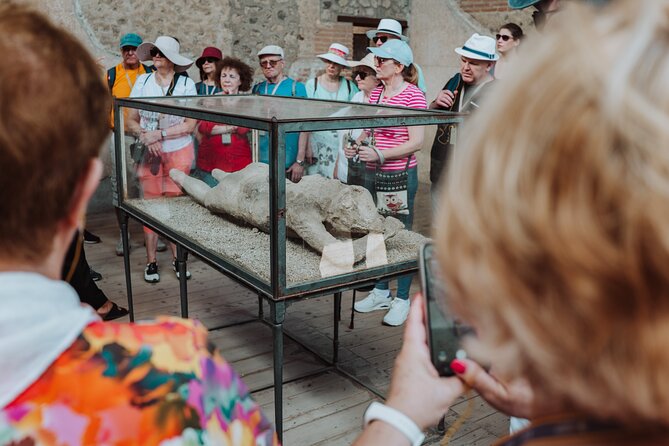
This stop also includes casts of victims of the eruption, and the tour specifically calls out casts of a dog and a tree. The dog detail always hits people, because it reminds you that this was not a staged story. It was life, interrupted.
The stop is around 10 minutes, so you will not have hours here. But it is long enough to absorb what the space is showing you without feeling stuck.

The House of Menander: luxury you can spot, even fast
The route continues into the House of Menander. This is described as one of Pompeii’s richest and most magnificent houses, especially for architecture, decoration, and contents.
Even if you are not a Roman interior-design expert, you can usually tell when a home mattered. This is where you start seeing the contrast between public spaces and wealthy private life. The guide’s job here is to point out what is significant, since houses can feel like “more walls” without context.
This stop is about 15 minutes and includes admission. In a two-hour tour, that is a good amount of time. You get a chance to see multiple parts of the home rather than just getting waved through a doorway.
Stabian Baths and the Lupanar: old thermal life and the city’s adult side
Next up: the Stabian Baths (Terme Stabiane). The tour notes these occupy a vast area and are the oldest thermal complex in the city. That combination, scale plus age, makes this a standout.
You are walking through what used to be a major routine of Roman life. Baths were social, not just functional. They were places to talk, meet, relax, and move through different temperatures and spaces.
A quick heads-up: baths ruins can be visually similar across sites, so the value is in hearing what makes these ones special. If you want to learn without getting overwhelmed, this is a good stop, as long as you listen while moving.
Then you visit the Lupanar, the most famous brothel in the ruined Roman city. It is a famous stop for a reason, and it is also a stop that helps you see Pompeii as complicated and human. Roman cities had all sorts of public life, including adult entertainment.
The tour keeps this portion around 10 minutes. That is the right length for many people. If you are sensitive to the topic, it is still better to get a short, guided explanation than to stumble into it on your own with no context.
House of the Faun and Teatro Grande: big homes to big crowds
After the Lupanar, the route continues to the House of the Faun, described as one of the largest and most impressive private residences in Pompeii. This is a step up in “wow scale” from smaller homes. The guide can help you interpret why the house’s design and spaces signal wealth and status.
This stop is about 15 minutes and includes admission. In that time, you can usually understand the overall layout even if you cannot slow down for every detail.
Then you reach Teatro Grande, the most important theater in Pompeii, around 10 minutes. A theater stop can be tricky if you just think of it as entertainment. But your guide can connect it to civic life: performances were part of how communities shared culture and identity.
The main street walk and where your tour ends
At the end, you walk through the main street of Pompeii. This matters more than it sounds. It gives you a visual sense of movement through the city, how people would have passed storefronts and public spaces, and how far these sights are from each other when you walk it on your own.
The tour ends inside the ruins at Piazza Esedra. The important practical detail: you are free to keep wandering after the guided portion ends. I like that model because it lets you decide what you want to repeat. Want more photos of the forum? Go back. Want to linger in a house that caught your eye? You can.
If you like having a plan but also hate feeling managed, this ending is a nice balance.
Price and value: what $77.06 buys you in the real world
The price is $77.06 per person, and the duration is about two hours. In a place like Pompeii, tickets and timed entry add up fast, and guides matter because ruins are easier to understand with direction.
Here is what makes the price feel reasonable based on what’s included:
- Guidance for the entire duration
- Pompei Express entrance ticket
- Small group (max 15)
- Headsets for groups of 10 or more
- Licensed guide with archaeological background
Food and drinks are not included, and private transportation is not included. That is normal for city-ruins tours, but it affects planning. Bring water, or plan a break after. If you arrive hungry, you will need to solve that yourself.
I also think the real value is not just “what you see,” but how quickly you learn the city. Pompeii can feel repetitive if you do not know what each area is for. A strong guide turns short stops into meaningful understanding.
Guide quality: the kind of archaeologist experience that earns repeat praise
One theme stands out in the names and styles people mention. Guides like Antonella, Camillo Sorrentino, Teresa, Hugo, Nicoletta, and Rafaelle are repeatedly singled out for being prepared and for making the information click.
A couple of things you can look for in the guide experience, even before you book:
- The tour should explain both what you see and why it mattered.
- The guide should help you handle crowd flow, especially on busier days.
- The best guides use practical connections, like how places relate to modern life, not just dry dates.
If you get someone like Antonella or Camillo in the lead role, you are likely to feel that you are watching Pompeii with context instead of just viewing it.
Who this Pompeii tour suits best
This works best if you want a guided structure but still like time afterward to wander.
It is a great fit for:
- First-time Pompeii visitors who want the main hits without losing the plot
- Teenagers and adults who enjoy explanations and architecture
- People who prefer a small group and clear audio support
One caution from the same style of feedback pattern: the information level can feel more suited to older kids and adults rather than very young children. The stops include intense topics like the eruption victims and the brothel, so it is worth considering your group’s comfort level.
If your idea of the perfect day is slow roaming and long museum-style pacing, you might want a longer tour option. But if you want an efficient hit of key sites in about two hours, this is a solid match.
Should you book it?
Yes, if you want Pompeii organized into a smart walk, with a small group and headsets, and if you care about understanding what you are seeing rather than just collecting photos. The Pompei Express ticket and included admissions on major stops reduce friction, and the release inside the ruins at Piazza Esedra is a great way to tailor the rest of your visit.
I would skip it (or pair it with more free time) if you want long stays in each location, because the route is designed to cover a lot in about two hours.
FAQ
How long is the Pompeii small-group tour?
It runs for about 2 hours.
What is the group size limit?
The tour is a small group with a maximum of 15 travelers.
What language is the tour offered in?
The tour is offered in English.
What is the meeting point?
The start meeting point is Via Villa dei Misteri, 2, 80045 Pompei NA, Italy. At the first stop, you meet at the main entrance called Porta Marina Superiore, in front of the Hortus bar & Restaurant, looking for an Askos Tours sign.
Where does the tour end?
The tour ends inside the ruins at Piazza Esedra, 80045 Pompei NA, Italy.
What is included in the tour price?
Included are guidance for the full duration, the Pompei Express entrance ticket, a small-group experience (max 15), headsets for groups of 10 or more, and a licensed guide with an archaeological background.
Is food included?
No. Food and drinks are not included.
Is private transportation included?
No. Private transportation is not included.
Are tickets included for specific stops?
Yes. Admission ticket inclusion is listed for key sites such as Foro de Pompeya, Granaries of the Forum, House of Menander, Stabian Baths, Lupanar, House of the Faun, and Teatro Grande. The first two stops are marked as admission ticket free.
Is the tour suitable for most travelers?
The provided info says most travelers can participate, and service animals are allowed.
More Tours in Pompeii

More Tour Reviews in Pompeii
Not for you? Here's more nearby things to do in Pompeii we have reviewed






Tour Reviews, compared.
 ★ 4.8Pompeii: Entry Ticket and Guided Tour with an ArchaeologistFrom $3519,459 reviews
 ★ 4.2Pompeii: Entry Ticket with Optional Audio GuideFrom $2612,360 reviews
 ★ 4.8Pompeii: Small Group Tour with an ArchaeologistFrom $4012,264 reviews
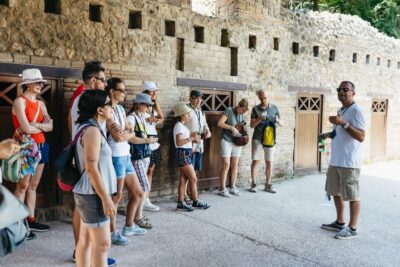 ★ 4.3Pompeii Ruins & Mount Vesuvius Day TourFrom $12011,459 reviews
 ★ 4.6Sorrento, Positano and Amalfi Full-Day TourFrom $10710,988 reviews
 ★ 5.0Sorrento, Positano & Amalfi Coast – Small Group TourFrom $768,643 reviews
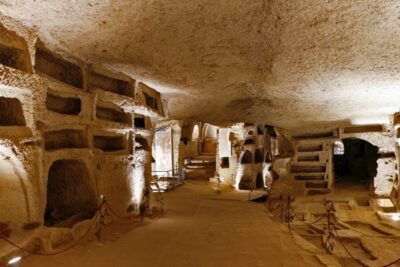 ★ 4.6Catacombs of San Gennaro Entry Ticket & Guided TourFrom $157,941 reviews
★ 5.0Pompeii Small Group Tour with an ArchaeologistFrom $356,593 reviews
★ 4.6Catacombs of San Gennaro Entry Ticket & Guided TourFrom $157,941 reviews
★ 5.0Pompeii Small Group Tour with an ArchaeologistFrom $356,593 reviews