
Tour review · TOUR REVIEWS
Pompeii: Guided Tour with Priority Entrance
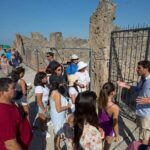
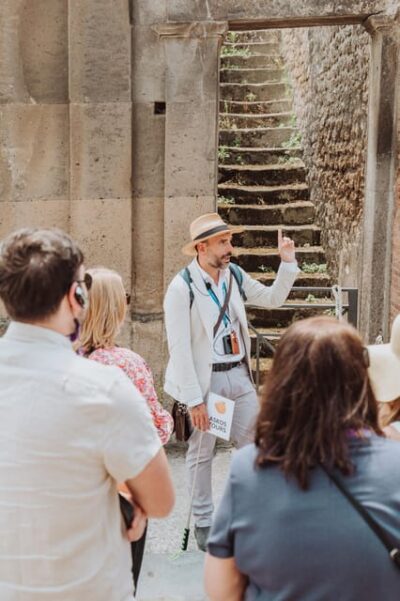
Pompeii is one of those places where timing matters. This guided tour uses priority admission so you spend less time stuck in lines and more time understanding what you are looking at across the Forum and key monuments. It is built for a busy outdoor site, with a licensed guide and headsets in larger groups to keep the story clear.
I love the way this tour connects the dots between buildings and daily life. You see the Forum core of civic life, then the Basilica, the Temple of Jupiter area, and the market street Via dell’Abbondanza, all tied to how Romans actually organized work, worship, and justice.
One thing to plan for: Pompeii is hot and full of uneven ground. Even with priority entry, you will still do a fair amount of walking, plus there are stretches with limited shade.
Key things to know before you go
- Skip-the-line entry helps you get moving faster inside the Pompeii archaeological area
- Official, licensed English guide gives context to what otherwise can feel like scattered ruins
- Headsets are provided in groups larger than 10, so you can follow without sprinting after the guide
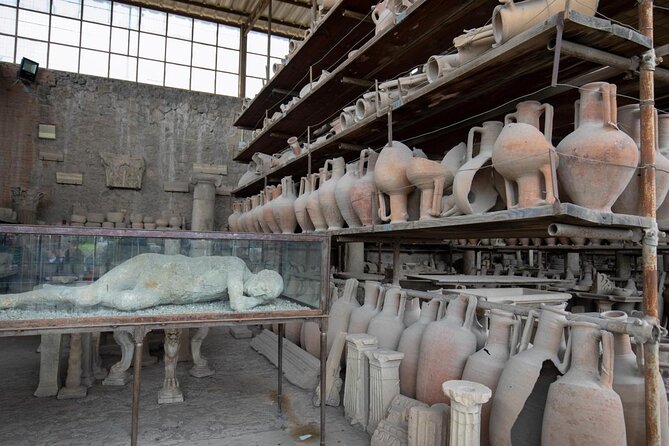
- A tight route in about 2 hours 30 minutes hits the Forum, Baths, Lupanar, mosaics, and theater highlights
- Max group size of 25 keeps the experience manageable
- Bring comfort items like sunscreen and good shoes, because most of the route is outdoors
Why priority entrance really changes Pompeii
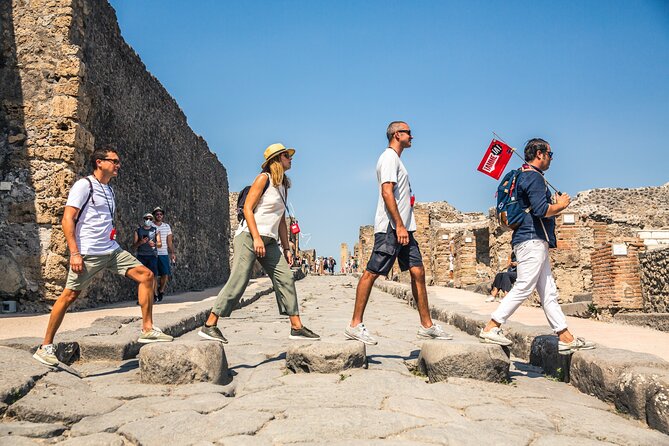
Pompeii is vast, and the worst feeling is arriving and then losing your momentum to queues. With this tour, you get priority admission, which is exactly what you want on a limited-time trip. It is a simple upgrade, but it can be the difference between seeing your key spots with energy versus rushing through them later.
The second big value is that you are not just buying entry. You are buying someone to interpret the layout, the architecture, and the Roman logic behind the sights. You will notice how the Forum area links public worship, administration, and business.
You can also read our reviews of more guided tours in Pompeii


Meet at Camping Zeus and get your bearings fast
Your starting point is Camping Zeus, at Via Villa dei Misteri, 3, 80045 Pompei NA, Italy, near Zeus Car Park. The tour ends back at the same meeting point, so you are not left figuring out how to get across a large site after your guide finishes.
You also get a mobile ticket, which matters when you are in a place where checking in is quick. If you are arriving by public transportation, the meeting area is listed as near public transit, which is helpful for planning a stress-free day.
And with a maximum group size of 25 travelers, the tour tends to feel like a walk with a group, not a mass event. That matters at Pompeii, where it is easy to get separated or stuck behind slow walkers.
The Forum-to-Basilica core route, where Roman civic life comes into focus
The heart of this tour is a classic Pompeii sweep through the places that explain how the city worked. You start with the Archaeological Park of Pompeii and then move through major Forum landmarks, with the guide using headsets where needed so you can keep up.
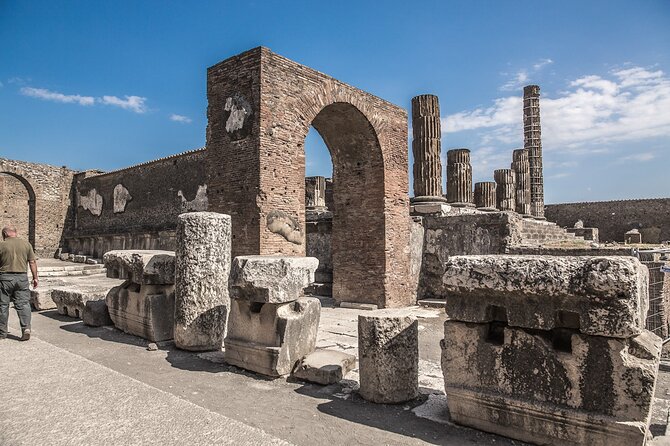
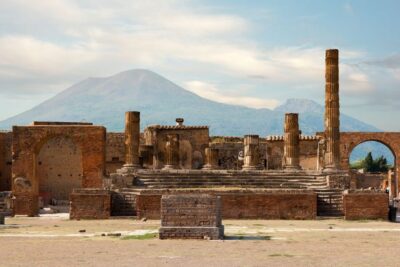
You begin with the Civil Forum, described as the core of daily life. This is where the big public buildings gathered, tied to administration, justice, business management, trade activities, and citizen worship. Standing here, it becomes easier to understand why Pompeii was not just homes and streets, but also a civic machine.
Next is the Temple of Jupiter, positioned on the north side of the Forum with Mount Vesuvius rising behind it. The story gets more specific with the colony’s founding around 80 BC, when the temple was radically renovated into a Capitolium style complex. The guide will connect the statues of Jupiter, Juno, and Minerva, and the idea that they were placed high so people in the Forum square could see them.
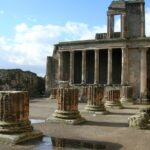
Then you hit the Basilica, one of the most important buildings in the Forum. It covers about 1,500 square meters, and it was used for business and for administration of justice. Even the building details matter here: five entrances from the Forum separated by tuff pillars, and an interior divided into three naves with brick columns capped with ionic capitals.
What to look for: in this area, focus less on trying to memorize names and more on spotting how spaces connect. Pompeii makes that clear. Once you see how the Forum and Basilica functioned together, the rest of the city starts to make more sense.
Macellum and Via dell’Abbondanza: how Pompeii fed people and ran the day
After the civic core, the tour shifts to the commercial and street-life side of Pompeii. The Macellum is one of the most interesting stops because it is described as a tuff quadriporticus with a worship hall. It is also where the “politics of food and cult” feel obvious, because the tour points out details tied to imperial influence.
In the Macellum, you will see references to marble statue copies, a female and a male armed, plus a fragment likely connected to an emperor such as Titus or Vespasian. The guide links those pieces to the idea of imperial cult worship in that market area. You also learn how different rooms were used, including a meeting space for a sacred board and a larger room with a masonry counter that may have served fish sales.
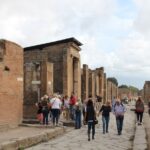
Then comes Via dell’Abbondanza, described as the ancient main street, the decumanus maximus. It ran east and west from the Forum toward Porta Sarno, and the tour frames it as a noisy, packed corridor of daily activity. You will hear how shops and workshops (officinae), cafes, snack-bars, and food places lined the street.
Why this part is worth your time: a guided route can easily become a “look, but don’t touch” parade of monuments. Here, the street-and-market segment brings Pompeii back to human scale. You start picturing the rhythm of a day: commerce, quick meals, errands, and worship woven into one walk.
Baths and brothels, plus the House of the Faun and its Alexander Mosaic
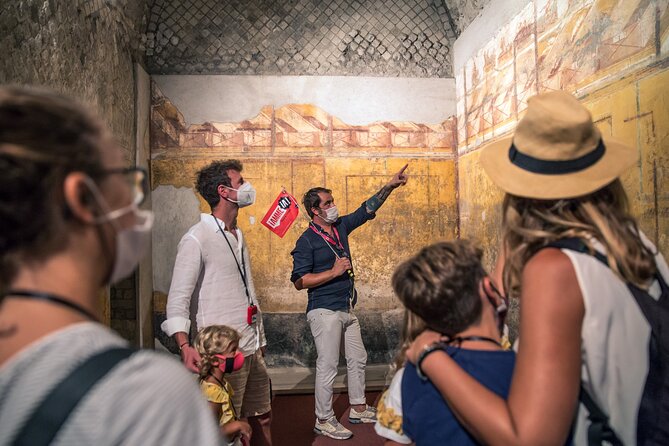
This tour does not avoid the full range of Roman life. After the Forum and street stops, you move into the therms and entertainment side of the city.
The first is the Stabian Baths (Terme Stabiane). These date to just after the colony’s founding of veteran settlers around 80 BC, connected to General Sulla. The guide points out that women and men had separate entrances, then walks you through the men’s sequence, including apodyterium (dressing room), tepidarium (medium-temperature baths), frigidarium (cold baths), and calidarium (hot baths). The stop is listed as about 10 minutes, with the note that admission is free for this segment.
Next is the Lupanar, Pompeii’s famous brothel. This is a short stop, about 10 minutes, and the tour includes admission here. The focus is on the erotic wall paintings and what they reveal about social life and entertainment in Roman Pompeii. The provided details get very specific: many prostitutes are described as Greek and Oriental slaves, and the pay is noted as ranging from two to eight Asses, with a glass of wine costing one As.
If you are traveling with teens or you prefer not to see sexual imagery, this is the stop to think about in advance. The good news is it is brief, and it is framed by the guide in a historical context rather than shock value.
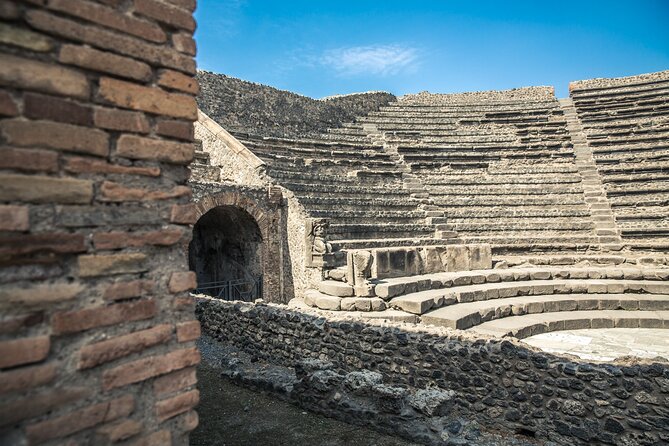
Then the tour moves into high-art Pompeii with the House of the Faun. This grand villa is known for mosaics, and the guide spotlights the striking Alexander Mosaic as a major storytelling masterpiece. After that, you will see the Large Theater, an open-air venue where crowds gathered for comedies, dramas, and musical performances.
Practical takeaway: this stretch gives you Pompeii’s full personality. Civic power and market life are only half the story. Mosaics and theater show ambition and culture, while the baths and Lupanar remind you the Romans had routines, leisure, and social systems that were not “polite museum” things.
Staying comfortable for a hot, uneven, headset-assisted walk
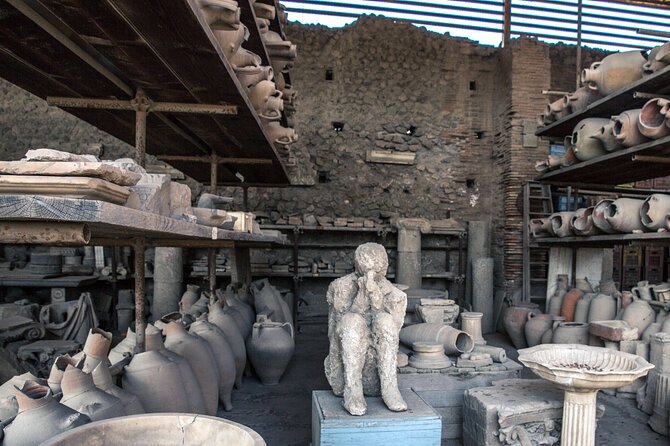
Pompeii is outdoors and uneven. One of the most useful bits of real-world advice from previous participants is simple: wear comfortable shoes and plan for walking on uneven surfaces. You will also want sunscreen, because summer heat can hit hard even when you are stopping for shade.
This tour includes headsets to follow the guide’s commentary in a busy outdoor site, especially for groups over 10 people. That matters because Pompeii can force you to stop and look while the guide moves on. With headsets, you do not have to keep sprinting just to hear what is being explained.
Also, be realistic about pacing. This is about 2 hours 30 minutes total, so you are covering highlights rather than taking your time everywhere. Some stops are listed as short segments (like the baths and the Lupanar), so bring your curiosity, not your desire for slow wandering.
Finally, manage what you carry. If you can travel light, you will enjoy the day more. The tour notes explicitly suggest avoiding heavy bags, and that advice is spot on for an archaeological site where you are constantly stepping around stone, curbs, and uneven paths.
Is the price worth it for Pompeii, at about $59.13 per person?
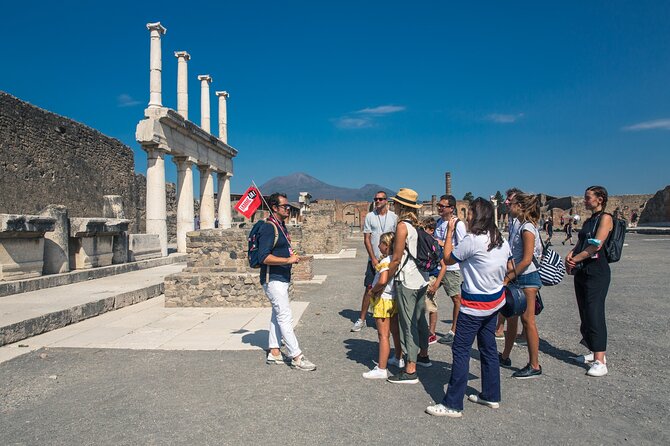
At about $59.13 per person, you are paying for three things that are hard to replace when you self-explore. First is the priority entrance, which saves time at one of Europe’s most crowded ruins. Second is the official, licensed guide, which turns “I see columns” into “I understand what the building was for.” Third is the headset setup that keeps communication workable in a busy environment.
You still need to handle your own timing and comfort. Lunch and transportation are not included, so factor in food stops before or after. Also, there is no promise you will be completely away from crowds, because Pompeii is still Pompeii, but priority entry usually keeps you from being stuck at the worst bottlenecks.
If you value context and efficient use of your time, this price looks fair. If you only care about pictures and are happy reading a guidebook on your own, you might question the added cost, especially with a shorter attention span at ruins.
Should you book this Pompeii guided tour with priority entrance?
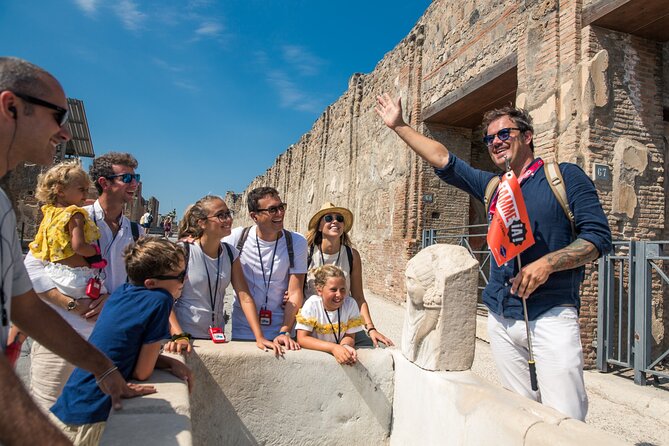
Book it if you want a structured highlights route that explains what you are seeing, with priority access and headsets to keep you connected to the guide. This is a strong choice for first-timers and for anyone who feels overwhelmed by the sheer size of Pompeii.
Consider skipping the tour, or at least setting your expectations, if you strongly dislike group walking, you want to linger for long stretches, or you would rather avoid sexual imagery linked to the Lupanar. In those cases, you might prefer more flexible self-guided time so you can move at your own pace.
Also, aim for a comfortable plan with the weather in mind. The experience requires good weather, and it is hottest on the days you feel it most.
FAQ
How long is the Pompeii guided tour with priority entrance?
It is approximately 2 hours 30 minutes.
What is included in the tour price?
You get a 2.5-hour guided tour, skip-the-line admission to the Pompeii ruins, headphones in Pompeii to hear the guide clearly for groups larger than 10, and an official, licensed guide.
Is the tour offered in English?
Yes, the tour is offered in English.
Where is the meeting point?
You meet your guide at Camping Zeus, Via Villa dei Misteri, 3, 80045 Pompei NA, Italy (Zeus Car Park meeting point). The tour ends back at the meeting point.
What is the maximum group size?
The tour has a maximum of 25 travelers.
Do I get a mobile ticket?
Yes, it is listed as a mobile ticket.
Are there specific stops during the tour?
Yes. The tour covers major sights including the Civil Forum, Temple of Jupiter, Macellum, Via dell’Abbondanza, Stabian Baths, Lupanar, the House of the Faun (including the Alexander Mosaic), the Large Theater, and the Basilica.
Is the Stabian Baths stop admission included?
The Stabian Baths segment is listed as free admission ticket free.
Is the Lupanar stop admission included?
Yes, the Lupanar segment is listed as admission ticket included.
Is lunch or transportation included?
No. Lunch and transportation are not included.
What is the cancellation policy?
You can cancel up to 24 hours in advance for a full refund. If you cancel less than 24 hours before the start time, the amount paid is not refunded.
More Guided Tours in Pompeii



More Tours in Pompeii

More Tour Reviews in Pompeii
Not for you? Here's more nearby things to do in Pompeii we have reviewed





Tour Reviews, compared.
 ★ 4.8Pompeii: Entry Ticket and Guided Tour with an ArchaeologistFrom $3519,459 reviews
 ★ 4.2Pompeii: Entry Ticket with Optional Audio GuideFrom $2612,360 reviews
 ★ 4.8Pompeii: Small Group Tour with an ArchaeologistFrom $4012,264 reviews
 ★ 4.3Pompeii Ruins & Mount Vesuvius Day TourFrom $12011,459 reviews
 ★ 4.6Sorrento, Positano and Amalfi Full-Day TourFrom $10710,988 reviews
 ★ 5.0Sorrento, Positano & Amalfi Coast – Small Group TourFrom $768,643 reviews
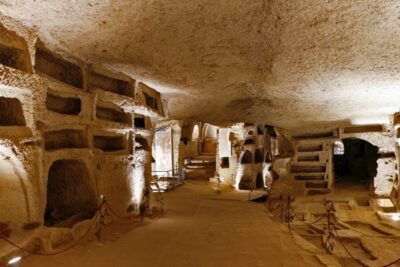 ★ 4.6Catacombs of San Gennaro Entry Ticket & Guided TourFrom $157,941 reviews
★ 5.0Pompeii Small Group Tour with an ArchaeologistFrom $356,593 reviews
★ 4.6Catacombs of San Gennaro Entry Ticket & Guided TourFrom $157,941 reviews
★ 5.0Pompeii Small Group Tour with an ArchaeologistFrom $356,593 reviews