
Tour review · TOUR REVIEWS
Pompeii Tour & Admission included in a Small Group
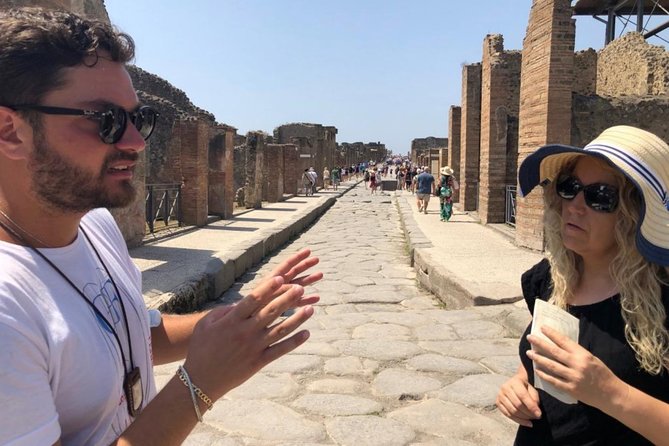
One city, two hours, and a lot of Roman drama. This small-group Pompeii tour is built to help you grasp what you are looking at fast, from the grand public heart of town to the daily-life details, all while Mt. Vesuvius looms in the background. You start at the Villa of the Mysteries area and walk into the main Pompeii gate at Porta Marina with a guide who keeps the story moving.
I especially like two things: first, the Pompeii admission ticket is included, so you are not juggling paperwork while you are trying to enjoy ancient streets. Second, you get real interpretation of daily life, with stops that cover temples, markets, baths, eateries, and major homes in a way that feels practical, not just name-dropping.
One possible drawback is the pace and the ground. Pompeii is uneven, with curbs and stepping stones, and some indoor or guarded areas can be seasonal or close earlier in the day. If you want a slow, deep excavation-focused visit, this route may feel like highlights more than a full scholarly walkthrough.
Key highlights you should plan around
- Admission included, so you can focus on the ruins instead of tickets
- Small group size (up to 15), which helps you keep track of the guide and move efficiently
- Headset support when it gets crowded, so you do not have to strain to hear
- Porta Marina to the Roman Forum route, built around how Pompeii worked day to day
- Daily-life stops like a thermopolium, baths, and the Macellum marketplace
- Iconic domus and theaters, including the Casa del Fauno and the Teatro Grande
Starting at the Villa of the Mysteries, then Porta Marina
Your tour meeting point is the Villa of the Mysteries area, on Via Villa dei Misteri (Villa dei Misteri, 2, 80045 Pompei). After check-in, you head into the site so the “first steps” are handled for you. That matters at Pompeii, because the entrance area can feel like a maze if you show up with only a map and big expectations.
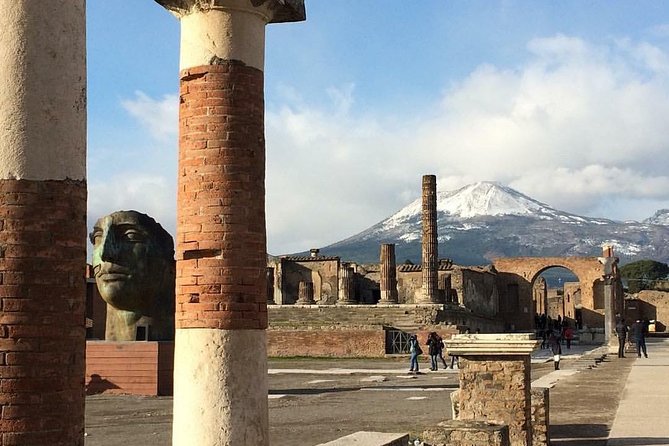
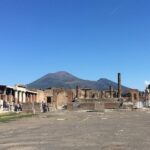
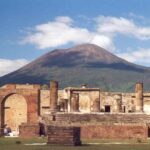
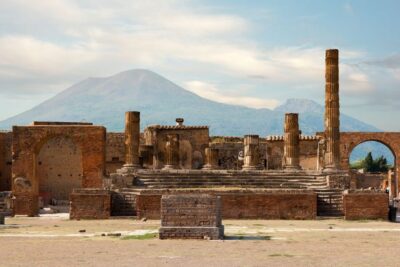
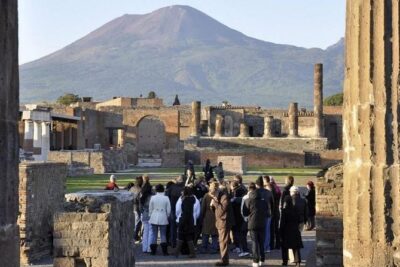
Once you join at the main entrance of Porta Marina, Mt. Vesuvius is part of the visual setup, not just a distant landmark. The guide uses that geography to frame the city’s last moments and the eruption of 79 AD. It is a simple trick, but it makes the ruins feel less like scattered stone and more like a place with consequences.
You also get a mobile ticket plus a paper map. In plain terms, this is a “do not get stuck” combo. The map helps you orient yourself even after the guided portion ends, and the mobile ticket reduces the chances of last-minute confusion when you are standing in line.
You can also read our reviews of more tours and experiences in Pompeii.
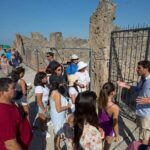
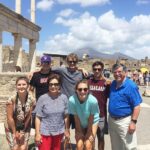
How the 2-hour route stays focused (12 stops, 10 minutes each)
The whole experience runs about 2 hours, and the route is structured as a sequence of quick, high-impact stops. That means you will see a lot, but you will not linger for an hour in one area. Each major stop is about 10 minutes, which is actually a smart way to handle Pompeii’s sprawl.
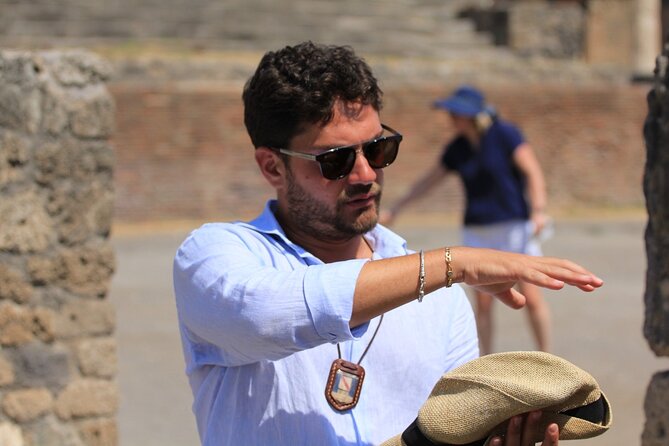
The guide’s job here is speed with accuracy. You get context first, then you move on. That is why the walking feels productive instead of exhausting. It also helps first-timers, because Pompeii can overwhelm you if you are just drifting around.
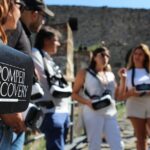
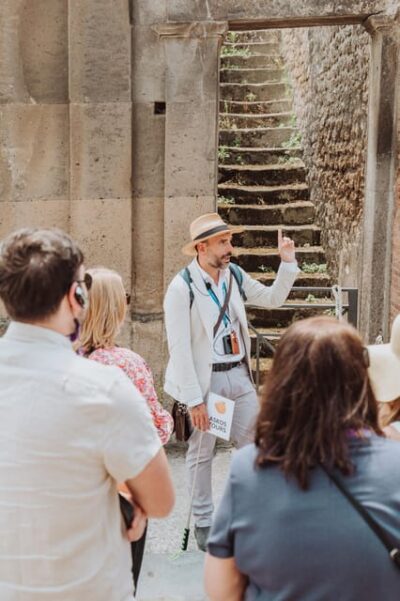
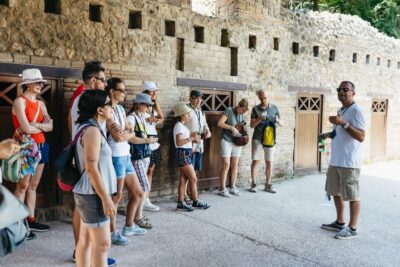
A small group size is part of the plan, with a stated maximum of 15 travelers. If the site is crowded, you receive a headset, which is a big quality-of-life upgrade. Pompeii is loud in a busy way, and headsets cut out the constant “what did they say?” moments.
There is sometimes a little breathing room near the route, so you can look around on your own after the key interpretation. If you are the type who wants to take photos without feeling guilty for slowing the group, this format can work well.
Porta Marina to the Roman Forum: the city’s main stage
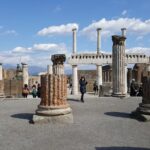
The longest and most substantial part of your visit is the main Archaeological Park of Pompeii stop. You begin at Porta Marina and then walk through spaces that explain how Pompeii operated. The focus is not only on pretty ruins, but on how Romans lived in public.
Here are the kinds of areas you will move through:
- the Roman Forum, the civic center where decisions happened and people gathered
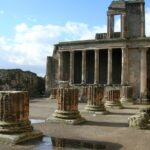
- the Basilica, a major administrative building tied to business and justice
- market-area zones and the main temples
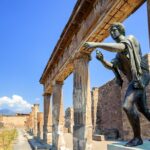
- the Decumanus Maximus, Pompeii’s main east-west street
- a major baths stop on this axis, described as recently reopened
- standout domus and Roman shops, including places like thermopolia and bakeries
This is also where the guide connects the eruption story to what you see. You get the drama of 79 AD, but anchored to street-level realities: how the city was laid out, where people spent time, and how public buildings shaped daily behavior.
If you love architecture, this stop gives you enough Roman structure to make the rest of your Pompeii day make sense. You will see big civic spaces, then turn around and realize that the same streets still connect you to homes, shops, and entertainment.
Temples in short stops: Venus, Apollo, and Jupiter over Vesuvius
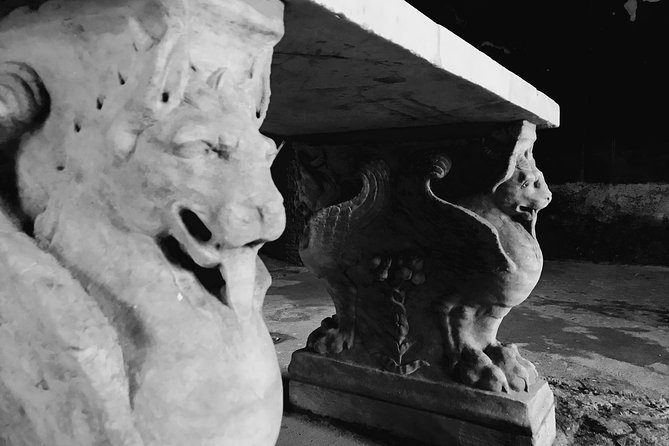
After the main park introduction, the tour uses a set of quick, targeted religious stops. These are smaller time blocks, but they help you understand Pompeii as a living belief system, not just a set of ruins.
You visit:
- Tempio di Venere (Temple of Venus), dedicated to Venus, patron goddess of Pompeii
- the Sanctuary of Apollo, among the oldest worship places in Pompeii, placed strategically along the road that leads toward the public heart
- Basilica again in the tour route context, as a major Forum building used for administration and justice
- Forum – Main Square, the center of daily life
- Tempio di Giove Capitolino (Temple of Jupiter), positioned to dominate the northern side of the Forum with Vesuvius rising behind it
Even though these stops are quick, the “why here” explanation is the value. Pompeii religion is urban. Temples are not off by themselves in a field. They shape routes and sightlines. When you stand in the Forum area and see how Vesuvius frames certain views, the city starts to feel planned for both daily routine and spectacle.
Also, these stops are listed as admission free within the tour framework. Practically, that means you are not paying again or thinking about ticket types while you keep moving.
Macellum and the Forum Baths: where food and daily rhythm meet
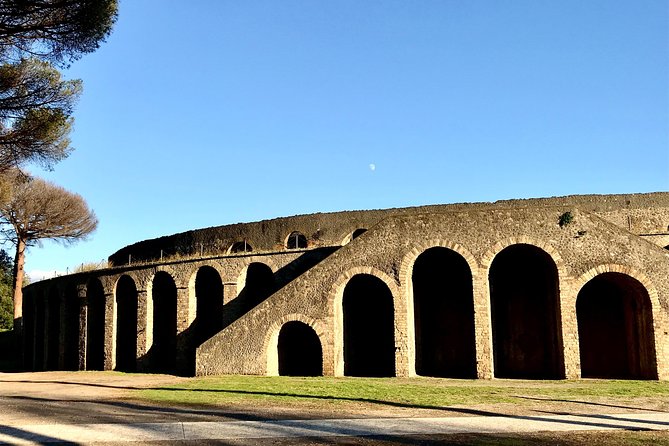
This is one of the tour’s strongest “daily life” sections. Pompeii is famous for big monuments, but the food and water infrastructure is what makes it feel human.
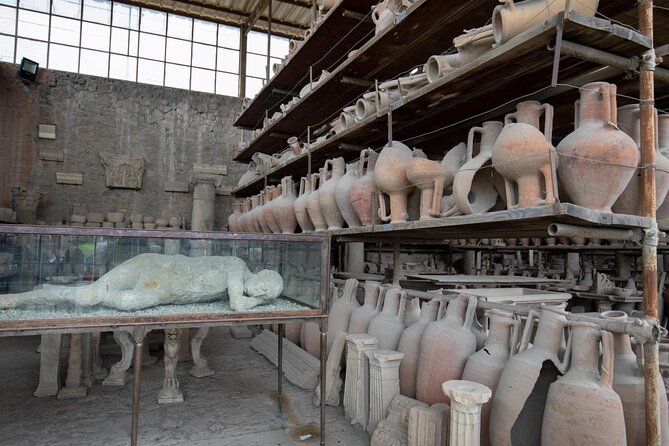
You stop at the Macellum, a monumental marketplace building used for selling food and daily products. What makes this stop more memorable is the mention of plaster casts of bodies as part of the presentation there. Seeing those casts changes the atmosphere in a quiet way. It is no longer just “ruins with Roman style.” It becomes human scale.
Then you go to Terme del Foro (Forum Baths). This area is described as one of the best-preserved parts of the city. An important detail here is the layout: separate entrances for women and men. That kind of information is exactly why a guide matters. Even when you can see the rooms, you may not immediately infer how the building functioned socially.
If you are the type who likes to learn how people actually spent a regular day, these are the stops that will stick in your head after you leave. Food, bathing, and shopping are universal. The Roman version is what makes Pompeii so mind-blowing.

Thermopolium snacks and the Via dell’Abbondanza street walk
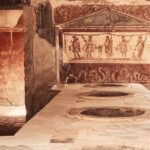
Next you hit a thermopolium stop, described as Termeopolio di Vetuzio Placido. A thermopolium is basically an ancient refreshment place, a place to grab food without cooking at home. That detail turns Pompeii streets from “museum walk” into “lived environment.”
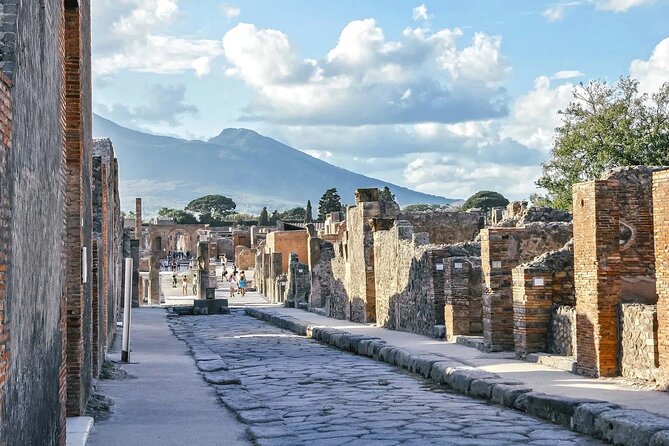
From there, you go to Via dell’Abbondanza, the ancient main street, identified in the route as the Decumanus Maximus. This is the artery of town, and it helps you picture movement patterns: who walked where, where storefronts likely fed the street, and how people connected home, work, and public squares.
One practical bonus to this section is the mental map it creates. Once you understand the main street axis, you are less likely to feel lost if you decide to explore on your own afterward.
Casa del Fauno and the Vettii Houses: home life and seasonal access
The tour includes both major house experiences in the middle of the walking route.
You see:
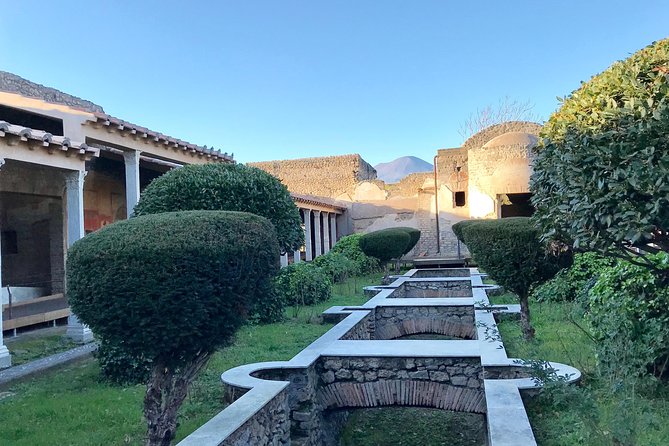
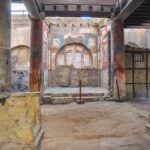
- Casa del Fauno (House of the Faun), one of the largest houses in Pompeii, with a welcome inscription (HAVE) in Latin on the sidewalks
- House of the Vettii (referred to as the Vettii houses in the tour details), placed under the protection of Priapus, god of prosperity
There is one important consideration: these house interiors are said to be subject to seasonal openings and closings. In plain terms, that means what you can see may vary based on the day. You might get the full experience, or you might have to make do with what is open at that moment.
Still, even when access is limited, the guide can help you connect what you see to how wealthy Romans lived. A big house is not just big. It is a status signal, a social stage, and a map of daily movement inside the home.
If you want to understand why Pompeii feels so intimate for such a huge archaeological site, the domus stops are a major reason.
Teatro Grande: comedy, tragedy, and public entertainment
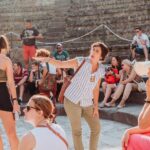
You end at Teatro Grande. The theater is described as a place where performances in the Greco-Roman tradition took place, including comedies and tragedies.
This stop matters because it rounds out the city picture. Pompeii is not only about religion, courts, and commerce. It also includes public entertainment, and the theater shows how Romans used shared spaces to keep culture communal.
In a two-hour tour, ending with a major public venue is a smart storytelling move. It gives you a sense of how people gathered, not just where they lived and worked.
What to bring, and how to avoid the common Pompeii pain points
Pompeii is rewarding, but it punishes sloppy footwear. Expect uneven terrain, with curbs and stepping stones. One review detail also suggests the ground can be challenging even for people who are generally fine on foot.
Here’s how I’d plan your kit for this tour:
- Wear shoes with solid grip. Avoid slick soles.
- Bring your own water. Bottled water is not included, and two hours can still make you thirsty.
- Charge your phone or bring a small power bank if you want to use the map after the tour.
- If you get a headset, keep it handy and clean. It is a gift when the site gets busy.
One more timing note: some guarded or specific areas can close earlier than you want, depending on the day and rules on site. If your schedule is tight, having a guide who knows where the exits are helps a lot.
Price, value, and what you are really paying for
At $66.01 per person for an about two-hour visit, you are paying for more than “someone walking you through ruins.”
You are paying for:
- Pompeii admission included, so you skip the hassle and cost of buying separately
- an authorized guide or archaeologist, meaning you get interpretation, not just navigation
- headset support if the site is crowded
- a paper map that helps you keep your bearings
Value jumps when you consider how much Pompeii can cost you in time. If you arrive with no plan, you can burn an hour just trying to locate the right streets and buildings. This tour’s whole structure is meant to prevent that.
There is one fairness note. The tour is a highlight route. If you are hoping for a deep explanation of excavation methods and how finds are processed, this is probably not the best fit. It is focused on the city you can walk through and understand.
Which guide style matches your day?
From the guide names attached to past experiences, the pattern is clear. People describe guides like Livio, Antonio, Riccardo, Ornella, and Annalisa as engaging, enthusiastic, and strong at connecting Pompeii’s details to the broader story.
That matters because Pompeii can be technical. When a guide keeps the tone respectful and the pacing clear, the site becomes easier to absorb.
If you are traveling with kids, you will also like the high-energy style reported for at least one tour where the guide kept children engaged. Even if your group has no kids, a lively guide makes the stops feel less like a lecture and more like a conversation you get to walk with.
Should you book this Pompeii tour with admission included?
Yes, I think you should book it if you want a smart first Pompeii day without ticket hassles. The best reasons are simple: admission is included, the group stays small, and the route covers both the big-picture civic spaces and the everyday details that make Pompeii click.
You might skip or choose a different style if:
- you want a slow, deep excavation-focused approach
- you plan to spend extra hours hunting for one specific house, bakery, or excavation trench
- you struggle with uneven stone paths and are looking for a low-impact visit
If you want an efficient, high-impact Pompeii introduction that helps you understand what you are seeing as you walk, this tour earns its place. Then, if you still want more, you will be well-positioned to explore further on your own because your internal map will already be built.
FAQ
How long is the Pompeii tour?
The tour is about 2 hours.
Is Pompeii admission included in the price?
Yes. Admission to the Pompeii site is included.
What language is the tour offered in?
The tour is offered in English.
How many people are in the group?
The group maximum is listed as 15 travelers.
Do I get a ticket on my phone?
Yes. The tour includes a mobile ticket.
Is there a paper map?
Yes. A Pompeii paper map is included.
Will I have trouble hearing the guide in a crowd?
Headsets are provided in case the site is crowded.
Where does the tour start and end?
It starts at the Villa of the Mysteries (Via Villa dei Misteri, 2, 80045 Pompei NA, Italy) and ends back at the meeting point.
Is bottled water provided?
No. Bottled water is not included.
Will all house interiors be open?
Some homes are described as subject to seasonal openings and closings, so access can vary by day.
More Tours in Pompeii

More Tour Reviews in Pompeii
Not for you? Here's more nearby things to do in Pompeii we have reviewed



Tour Reviews, compared.
 ★ 4.8Pompeii: Entry Ticket and Guided Tour with an ArchaeologistFrom $3519,459 reviews
 ★ 4.2Pompeii: Entry Ticket with Optional Audio GuideFrom $2612,360 reviews
 ★ 4.8Pompeii: Small Group Tour with an ArchaeologistFrom $4012,264 reviews
 ★ 4.3Pompeii Ruins & Mount Vesuvius Day TourFrom $12011,459 reviews
 ★ 4.6Sorrento, Positano and Amalfi Full-Day TourFrom $10710,988 reviews
 ★ 5.0Sorrento, Positano & Amalfi Coast – Small Group TourFrom $768,643 reviews
 ★ 4.6Catacombs of San Gennaro Entry Ticket & Guided TourFrom $157,941 reviews
★ 5.0Pompeii Small Group Tour with an ArchaeologistFrom $356,593 reviews
★ 4.6Catacombs of San Gennaro Entry Ticket & Guided TourFrom $157,941 reviews
★ 5.0Pompeii Small Group Tour with an ArchaeologistFrom $356,593 reviews