
Tour review · TOUR REVIEWS
Pompeii tour with LOCAL GUIDE and SKIP THE LINE entrance
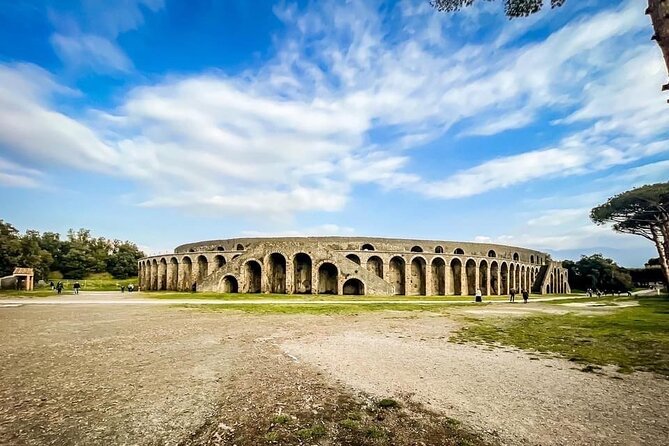
Pompeii feels uncomfortably close. This skip-the-line visit, led by a local guide, packs the best-known areas into about 2.5 hours, starting near the Via Villa dei Misteri entrance. You’ll also have a chance to stay inside after the guided portion and soak up the ruins on your own.
Two things I really like are the daily-life focus and the max 14 group size. The tour doesn’t just point at famous stones. It explains how people ate, worked, loved, bathed, and governed, in the very places you can still walk. And with a smaller group, the guide can slow down when you ask questions.
The main drawback is the time limit. If Pompeii is a bucket-list once-in-a-lifetime stop, 2 to 2.5 hours can feel fast, especially if you want to linger in every room or shop for souvenirs after you’ve finished learning.
Key things to notice on this Pompeii tour
- Priority entry gets you moving quicker once you reach the ruins.
- Casa del Menandro includes atrium frescoes tied to stories from the Iliad and Odyssey.
- Lupanar details explain the brothel layout, including built-in beds and the corridor’s wall scenes.
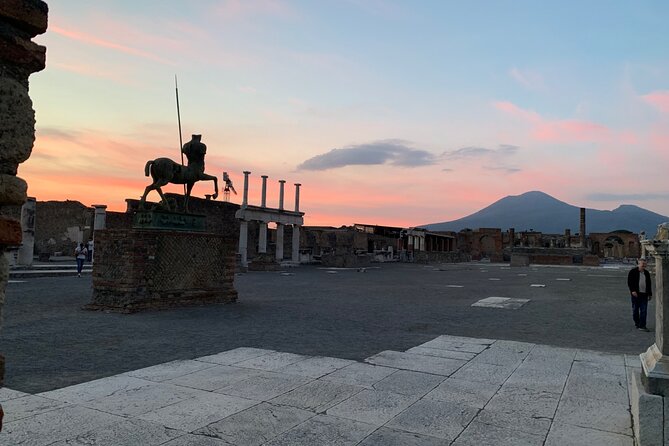
- Forum of Pompeii orientation sets up where key buildings sat, and how the square’s axis relates to Vesuvius.
- Stabian Baths are the oldest thermal complex you can still visit at Pompeii.
- Extra time after the guide lets you return to what interested you most.
Skip-the-line entry that saves queue time
Pompeii can mean long lines at the entrance, especially when multiple tour groups hit at once. This experience builds in priority service, so you’re not stuck waiting while everyone else streams in. You also use a mobile ticket, which keeps your day simpler once you’re there.
What matters most is not just speed. It’s stress. When you lose 30 to 60 minutes to waiting, you end up rushing through the ruins to make the rest of your day work. Here, you’re more likely to arrive already in the right rhythm for looking closely.
You can also read our reviews of more guided tours in Pompeii



Meeting at Via Villa dei Misteri and planning your arrival
The meeting point is Via Villa dei Misteri, 3, 80045 Pompei (NA), Italy. The tour also ends back at the same meeting point, so you’re not left figuring out transit or how to get back after a fast-moving day.
Because this is a busy archaeological site and the area around it can be a bit confusing, I’d plan to arrive a little early. One guest experience flagged that meeting-point directions can be unclear, and arriving late can turn into a domino effect with trains and timing. Give yourself buffer time and you’ll enjoy the start more.
Group size stays small, with a maximum of 14 travelers. That’s not just a comfort thing. It helps the guide manage the flow through tight spaces without constant bottlenecks.
Stop 1: The Archaeological Park walk, built around the city’s “frozen moment”
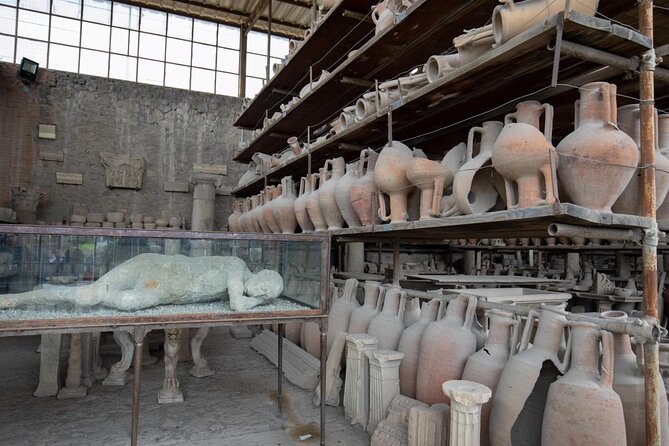
Your visit begins at the Archaeological Park of Pompeii. This is the part where Pompeii stops being a photo and becomes a place you can understand. The big idea is preservation. Volcanic ash trapped the city and its people, giving historians and archaeologists a rare, street-level snapshot of Roman life nearly 2,000 years ago.
You’ll get an orientation-style walk that explains why Pompeii feels like time stopped mid-scene. Excavations began in the 18th century, and after roughly 250 years, about 75% of the site has been brought to light. That context helps you read what you’re seeing, and it also explains why some areas feel fully exposed while others look like they’re waiting for the next reveal.
What you’ll want to do during the first stretch
- Watch how the guide frames each area as daily routine, not random ruins.
- Look for street-level clues, like where people would have moved between homes and public space.
- Ask questions early. Early answers stick, and the rest of the tour makes more sense.
The tradeoff
Stop 1 is about the groundwork, and it’s time-heavy. If you love pure wandering with no schedule, you’ll feel the clock here, because the tour continues to specific targets after this initial park walk.
More Naples tours, ruins, coast days, and city experiences to compare



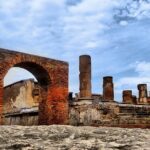

Casa del Menandro: Frescoes, a named portrait, and the “ordinary” luxury of banquets

Next comes Casa del Menandro, a large home that gives you a feel for how higher-ranking families lived. Houses like this are where Pompeii stops looking like a museum and starts looking like neighborhoods.
You’ll see an atrium with frescoes that reference stories from the Iliad and the Odyssey. Even if you do not know every character or scene, the guide’s pointing helps you understand the household’s values. These paintings weren’t random decoration. They were identity.
This house also shows the layered, practical side of wealth. It’s known as Casa del Menandro because of a portrait of Menander, an Athenian playwright, placed in the porch. Beneath the house area, there’s an underground room that was likely used for storage, possibly a cellar. One standout detail is a hidden treasure discovered during restoration: a chest with 118 pieces of silverware, now exhibited in the National Archaeological Museum of Naples. Pottery forms connected to serving wine and banquets round out the picture, making the whole stop feel real, not theoretical.
The “quiet wow” you might miss if you rush
Look for how many clues are about hosting and everyday routines: food service items, storage space, and the way rooms connect. These are the kinds of details that make your understanding stick after you leave Pompeii.
The drawback of this stop
Casa del Menandro is limited by the overall tour timing. It’s fascinating, but the time is tight, so if you want to read every wall and floor-level feature yourself, you’ll likely want to plan extra independent time later.
Lupanar: Brothel layout, price details, and the corridor story
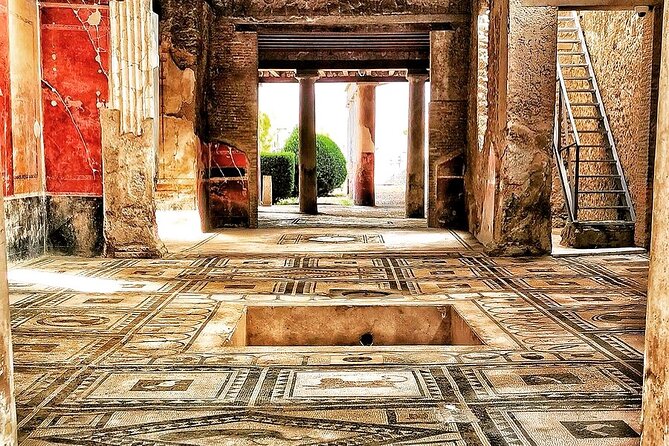
Then you’ll reach the Lupanar, and this part is not for everyone. It shows the Roman world as it actually was, including the economy of paid sex. The tour explains that the prostitutes were mostly Greek and Oriental slaves, and that services were described as costing between two and eight asses, with a cup of wine costing one.
What makes this stop educational is the layout. The building has two floors. On the upper level, there were spaces tied to owners and slaves. On the lower level, you can picture five rooms positioned on either side of a corridor, with built-in bed space and curtains that could close off the rooms from the corridor.
One very specific visual anchor is the latrine visible under the stairwell area. Those physical details keep the building grounded and prevent it from turning into vague scandal.
You’ll also hear about the wall images in the central corridor, where small erotic depictions acted like a public-facing advertisement for what customers could expect. The name comes from Latin lupa, meaning prostitute.
Important note for your comfort
This is adult-themed content, and the tour is honest about it. If you’re traveling with kids or you prefer light and gentle explanations, you may want to adjust your expectations before you go in.
Forum of Pompeii: Where administration, justice, and business met
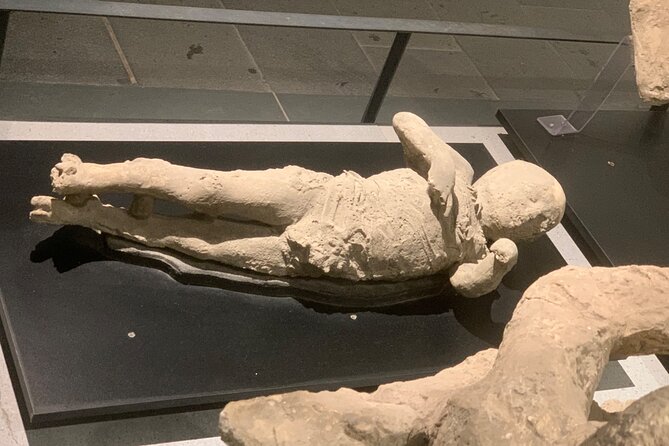
After the Lupanar, the tour shifts back into civic power with the Forum of Pompeii. This is the core of daily life in the city. Public buildings for administration and justice faced the square, and commercial activity flowed around it.
You’ll learn how the Forum changed over time. Originally it was more of an open area with rammed earth. The guide explains that on the west side sat the Sanctuary of Apollo, while the east side had a row of shops. Later changes in the III to II century BC regularized the space, adding arcades and paving with tuff slabs.
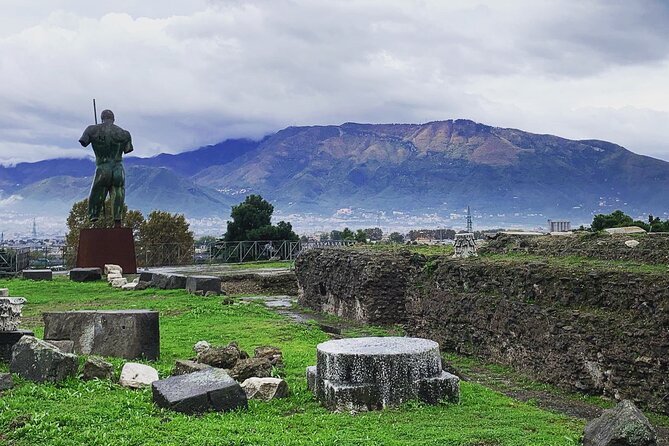
One detail I like because it gives you a way to “see” the city’s structure is the axis idea. The square’s axis lines up toward the facade of the Temple of Jupiter, placed in line with Vesuvius. That’s the kind of spatial clue that turns a flat square into a meaningful stage.
At imperial age, the Forum was paved again with travertine slabs. Some slabs include recesses made to accommodate bronze letters from a major inscription. If the guide points them out, you’ll feel how messaging and governance literally sat in the street scene.
A quick way to enjoy this stop more
Stand where the guide tells you and keep an eye on alignment. When you understand the axis, the Forum reads like a plan, not a pile of stones.
Stabian Baths: Roman bathing, buried and rediscovered
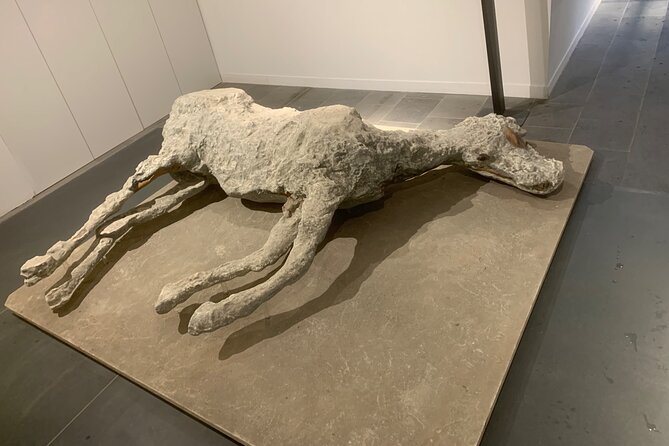
The final major stop is the Stabian Baths (Terme Stabiane). These are Roman thermal baths, buried by the eruption in 79 and later rediscovered through excavation. The highlight here is simple: of their kind, the Stabian Baths are described as the oldest building in Pompeii.
Bath complexes were social spaces, not just hygiene. People met there, talked, relaxed, and kept up routines. That context helps you interpret what you’re walking around, even though the time you spend on the baths is shorter than your first stop.
Why I think this stop is worth the time
It rounds out the story. After homes, sexual commerce, and the civic heart, you end with a place where the city’s routines would have repeated again and again.
Who your guide might be, and why names keep coming up
Guides clearly make a difference with Pompeii. In the feedback connected to this experience, a few names come up with strong praise.
Antonio is noted for being kind to younger travelers and for making the ruins interesting in a way that lands for families. Anna is mentioned as patient when meeting up was delayed by train issues. Gennaro (and the provider name listed as Gennaro Balzano) shows up as both friendly and funny, with an emphasis on answering questions without rushing people out the door. Sasa is described as informative, with guests appreciating the way explanations connected the city’s pieces.
So what should you expect as the practical takeaway? Look for a guide who slows down for questions and who can explain why each stop matters. If you get that kind of guide, Pompeii can feel like a guided conversation instead of a checklist.
Price and value: What $66.38 buys you in the real world
At $66.38 per person, you’re paying for more than walking into Pompeii. This ticket package includes entry tickets, an authorized local guide service, and priority service to skip the line. You also get a mobile ticket, which reduces hassle on the ground.
The value is strongest if you’re the kind of traveler who wants clear direction. Pompeii is big, confusing, and easy to underuse if you go without a guide. With this format, you’re not trying to cover everything. You’re getting a focused circuit through major “what daily life looked like” moments.
The one thing to keep in mind is that the tour is short. If you are hoping for a long, slow, wall-by-wall experience, the time limit will be the weak link. A guest specifically called out wishing they had booked longer so they could see and learn more.
Who this Pompeii tour fits best
This tour is a great fit if you want:
- A first Pompeii visit with smart highlights and explanations that connect the dots.
- Short on time, but still want a guided experience rather than wandering without context.
- A small group vibe with up to 14 travelers, which makes it easier to ask questions.
- Family-friendly engagement, since guides have been praised for working well with kids.
It may be less ideal if you:
- Want to spend a lot of time in one or two buildings, reading and re-reading.
- Plan to take lots of photos with long pauses and backtracking.
- Need extra time to process adult-themed content at the Lupanar stop and prefer a more flexible pace.
Should you book this Pompeii skip-the-line tour?
If you want a guided Pompeii experience that gets you in quickly, shows you several iconic sites, and leaves you with enough momentum to explore afterward, I’d say yes. The combination of skip-the-line priority, an authorized local guide, and a carefully chosen set of stops is a solid way to turn limited time into real understanding.
If Pompeii is your one chance and you hate feeling rushed, consider a longer or private format so you can linger. You’ll get more out of Casa del Menandro, the Forum, and the baths when you’re not racing between them.
Ultimately, book this if you want the best “highlights with context” in one clean half-day window. Skip it if your top priority is slow, deep independent wandering with lots of empty time.
FAQ
How long is the Pompeii tour?
The tour is listed at about 2 hours 30 minutes.
Where do I meet for the tour?
You meet at Via Villa dei Misteri, 3, 80045 Pompei NA, Italy.
Does this tour include skip-the-line entry?
Yes. The tour includes priority service to skip the line for entry.
Are entrance tickets included?
Yes. Entrance tickets are included.
What language is the tour offered in?
The tour is offered in English.
What group size should I expect?
There is a maximum of 14 travelers.
Will I receive a mobile ticket?
Yes. The tour uses a mobile ticket.
Is there time to explore after the guided part?
There is a possibility of remaining inside the excavations after the guided tour.
Is the experience refundable?
No. It is non-refundable and cannot be changed.
What if the tour is canceled due to poor weather or low traveler numbers?
The experience requires good weather. If canceled due to poor weather, you’ll be offered a different date or a full refund. If canceled because the minimum number of travelers isn’t met, you’ll also be offered a different date or a full refund.
More Guided Tours in Pompeii



More Tours in Pompeii


More Tour Reviews in Pompeii

Not for you? Here's more nearby things to do in Pompeii we have reviewed








Tour Reviews, compared.
 ★ 4.8Pompeii: Entry Ticket and Guided Tour with an ArchaeologistFrom $3519,459 reviews
 ★ 4.2Pompeii: Entry Ticket with Optional Audio GuideFrom $2612,360 reviews
 ★ 4.8Pompeii: Small Group Tour with an ArchaeologistFrom $4012,264 reviews
 ★ 4.3Pompeii Ruins & Mount Vesuvius Day TourFrom $12011,459 reviews
 ★ 4.6Sorrento, Positano and Amalfi Full-Day TourFrom $10710,988 reviews
 ★ 5.0Sorrento, Positano & Amalfi Coast – Small Group TourFrom $768,643 reviews
 ★ 4.6Catacombs of San Gennaro Entry Ticket & Guided TourFrom $157,941 reviews
★ 5.0Pompeii Small Group Tour with an ArchaeologistFrom $356,593 reviews
★ 4.6Catacombs of San Gennaro Entry Ticket & Guided TourFrom $157,941 reviews
★ 5.0Pompeii Small Group Tour with an ArchaeologistFrom $356,593 reviews
Browse the lists this tour appears in