
Tour review · TOUR REVIEWS
Pompeii and Herculaneum small group tour – skip the line
Two ancient cities, one well-paced day. This Pompeii and Herculaneum small-group tour gets you skip-the-line entry in Pompeii, then pairs it with a train hop to another UNESCO site. You see how Romans worked, shopped, bathed, and lived, without spending your whole day stuck in queues.
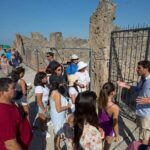
I love the small group size (up to 20). When guides like Amadeau, Vince, Sergio, and Diego lead the day, the pace stays human, questions are welcome, and the history comes with real explanations instead of a blur. I also love the Roman “everyday stuff,” from the Basilica portico and the Foro square to houses with frescoes and the thermal complexes you can still walk through.
The main tradeoff is that it is a lot of walking on uneven ground. It is not stroller friendly, and you will want good shoes, plus water breaks built in.
Key things that make this tour worth your time
- Skip-the-line in Pompeii and Herculaneum so you spend more time inside the ruins
- A max group size of 20, which helps you actually hear the guide and ask questions
- Two UNESCO World Heritage sites in one shot, with a train transfer between them
- A stop-by-stop route, from Pompeii’s Foro and thermal baths to Herculaneum’s houses and baths
- Circumvesuviana one-way train included, so you do not have to figure that out mid-trip
- Short stops with lots of variety, so you get both famous landmarks and memorable details
Why this skip-the-line combo feels manageable
Pompeii and Herculaneum are big names, but they can also feel like a logistics test. This tour turns it into a clean plan: Pompeii first, Herculaneum second, and you get a guided walkthrough of what to look for.
I like that it is not trying to turn your day into a race. The route is packed with stops, yet each one is given enough time for you to notice key details, especially the kind that are easy to miss when you rush on your own. And because it is a small group, the guide can keep things organized even if you are walking at different speeds.
More Naples tours, ruins, coast days, and city experiences to compare
Meeting point and the “skip the line” effect in Pompeii
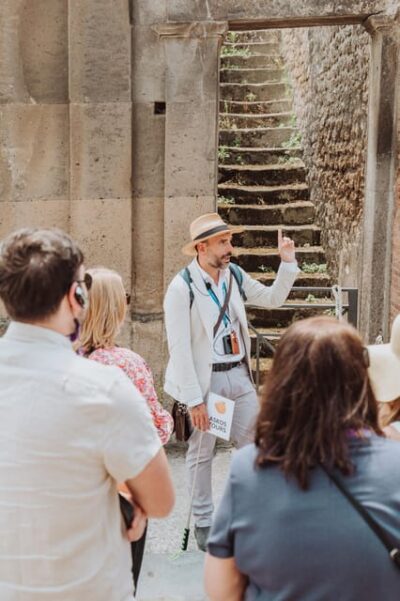
You start in Pompeii at Piazza Esedra, 4. From there, the guided portion begins at the main entrance area called Porta Marina Superiore, where your guide holds an Askos Tours sign.
That skip-the-line access matters here. Pompeii can have lines and bottlenecks, and when you are combining two sites, losing time at the gates is painful. With the admission handled and the group kept together, you can get into the ruins and start orienting your brain from the first minutes.
In Pompeii, the tour structure also helps you build context fast. You begin with public spaces, then move through streets and house interiors, then swing into theaters and bath areas. That sequence makes it easier to understand how a Roman city actually worked.
Pompeii’s public spaces: Basilica, Foro, and the main street
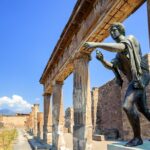
The first Pompeii stops are all about how people moved, met, and did business. The Basilica is described as an open portico that sheltered merchants and other activity. Even if you only catch part of the layout, it gives you a mental model for daily commerce in a Roman town, not just grand monuments.
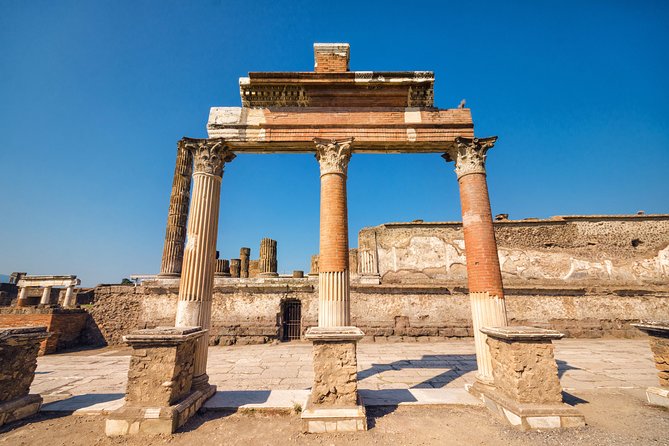
Next comes the Foro de Pompeya, the ancient main square. This is where you get a feel for civic life: the kind of place where announcements would happen and where people would gather. The tour keeps it practical here, with a short stop that still gives you time to look at the square’s role and surroundings instead of sprinting past it.
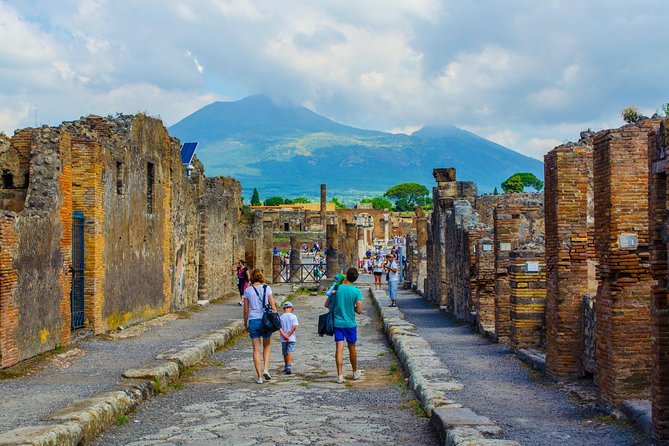
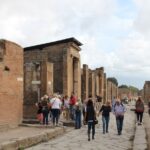
Then you walk through the main street of Pompeii. That simple act is surprisingly valuable. It is a fast way to connect the big named sights with the street grid and the rhythm of the city.
Pompeii’s famous houses: Menander, Fauno, and the details that stick
Pompeii’s houses are where the tour really pays off. Casa del Menandro is a prime example, described as one of the richest and most magnificent houses in the city in terms of architecture, decoration, and contents. A guided stop helps you see how the decoration supports the lifestyle, not just the fact that it is decorated.
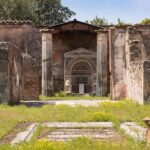
Casa del Fauno is another major highlight. It is described as one of the largest and most impressive private residences in Pompeii. When you look at the scale and plan, it helps you grasp that these were not “small houses.” They were status statements, with room for display, movement, and everyday living.
Short house stops also force good choices. You will not absorb every square meter in a few minutes, so the smart move is to listen for what the guide wants you to focus on, like where the decoration is concentrated or what elements signal wealth.
Granaries, baths, and the creepy-but-important casts
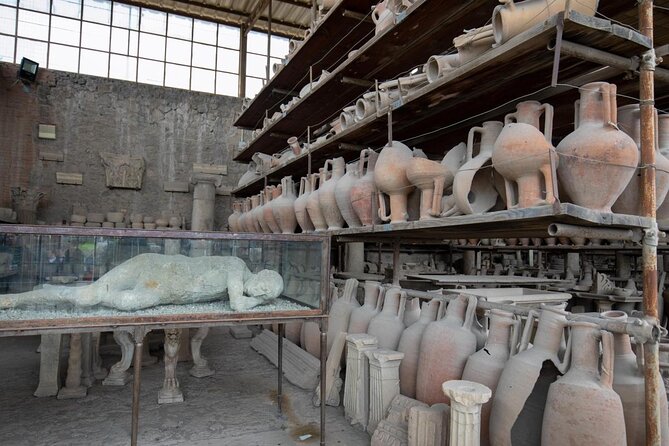
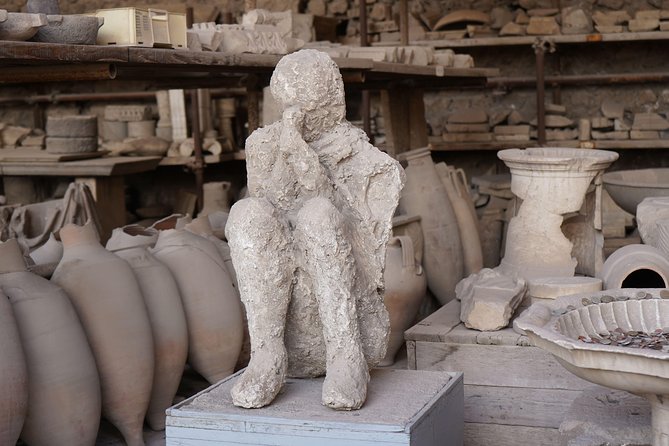
The tour includes the Granai del Foro, the granary area. This stop is notable because it goes beyond architecture. You are told you will see marble tables and bath areas for fountains that adorned house entrances, plus casts of victims from the eruption, including a dog and a tree. That combination is jarring in the best educational way, because it connects the city’s day-to-day beauty to the scale of the disaster.
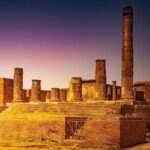
Right after that you visit Terme del Foro. These occupy a vast area between crossroads and major streets, and they are described as the oldest thermal complex in Pompeii. Roman baths are not just “bathrooms.” They were social and routine spaces, and you can still read the layout if the guide points out what was where.
The brothel lane and theaters: mix of daily life and spectacle
Pompeii does not hold back with variety. You will have a look at the most famous brothel in the Roman city. Even with limited time, this stop helps you understand that Roman cities included commercial and adult life as part of the streetscape, not as a separate topic.
Then you shift into culture and spectacle with Teatro Piccolo and Teatro Grande. Teatro Grande is labeled the most important theater in Pompeii, and you get a longer stop here, about 15 minutes. That time is useful because a theater is a structure you should see from different angles to understand sightlines and layout.
Teatro Piccolo is also included, giving you a sense of scale and variety in performance spaces. This is a good moment to notice how Roman entertainment fit into the city plan, right alongside daily life.
The train transfer to Herculaneum: quick, straightforward, but plan your time
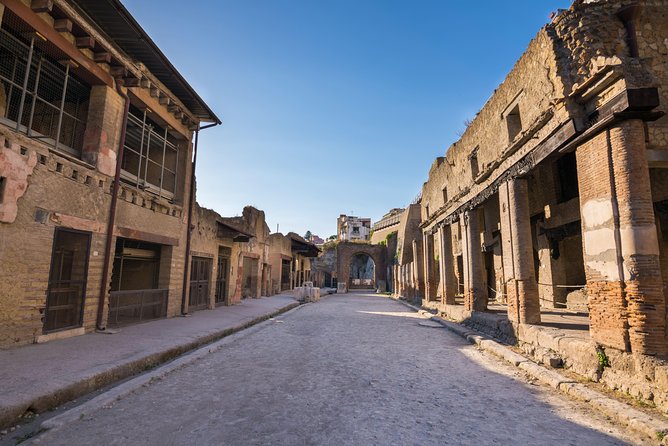
After Pompeii, you transfer by train to Herculaneum. The schedule described here is about 30 minutes on the Circumvesuviana train, plus about 10 minutes of walking to reach the meeting point at the Herculaneum ruins ticket office.
This is one of the biggest practical wins of the tour. The Circumvesuviana one-way train ticket is included, so you are not juggling apps, schedules, and tickets while you are also tired from Pompeii.
There is also a quick lunch break if required. One nice touch from real-world experience is that this can include a stop at an air-conditioned place for lunch, which is a lifesaver on hot days. Meals themselves are not included, but having time to reset is smart.
One note to keep in mind: the Herculaneum station area can be under renovation at times. The general advice is simple, follow the signs and give yourself a bit of breathing room.
Herculaneum first impression: why the second half feels different
Once you reach Herculaneum, the feel shifts. The tour keeps moving, but the vibe often lands as less crowded and more intimate than Pompeii’s busiest zones. That helps you slow down mentally even when the clock keeps ticking.
The guide leads you through houses and baths where preservation details matter. You are not just looking at empty outlines. You are given names tied to visible features, which helps you keep track of where you are in the site.
Herculaneum houses: stags, wood partitions, and carbonized doorways
Casa dei Cervi gets its name from marble statues of stags or deer found in the peristyle. That is an easy-to-follow way to understand why Herculaneum’s houses can be identified even when much is missing.
La Terrazza di M. Nonio Balbo is another named space tied to marble statuary found in a peristyle. The tour uses these naming clues to keep your attention anchored, so you are not just wandering through rooms.
College of the Augustales is also on the route. The description provided for this stop points to marble statues found in the peristyle as part of the naming idea, so expect the guide to tie identifying details back to the decor you can still see.
Casa del Rilievo di Telefo is described as unusual because it has its own private access to the adjoining Suburban Thermae to the south. That kind of specific relationship is the sort of thing a guide can explain fast in context, and it makes the site feel more connected than a list of rooms.
Partem Domus lignea, also called Casa del Tramezzo di Legno, is important because an elegant wooden partition remained. This is one of those stops where you should let the guide do the talking, because the value is in understanding what you are seeing, not just reading the name.
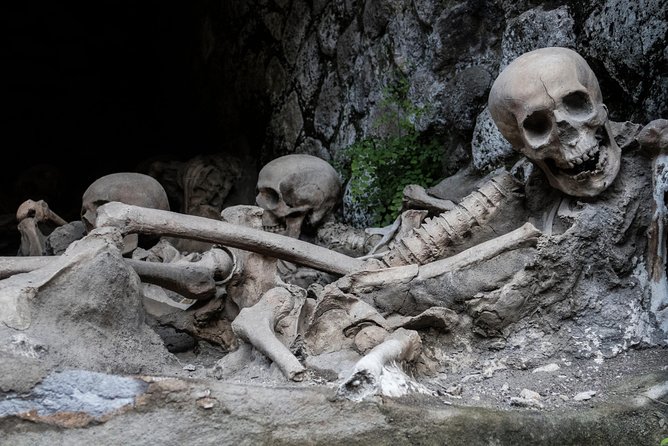
Then you reach the House of the Skeleton. It gets its name from the discovery of human remains in a second-floor room in 1831. It is a sobering stop, but it is also one of the most direct links the ruins have to the eruption’s human impact.
Casa del Salone Nero, the House of the Black Hall, is described as a more luxurious mansion with a monumental entrance. You can also see carbonised remains of the doorposts and lintel. That detail helps you grasp scale and structure at a close distance.
Herculaneum baths and the “house as a city” idea
Central Thermae is included and described as built around the beginning of the 1st century AD. It is divided into men’s and women’s baths, each with separate entrances. That split is a key cultural clue, and it also shows you that even leisure and hygiene followed social rules.
Casa Sannitica is described as typical of the Samnites, with an atrium skirted by a gallery with Ionic columns, plus frescoes in the rooms. That combination makes the house feel like a design lesson, with architecture, art, and lifestyle bundled together.
Casa del Bel Cortile is described as original because it has a courtyard with a stairway and a stone balcony instead of an atrium. Again, the tour uses distinctive layout features to keep you oriented.
Casa del Rilievo di Telefo and these other domus stops all teach the same thing: Roman homes were functional and performative. They had clear movement paths, social areas, and decorative choices meant to signal status.
House of the Grand Portal wraps up the housing highlights in the center of the archaeological area, with collonnati and frescoes everywhere, plus charred remains of wooden parts. It is a strong closer because it pulls multiple themes together, scale, decoration, and preservation.
Price and what you are actually paying for
The price is $119.85 per person for a tour around 5 hours 30 minutes. On paper, that can sound like a lot, until you tally what is handled for you.
You get guidance throughout both sites, skip-the-line admission in Pompeii, skip-the-line admission in Herculaneum, and a one-way Circumvesuviana train ticket from Pompeii to Herculaneum. The admission ticket wording and included transport are the big value drivers. It means you are paying for time saved and decision reduced.
Meals are not included, and you are responsible for getting to Pompeii and from the end point. But inside the ruins, the tour removes the main friction points: entry lines, navigation confusion, and figuring out how to connect two major archaeological sites.
Who this tour suits best, and who may struggle
This tour is ideal if you want a guided sweep through both sites without turning it into a multi-day project. If you like structure, clear stops, and a guide who can connect details to everyday Roman life, you will probably enjoy the format.
It is also a great match if you value humor and pacing. Multiple guides named in the experience notes, like Michele and Alfredo, are described as energetic and funny, while still keeping the day organized.
The downside is physical. Expect uneven ground and lots of walking. If you are pushing a stroller, you might want a different plan, because the ruins require you to carry or manage it often.
Mobility concerns can matter here, because the schedule uses short stop times across many areas. You can still enjoy Pompeii and Herculaneum, but you will want to be realistic about how much time you can spend standing and moving.
Should you book this Pompeii and Herculaneum skip-the-line tour?
I would book this if you want the best of both UNESCO sites in a single day and you do not want to fight lines or transport details. The combination of skip-the-line access, a small group, and a guided route through Pompeii’s public spaces, houses, baths, and theaters, plus Herculaneum’s houses and thermal areas, is a lot of value for one ticket.
Skip it if you need long, slow time in just one site, or if walking through uneven ruins is a major problem. In that case, a more relaxed plan with fewer stops may suit you better.
If you go, pack water, use the restroom before you start, and wear shoes you can trust. It is the kind of day that can be hot and long, but when the guide is on top of the route, you leave with a much clearer picture of Roman life before the eruption froze it in place.
FAQ
What is the duration of the Pompeii and Herculaneum small group tour?
The tour runs for approximately 5 hours 30 minutes.
Is this tour a skip-the-line experience?
Yes. The tour includes skip-the-line tickets for admission in Pompeii and also skip-the-line tickets in Herculaneum.
Which places are included in the itinerary?
You visit Pompeii Archaeological Park and multiple stops in Pompeii, then transfer to Herculaneum (Parco Acheologico di Ercolano) for additional house and bath stops.
How do you get from Pompeii to Herculaneum?
You transfer by train using the Circumvesuviana, with a one-way train ticket included, plus a short walk to the Herculaneum ruins.
Is lunch included?
No. Meals are not included, though the schedule allows for a quick lunch break if required.
What is the tour language?
The tour is offered in English.
Where does the tour start and end?
It starts at Piazza Esedra, 4, 80045 Pompei NA, Italy, and ends at the Archaeological Park of Herculaneum at Corso Resina, 187, 80056 Ercolano NA, Italy.
Is there a cancellation policy?
There is free cancellation. You can cancel up to 24 hours in advance for a full refund. If you cancel less than 24 hours before the experience start time, the amount paid is not refunded.
More Skip the Line in Pompeii

More Tours in Pompeii

More Tour Reviews in Pompeii
Not for you? Here's more nearby things to do in Pompeii we have reviewed


Tour Reviews, compared.
 ★ 4.8Pompeii: Entry Ticket and Guided Tour with an ArchaeologistFrom $3519,459 reviews
 ★ 4.2Pompeii: Entry Ticket with Optional Audio GuideFrom $2612,360 reviews
 ★ 4.8Pompeii: Small Group Tour with an ArchaeologistFrom $4012,264 reviews
 ★ 4.3Pompeii Ruins & Mount Vesuvius Day TourFrom $12011,459 reviews
 ★ 4.6Sorrento, Positano and Amalfi Full-Day TourFrom $10710,988 reviews
 ★ 5.0Sorrento, Positano & Amalfi Coast – Small Group TourFrom $768,643 reviews
 ★ 4.6Catacombs of San Gennaro Entry Ticket & Guided TourFrom $157,941 reviews
★ 5.0Pompeii Small Group Tour with an ArchaeologistFrom $356,593 reviews
★ 4.6Catacombs of San Gennaro Entry Ticket & Guided TourFrom $157,941 reviews
★ 5.0Pompeii Small Group Tour with an ArchaeologistFrom $356,593 reviews
Browse the lists this tour appears in