
Tour review · TOUR REVIEWS
Pompeii Walking Tour: The Real History of the Ruins
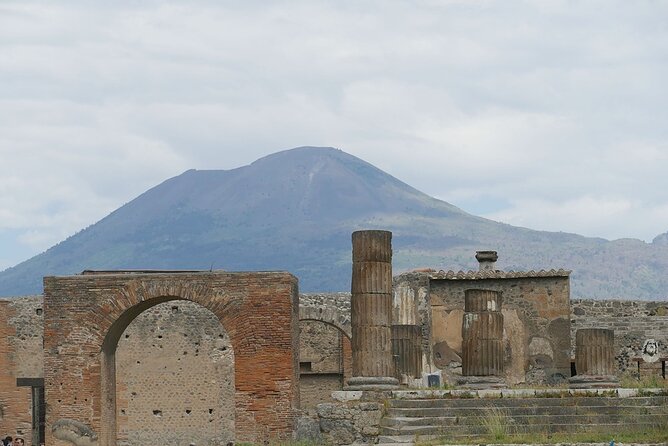
Two hours in Pompeii still feels unreal. This guided walk takes you through a city frozen in time by Vesuvius in AD 79, with stops that show how Romans lived, worked, and worshiped. I especially like the chance to walk along a perfectly preserved cobblestone street and then connect it to what you’re seeing in the buildings.
I also like the way the guide ties the ruins to everyday Roman culture, not just stone facts. You’ll move from theaters and wealthy homes to public bathing and the forum, so the city adds up as a place, not a checklist. One possible drawback: timing can be a little chaotic, so don’t assume you’ll start exactly at the advertised minute, even if you show up early.
Key highlights to look forward to
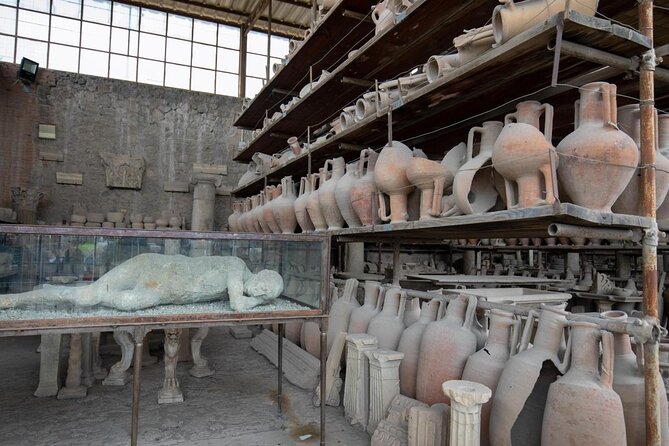
- A real sampling of Pompeii’s city life, from theater to baths to the marketplace core
- Admission ticket included for the main stops
- Via-style walking on a well-preserved cobbled route with shops and homes along the way
- Casa del Menandro as a standout wealthy domus stop (and it’s about more than just rooms)
- Stabian Baths and the Lupanar for the human side of Roman daily routine
- Forum landmarks including the Temple of Jupiter and the Basilica, with context for how civic life worked
Price and value for your time in Pompeii
At $42.05 per person for about 2 hours, this is a practical way to get Pompeii’s biggest “wow” moments without turning your day into a full marathon. The tour includes the entrance ticket plus a guided visit, which is what you want here. Pompeii is enormous, and a guide helps you read the site faster instead of wandering for hours trying to guess what you’re looking at.
This tour also tends to sell ahead. On average, it’s booked 46 days in advance, so if your dates are fixed, I’d plan early. The group size is capped at 35, which matters because it keeps the walk more manageable than the mega-tours that move like a crowd at a festival.
English is offered, and that’s important in Pompeii. Even when you know the big story, the details are what make it click: how spaces were used, what people did there, and why certain places were built the way they were.
You can also read our reviews of more walking tours in Pompeii


Meeting at InStazione and getting to Porta Anfiteatro
Your tour departs daily at 10.30 am from the InStazione help desk in Pompeii. You register your details there, then the group walks together with the guide to the entrance at Porta Anfiteatro.
Here’s my practical advice: arrive early, but also keep your expectations flexible. One of the clearest issues mentioned with this kind of tour is that start times can shift, sometimes with confusion between the time you plan for and the time the day actually begins. Build in buffer time so you’re not stressed if the group is delayed getting lined up.
Since you’re walking through a large archaeological park, comfortable shoes help. You’ll cover multiple stops in a short window, and Pompeii ruins are not designed for slow strolling with frequent “let’s stop and think” breaks.
Teatro Grande, where comedies and pantomime played
The first major stop is Teatro Grande, the Roman theater buried by the eruption of Vesuvius in 79 and later found through excavation. This is the kind of place where Pompeii stops feeling like “ruins” and starts feeling like a living city. The structure tells you how performance worked, and the guide’s role is to connect the theater to the kinds of shows held inside.
You’ll hear how theater here wasn’t one-note entertainment. Comedies, mimes, pantomimes, and atellane performances were part of what audiences experienced. That matters because it changes the way you look at the space. You’re not just seeing seats and walls, you’re imagining the crowd rhythm and how performers would have used the stage area.
Time-wise, this is one of your shorter pauses, so go in with the right mindset. Take in the whole shape of the theater, then let your guide’s explanation steer what you notice next.
Casa del Menandro, a wealthy domus you can actually read
Next you visit Casa del Menandro, a large urban domus of nearly 1,800 m². It was excavated between 1926 and 1932, and it’s a strong example of a wealthy family house in Pompeii.
The name comes from an image of the Greek poet Menander, found there. That little detail is useful because it gives you something to anchor on while you move through the rooms and decorations. Instead of trying to identify everything yourself, you can focus on what makes this house different: the scale and the wealth expressed through its art and design choices.
You’ll only have about 15 minutes at this stop, so don’t waste the time searching for everything at once. Look for key decorative elements and the overall layout, then use the guide’s explanations to connect those features to social status and daily life.
Via Stabiana and the shops corridor between major stops
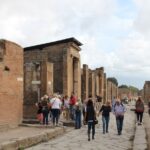
After Casa del Menandro, the walk continues toward Via Stabiana, a cobbled street with sidewalks and pedestrian walkways. This is one of the most valuable sections because it’s about movement, not just monuments. You can literally picture how people crossed the city on foot, passing storefronts and homes.
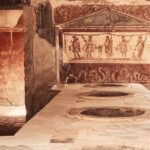
The tour also references public facilities, shops, and residences along this stretch. Some shop paintings have been restored, including the thermopolium of Asellina, which functioned as an inn. There are also artisan workshops, or officinae, in the area.
I like this part because it’s where Pompeii feels like a place you could have walked through in the morning. If you want one section where you can mix a bit of photos with understanding, this is it.
You can also read our reviews of more historical tours in Pompeii
Stabian Baths: the oldest kind of Roman bathing complex you’ll see
The Stabian Baths (Terme Stabiane) are a Roman bath complex buried by Vesuvius in 79 and later excavated. The tour calls them the oldest building of their kind in the city, so even with a short stop, they carry weight.
You’ll learn that the layout preserves both male and female sectors. That’s a powerful detail because it helps you understand bathing as a structured routine, not random hygiene. Baths in Roman life were social spaces as much as practical ones, and once you know that, the ruins become easier to interpret.
This stop is also about 15 minutes. Use that time to locate the key areas your guide points out, then step back for a full view to understand the overall complex layout. Even if you can’t remember every term, you’ll leave with a strong sense of how people organized their day around public spaces like these.
The Lupanar for the human side of Roman life
Next comes the Lupanar, one of the most talked-about sites in Pompeii. The lupanari were places for mercenary sexual pleasure, effectively houses of tolerance. Some of these spaces are still visible in the ruins, and your guide will frame it in terms of how Roman entertainment and commerce overlapped.
This is not a stop everyone wants to think about, and that’s fair. If you feel uncomfortable, it’s okay to keep it brief and focus on the historical context your guide provides, since that context is what makes the stop educational rather than just graphic.
Expect around 10 minutes here. That time limit is actually useful because you can absorb what you need, then move on to the civic heart of the city without dwelling too long.
Forum de Pompeya, Temple of Jupiter, and the Basilica
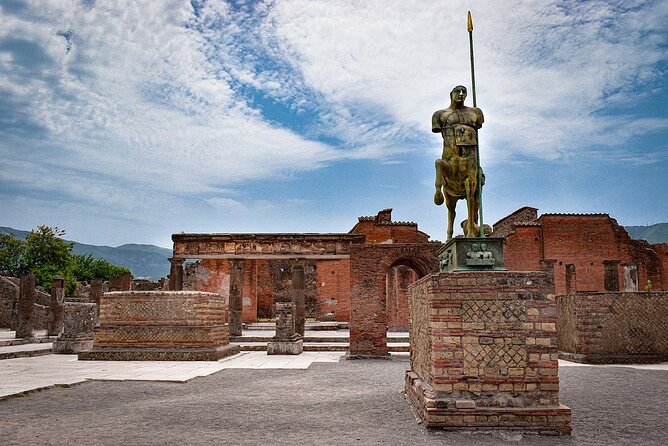
Now you shift from private and semi-private spaces into the civic core. The Forum of Pompeii was built around the 4th century BC during the Samnite era near a road junction. It started as a small open area with shops around it, built mostly in lava and tuff and cemented with clay.
After the Romans conquered Pompeii, the Forum was rebuilt and enlarged, especially in the 2nd century BC. The tour highlights how political and religious buildings took shape around the square. In other words, this place changed with power, and the stonework reflects those shifts.
You’ll see the Temple of Jupiter, which later became known as the Capitolium focus and was dedicated to Jupiter, Juno, and Minerva. Your guide also points out that the erarium, a public treasure, was kept in the basement along with sacred furnishings and votive gifts.
The Basilica follows, dating to the 2nd century BC. It functioned like an indoor forum when weather conditions made outdoor activity less practical. There’s also a clear emphasis on court space: a tribunal where the judge sat elevated above the parties. One detail your guide includes that’s worth remembering is that the judges’ area was reachable via a mobile wooden staircase, designed to reduce the risk of violence.
Even if you only get a few minutes at each landmark, the guide’s structure helps you connect them. You’ll end up with a simple model for how Pompeii handled religion, law, and daily errands in the same neighborhood.
Temple of Apollo and the granaries market scale
You’ll also visit the Temple of Apollo. Apollo’s cult traveled through Italic populations from the Greek world. Near the time before 79 AD, the guide notes that Apollo’s following had declined while Jupiter’s importance rose as the Capitolium grew.
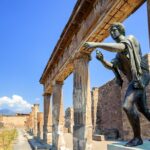
The current bronze statue of Apollo represented as an archer is visible, and in front of it you can observe the statue of Diana. Even if you don’t go deep into mythology, this stop is a good way to see how Roman religion blended local priorities and inherited Greek symbolism.
Finally, you reach the granaries area. It was a market for cereals and legumes, and the tour mentions that no traces of plaster were found, leading to the idea the structure wasn’t finished at the time of the eruption. You’ll also hear about a ponderary table, where tools helped traders manage the correctness of exchanges and convert units of measurement between the empire and Pompeii.
That last point is unexpectedly practical. It turns a ruin into a story about trade systems, paperwork-by-proxy, and why standard units mattered when money and goods moved across borders.
Pacing, photos, and how to make the most of 2 hours
Because this is an approximately 2-hour walk, the biggest trick is not slowing down too much at any one stop. The value here is in the sequence. You start with performance space, move into elite domestic life, then pass through street life, public bathing, and commercial or social sites. By the time you hit the Forum, the city’s layout makes more sense.
For photos, I’d prioritize wide shots at the start of each major area, then close-ups of whatever your guide points to. A few minutes disappear fast, and you’ll get more out of the stop if you use your time with purpose.
If you want to “self-guide” afterward, take note of what feels repeated: streets, thresholds, public buildings, and how spaces separate daily life into distinct zones. This tour gives you enough structure that a later wander through Pompeii won’t feel like aimless walking.
Who this Pompeii tour suits best
This is a good fit if you want the key ruins without spending a full day planning and navigating. It also works well if you’re the type who learns best through direct explanation, especially when a guide connects the ruins to Roman culture rather than treating each stop like a standalone postcard.
It’s also a solid choice for visitors who want adult-focused detail. The inclusion of the Lupanar and the civic law and religion sites means you’ll get a realistic view of Roman life in Pompeii, not just the pretty houses and sweeping views.
If you prefer long stays at one site, or you want maximum time for photos and reading on your own, you might feel rushed. The short stop durations are part of the design, and that design is built around coverage, not lingering.
Should you book this Pompeii Walking Tour?
I’d book it if your goal is a high-structure, English guided route through Pompeii’s most recognizable anchors in about 2 hours, with the entrance ticket included. At $42.05 this is a reasonable price for the combination of guided interpretation plus admission, especially if you don’t want to spend half your day figuring out what matters.
I’d be cautious only on timing. Arrive early, but expect that the start can slip. If you’re visiting alongside other plans later the same day, give yourself slack.
If the weather is poor, the experience can be canceled and rescheduled or refunded, so keep a flexible mindset. For most people, that’s easy, because Pompeii itself is outdoors and the site is better enjoyed when conditions are pleasant.
Bottom line: if you want Pompeii to make sense fast, this is a strong way to do it.
FAQ
What is the duration of the Pompeii walking tour?
The tour lasts about 2 hours.
How much does the Pompeii Walking Tour cost?
The price is $42.05 per person.
What language is the tour offered in?
The tour is offered in English.
Where do I meet for the tour?
You meet at the InStazione help desk in Pompeii, and then you go together to the entrance of Porta Anfiteatro with the guide.
What time does the tour depart?
The tour departs daily at 10.30 am.
What is included in the price?
The price includes the entrance ticket and the guided tour.
Is lunch included?
No, lunch is not included.
What is the cancellation policy?
You can cancel up to 24 hours in advance for a full refund. If you cancel less than 24 hours before the experience starts, you will not receive a refund.
More Walking Tours in Pompeii
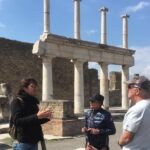
More Tours in Pompeii




More Tour Reviews in Pompeii

Not for you? Here's more nearby things to do in Pompeii we have reviewed







Tour Reviews, compared.
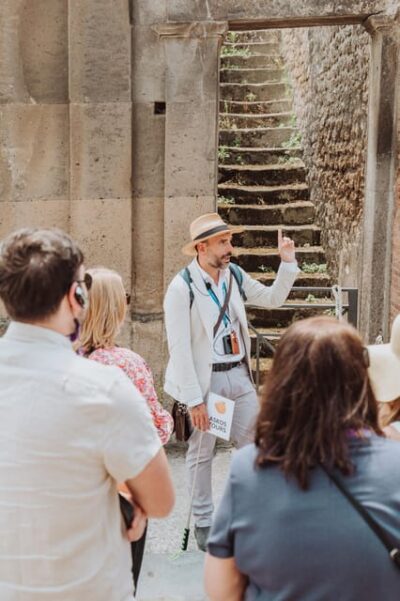 ★ 4.8Pompeii: Entry Ticket and Guided Tour with an ArchaeologistFrom $3519,459 reviews
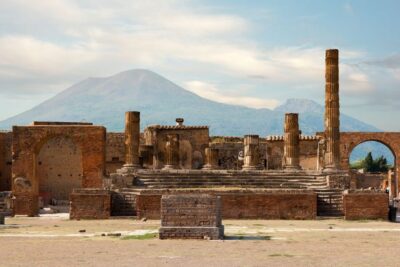 ★ 4.2Pompeii: Entry Ticket with Optional Audio GuideFrom $2612,360 reviews
 ★ 4.8Pompeii: Small Group Tour with an ArchaeologistFrom $4012,264 reviews
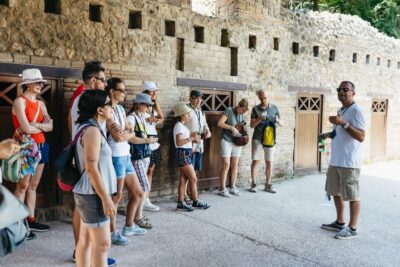 ★ 4.3Pompeii Ruins & Mount Vesuvius Day TourFrom $12011,459 reviews
 ★ 4.6Sorrento, Positano and Amalfi Full-Day TourFrom $10710,988 reviews
 ★ 5.0Sorrento, Positano & Amalfi Coast – Small Group TourFrom $768,643 reviews
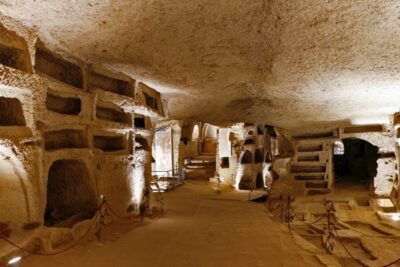 ★ 4.6Catacombs of San Gennaro Entry Ticket & Guided TourFrom $157,941 reviews
★ 5.0Pompeii Small Group Tour with an ArchaeologistFrom $356,593 reviews
★ 4.6Catacombs of San Gennaro Entry Ticket & Guided TourFrom $157,941 reviews
★ 5.0Pompeii Small Group Tour with an ArchaeologistFrom $356,593 reviews
Browse the lists this tour appears in